
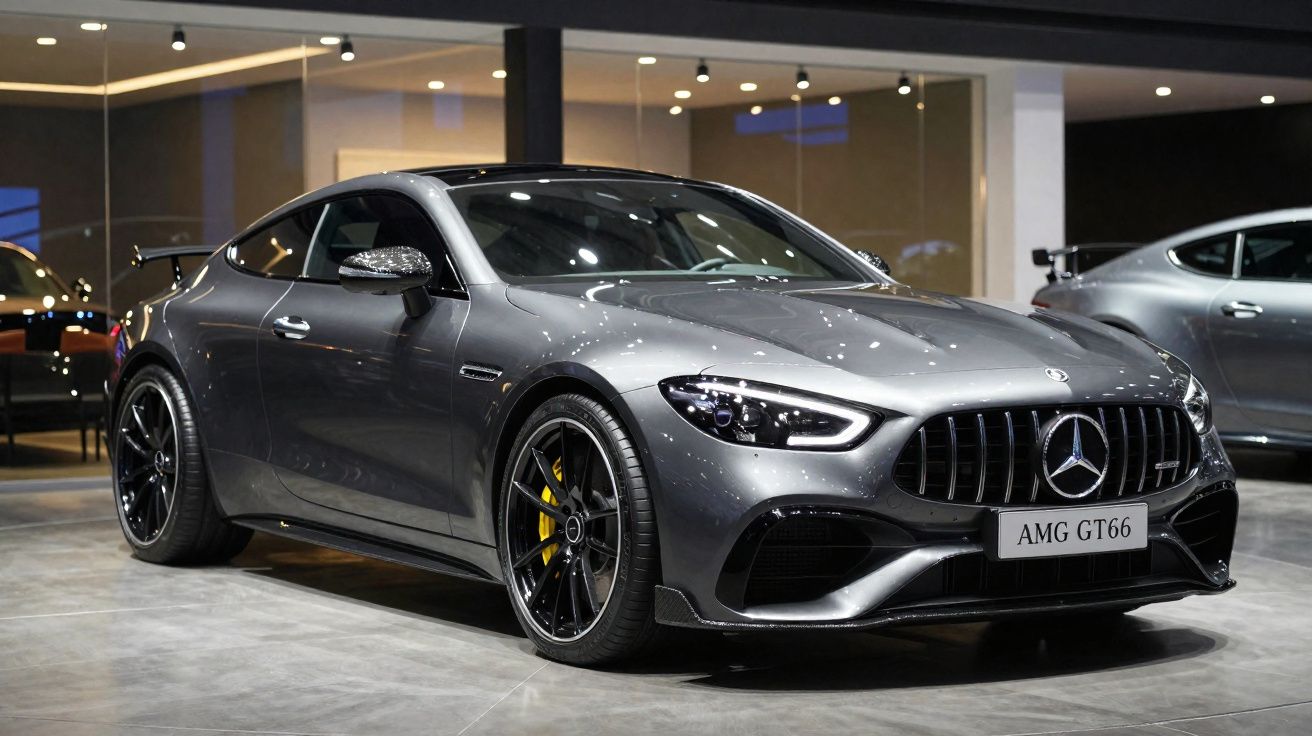
The Mercedes-AMG GT 63 Pro arrives in that narrow premium corridor where outright performance, serious money and brand kudos meet. From the kerb, it looks like the sort of car people would naturally weigh up against Porsche’s evergreen 911. Inside Mercedes-AMG, however, the message is clear: they do not believe their customers are wandering into Porsche dealerships to compare deals.
Mercedes-AMG GT 63 Pro vs Porsche 911: one body style, two mindsets
On paper, the GT 63 Pro and the Porsche 911 appear to cover much the same brief. Each is a low-slung, two-door coupe, each offers a 2+2 seating arrangement, and each trades heavily on attention-grabbing performance claims. AMG argues that, in reality, the similarities end with the brochure.
At the car’s launch in Australia, Mercedes-AMG executives painted a picture of buyers who are already deeply invested in the brand. Rather than defecting from other sports cars, many are moving across from vehicles such as the G63 SUV or the E63 saloon, seeking something more intense and more emotionally charged to park alongside what they already own.
The GT 63 Pro is positioned less as “the Porsche alternative” and more as the next purchase for committed AMG loyalists.
That distinction shapes how the car is sold. A driver swapping a G63 for a GT 63 is rarely poring over 911 option lists. The priority is staying with the three-pointed star, keeping the familiar AMG vibe, and preserving the specific appeal of an AMG V8 and its unapologetically loud character.
Front engine versus rear engine: where personality is engineered
Beneath the styling, the two cars are separated by fundamental packaging choices. The Porsche 911 continues with its signature rear-engine set-up, placing the flat-six over the rear axle. That architecture delivers strong traction, a unique sense of balance, and a silhouette that is instantly recognisable worldwide.
The Mercedes-AMG GT 63 Pro takes the opposite approach. Its twin-turbo V8 sits ahead of the cabin in a front-mid position (set back behind the front axle line), aligning it with classic grand tourer proportions. Drive is fed to all four wheels via AMG 4Matic+ all-wheel drive.
They may share the same segment in a spreadsheet, but on the road the AMG is a front-engined powerhouse, while the 911 remains a rear-engined precision instrument.
In practice, that produces two distinct styles of speed. The 911 typically feels shorter, more agile and more rear-led in its responses. The GT 63 Pro comes across as longer and broader in attitude-more of a high-velocity long-distance machine that can still turn up and intimidate on a circuit.
610 hp: AMG targets Stuttgart’s performance territory
Whatever the philosophical differences, AMG’s figures make it obvious the company is watching Porsche closely. The GT 63 Pro uses AMG’s familiar 4.0-litre twin-turbo V8, here calibrated to 610 hp and 850 Nm.
- Engine: 4.0-litre twin-turbo V8
- Power: 610 hp
- Torque: 850 Nm
- Drivetrain: 9-speed automatic, AMG 4Matic+ all-wheel drive
- 0–100 km/h: 3.1 seconds
- Top speed: 317 km/h
Compared with the standard GT 63, the Pro delivers a meaningful lift: 26 extra horsepower and 50 Nm more torque. That places it neatly within Porsche’s own performance hierarchy-stronger than the hybridised 911 GTS (535 hp, 609 Nm), yet just shy of the 911 Turbo S (711 hp, 800 Nm).
Judged purely on acceleration and top-end pace, the GT 63 Pro is not ducking the comparison. A 0–100 km/h sprint in 3.1 seconds and a 317 km/h maximum speed shift it into a realm that has traditionally belonged to dedicated supercars, rather than merely quick grand tourers.
Sound and sensation: flat-six heritage versus V8 thunder
Not every deciding factor is logical, but some are hugely persuasive. The 911’s flat-six draws on decades of motorsport pedigree, and it delivers a distinctive high-rev howl that many enthusiasts consider inseparable from the car’s identity.
AMG offers a different kind of theatre: a heavy, bassy V8 rumble, turbo whoosh under load, and the sharp crackles and pops that define the brand’s modern performance persona. For long-time AMG fans, that noise is not a footnote-it is a major reason the Porsche keys never become tempting.
For many GT 63 Pro owners, the V8 soundtrack is the emotional glue that keeps them in the AMG camp.
Why AMG customers are staying put
Mercedes-AMG presents the GT 63 Pro as a logical “next rung” for people already buying fast SUVs and high-output saloons. These customers may want something more extreme, but they also want that intensity delivered through a badge, cabin layout and user experience they already know.
Brand loyalty is also reinforced by routine. The dealer relationship, the familiar way options are selected, and the recognisable design language inside the cabin all reduce friction for existing owners. Moving to a 911 would mean adapting to a different ownership pattern, different ergonomics, and a different social signal in the office car park.
From AMG’s viewpoint, the GT 63 Pro plugs a specific hole: supercar-level numbers combined with day-to-day usability, a modern Mercedes tech ecosystem and a narrative that existing clients already buy into.
A further factor is how these cars fit into busy lives. For owners who drive year-round, the combination of high performance and all-weather confidence can matter as much as peak lap time. In that context, AMG 4Matic+ becomes part of the ownership proposition rather than a mere technical specification.
Personalisation also plays a role in keeping buyers “in house”. AMG customers who are used to tailoring paint, trim, wheels and interior themes across multiple Mercedes products often value continuity-both in the ordering process and in the end result-especially when the GT 63 Pro is joining, rather than replacing, other vehicles in the garage.
Porsche still stands alone as a benchmark
None of this suggests the 911 is being waved away. Across the industry, it remains a reference point for steering feel, chassis clarity and track-ready balance. Its rear-engine layout continues to provide a driving character that competitors find difficult to duplicate.
AMG’s claim is narrower: many of its buyers can admire the 911 from a distance without feeling compelled to own one. They respect what Porsche has built, but they still choose to spend their money with the three-pointed star.
Reading the spec sheet: enthusiasts versus real buyers
Online discussions often revolve around lap times, engine placement and acceleration metrics. Purchasing decisions in the real world can look quite different. A buyer coming from a £150,000 G63 may be factoring in school runs, winter road conditions and image, as well as weekend drives.
By that measure, the GT 63 Pro has an obvious logic. Four driven wheels, a familiar infotainment set-up and the comfort equipment expected of a modern Mercedes make it easier to live with. It promises supercar pace without forcing the lifestyle compromises that can come with a mid-engined exotic.
| Aspect | AMG GT 63 Pro | Typical 911 (GTS/Turbo) |
|---|---|---|
| Engine position | Front-mid | Rear |
| Main customer path | Existing AMG owners | Sports car enthusiasts, mixed brands |
| Character | High-speed GT, big V8 feel | Compact, track-focused |
| Image | Muscular, luxury performance | Iconic sports car |
What “2+2” and “AMG 4Matic+” mean in everyday ownership
Two phrases come up repeatedly with cars like the GT 63 Pro and the 911: “2+2” and “all-wheel drive”. They may read like jargon, but they influence daily practicality.
A 2+2 layout means two full-size front seats plus two smaller seats behind them. In real use, the rear seats are best for children, short trips, or extra bags. For someone used to an E63, it can feel like a concession. For a driver stepping up from a strict two-seater, those extra seats can be the difference between “occasional toy” and “car you can use”.
AMG 4Matic+ is an all-wheel-drive system that can adjust how much drive is sent to each axle. In good conditions it helps deliver aggressive launches. When the weather turns, it makes the car’s performance easier to access safely. For a high-powered, front-engined coupe, that reassurance matters to owners who drive in all seasons, not only on clear summer weekends.
How an AMG garage typically evolves
A common AMG household set-up might include a G63 for everyday duties, perhaps an E-Class or S-Class for work, plus room for one dedicated “fun” car. Instead of replacing an existing Mercedes with a Porsche, the GT 63 Pro can slot in as the sharper, more emotional addition-while still wearing the same badge.
That approach keeps servicing under one umbrella, maintains a unified digital ecosystem and preserves a consistent feel across the fleet. For high-net-worth owners, that kind of simplification has genuine value, even if it is rarely shouted about in adverts.
Viewed through that lens, AMG’s insistence that GT 63 customers are not truly cross-shopping a 911 becomes more believable. The headlines and performance figures may overlap, but for many buyers the decision is anchored in brand allegiance, preferred driving flavour and the realities of day-to-day use-factors that steer them decisively towards the Mercedes-AMG GT 63 Pro.


Comments
No comments yet. Be the first to comment!
Leave a Comment