
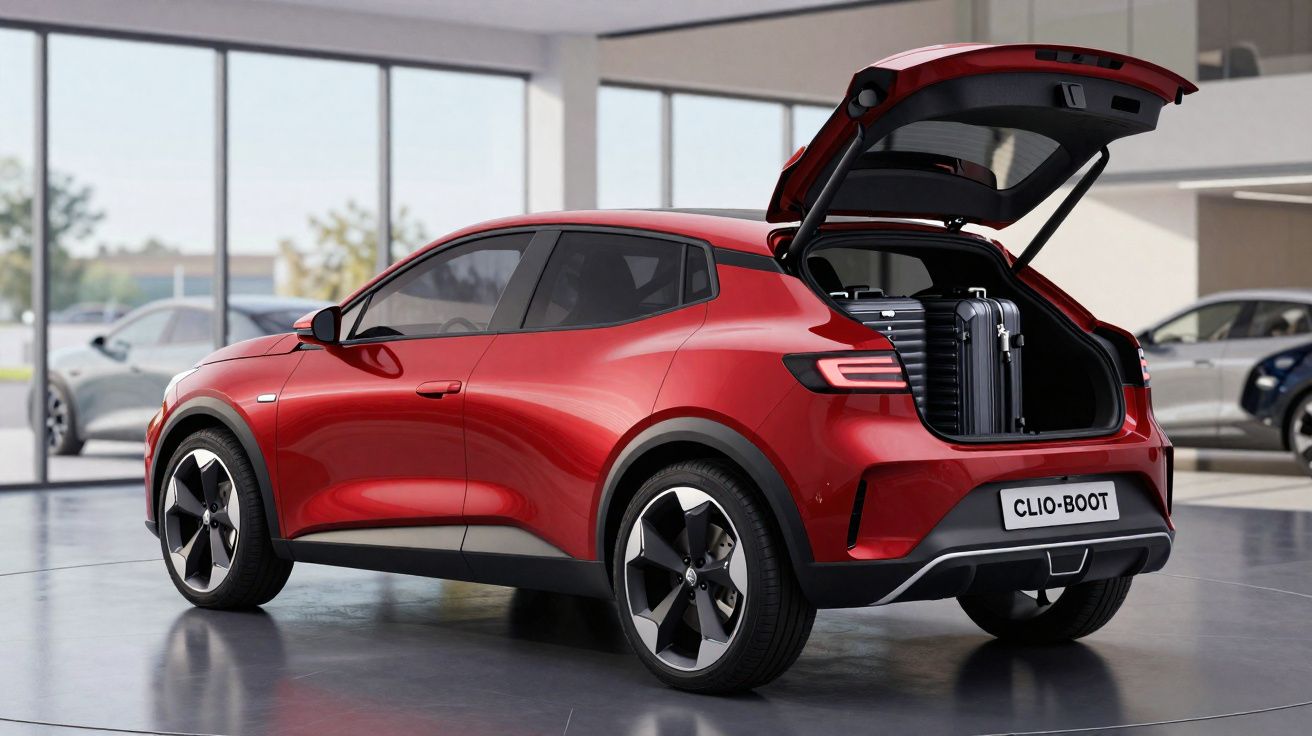
In a class where every litre matters, the latest Renault Clio generation is trying to win people over with something decidedly unflashy - yet genuinely important in everyday life.
Long established as an urban-friendly supermini, the French hatchback now arrives with a reworked boot designed around real routines: stop-start traffic, the weekly shop and the kind of short weekend trips that quickly expose how usable a car really is.
Renault Clio boot capacity in the real world: figures that actually matter
Start with the hard numbers. The Clio’s boot ranges from 309 to 1,094 litres with the rear seats folded. That places it firmly in the middle of the compact hatchback pack, broadly in step with familiar rivals such as the Peugeot 208 and Citroën C3.
In day-to-day terms, 309 litres is a sensible urban baseline: you can fit two medium suitcases, several supermarket bags and a couple of school backpacks without having to play luggage Tetris. Fold the rear seats and the Clio edges closer to small-van usefulness, giving enough room for items like a disassembled bicycle, moving boxes, or a bulkier pushchair alongside additional bags.
The Clio isn’t trying to be a mini-SUV; it’s aiming for a boot that’s versatile enough for most small households.
A subtle change: 4 cm that makes loading easier
One of the most worthwhile tweaks is at the rear load area. Responding to owner feedback, Renault has lowered the boot loading lip by 4 cm. On paper that sounds minor; in daily use it can mean noticeably less strain and less awkward lifting.
Anyone who has hauled heavy boxes or large water bottles into a high boot knows that a few centimetres can be the difference between “fine” and “my back will remember this tomorrow”. The same applies to wheelchairs, sturdier pushchairs, or work kit such as tool cases and camera equipment.
- Less effort when lifting heavy items in and out
- Easier access for older drivers and passengers, and for people with reduced mobility
- Lower chance of catching luggage on the edge while loading
- More practical use in tight parking bays where you can’t stand far back
More broadly, it fits a clear market shift: manufacturers are increasingly judged on how their cars work in everyday life, not just what the specification sheet claims.
Petrol version: the space advantage
Across the line-up, the petrol version stands out for boot capacity, offering 391 to 1,176 litres. The extra room compared with other configurations is largely down to the mechanical layout and how components are packaged beneath the boot floor.
In petrol form, the Clio clears 390 litres - more than many compact saloons offered only a few years ago.
With close to 400 litres available without folding the seats, the hatch becomes more accommodating for people who travel with extra kit or regularly carry bulky items. That added capacity can be particularly useful for couples with young children trying to pack a child seat, pushchair, clothes, and toys into a single trip.
Head-to-head with compact rivals
Overall volumes are closely matched across the segment, but the Clio tries to claw back an advantage through ergonomics and smarter day-to-day usability. Here’s how it stacks up against equivalent models typically sold in Europe:
| Model | Standard boot (litres) | Maximum boot (litres) |
|---|---|---|
| Renault Clio (standard) | 309 | 1,094 |
| Renault Clio (petrol) | 391 | 1,176 |
| Peugeot 208* | about 300 | around 1,100 |
| Citroën C3* | roughly 300 | close to 1,000 |
*Approximate figures, varying by version and market.
So yes, the headline numbers are similar - but the 4 cm reduction in loading height and the larger petrol-boot figure show Renault prioritising daily usability, not just a brochure statistic.
How the boot fits urban living
In big cities, compact cars remain the default choice for anyone chasing lower running costs and easier parking. In that context, a well-planned boot can feel like a “second room” - handy for everything from gym bags to last-minute shopping.
With just over 300 litres, the Clio suits that role neatly. For families who don’t often do long driving holidays but still need a car that’s ready for surprises, it strikes a reasonable balance between compact exterior dimensions and useful interior capacity.
Step up to the petrol version, and the jump beyond 390 litres nudges the Clio towards a more family-leaning brief. A four-person holiday weekend becomes more realistic: two large suitcases plus smaller bags can go in the boot rather than encroaching on rear passenger space.
Real scenarios: from supermarket to motorway
A few everyday examples make the Clio’s boot capacity easier to picture:
- A weekly shop for two adults and one child, including bulky household items (toilet roll packs, multipacks of milk, large cleaning products)
- Hobby kit such as a bodyboard, a hiking rucksack and a small cool box
- Luggage for a long weekend for three people, using medium suitcases and backpacks
- Small house moves - a microwave, a fan (dismantled), and boxes of books - using the folding rear seats
With the rear seats folded and capacity topping 1,000 litres, the Clio can also make sense for people carrying stock to markets, transporting musical instruments to gigs, or travelling with portable professional equipment.
Ergonomics, comfort and load safety
A practical boot is about more than litres. The interior shape, floor height and any side recesses all influence whether items stay put or slide around at every roundabout. While the published update focuses on volume, the change to loading height signals a more deliberate focus on boot ergonomics.
Reducing physical strain during loading can even have a safety angle. Drivers who arrive at the wheel already tired from lifting awkward weight above waist height may be less alert once on the road. It’s a small effect, but repeated over years it adds up - particularly for backs, shoulders and joints.
Cutting 4 cm from the loading lip aligns with health and wellbeing as much as convenience.
There’s also basic physics: the lower the weight sits, the less it can upset the car’s balance under cornering or heavy braking. Making it easier to place heavier items low down can contribute to a more predictable feel, especially when the car is fully laden.
Two terms worth understanding before you compare boots
Two phrases often confuse buyers: “standard” and “maximum” boot volume. Standard means the space with all seats in their normal upright position. Maximum is measured with the rear seats folded, sometimes with the boot floor set in a particular position. When comparing cars, both numbers matter - but most day-to-day driving is done using the standard figure.
It’s also crucial to note that versions can differ. On the Clio, the petrol drivetrain frees up more boot space, but that won’t always be true elsewhere. Hybrid and electric cars, for example, may lose boot volume to battery placement. Before committing, it’s worth checking whether the luggage your household actually uses will fit without compromise.
Getting the most from the Clio’s boot
If you’re considering using the Clio for regular trips, try a simple reality check: bring your suitcases to the dealership, fold the rear seats yourself, and see whether the opening and side access allow you to load longer items (such as smaller boards or lengths of timber) without awkward angles.
Organisation matters as much as capacity. Sturdier reusable shopping bags, fold-flat crates and internal cargo nets can split the space so groceries don’t crush softer items or mix with personal belongings. With around 300 to nearly 400 litres available depending on version, how you pack can be as decisive as the quoted number.
One more practical consideration: remember that boot volume isn’t the same as what you can legally carry. If you plan to load the car heavily (tools, stock, or frequent large shops), check the vehicle’s payload limit and use straps or non-slip mats to keep heavier items secure - especially when the rear seats are folded and loads can shift forward under braking.


Comments
No comments yet. Be the first to comment!
Leave a Comment