
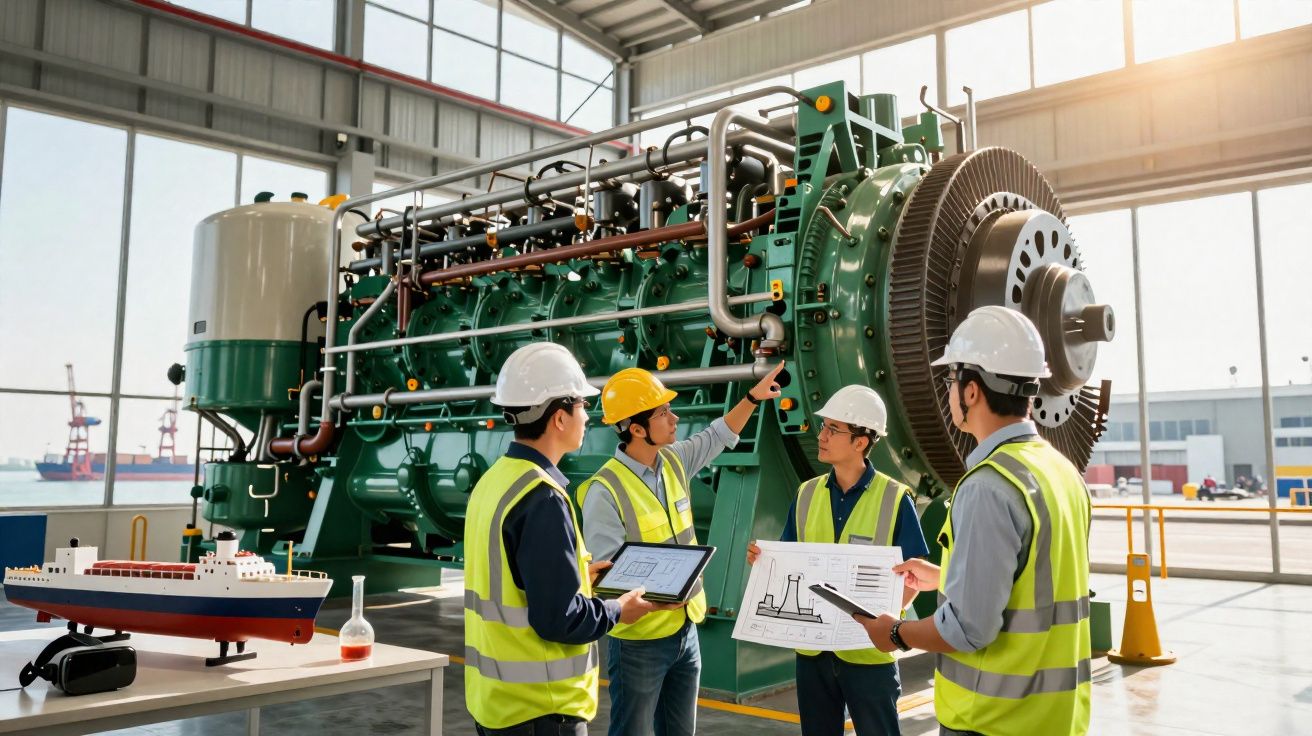
On France’s Atlantic seaboard, an old engine works once synonymous with brute diesel muscle is quietly positioning itself for a new industrial chapter.
In Saint-Nazaire, a long-established manufacturing site is being reshaped into a strategic pillar for nuclear safety, cleaner shipping and next‑generation biofuels. Its German owner, Everllence (previously MAN Energy Solutions), is marking the plant’s 80th anniversary with fresh capital, new contracts and an overhaul of both production areas and office space.
From diesel icon to Everllence Saint-Nazaire’s new role
The site’s roots go back to 1946 with the founding of S.E.M.T., the Company for the Study of Thermal Machines. From the post‑war expansion through to the mid‑2000s, the brand became a benchmark for high‑power diesel engines used in ships and power generation-built in Saint‑Nazaire on the Atlantic coast.
Although S.E.M.T. ceased to exist as a standalone company in 2006, the know‑how and industrial capability did not disappear. Now under Everllence, the factory still produces engines so large that they are shipped directly from a dedicated quay.
By 2026, the plant employs around 600 people and produces enormous four‑stroke engines weighing up to 320 tonnes each. To celebrate 80 years of operations, Everllence is preparing what site leaders describe as a “nice gift”: a major investment push, a stronger order book, and a comprehensive modernisation of workshops and offices.
Everllence is targeting roughly 40% growth at Saint‑Nazaire by 2028, fuelled by rising demand for nuclear safety equipment and cleaner maritime propulsion.
Nuclear growth: engines designed for the worst day imaginable
Emergency power when the grid fails
Within a nuclear power station, Everllence’s engines are not there to drive the main turbines. Their purpose is less visible-but vital: they provide the final layer of resilience if external electricity supply is lost.
These large units are used as:
- emergency diesel generators,
- backup power systems,
- independent electricity sources if the external network collapses.
If a station loses normal power, the engines must start automatically within seconds, keeping essential systems operating, including:
- reactor cooling systems,
- safety pumps,
- control and monitoring equipment.
They are engineered for the scenario no operator ever wants to face: a major grid failure or serious incident where minutes matter. That requirement drives extreme standards for reliability, redundancy and the ability to run for hours-or even days-under heavy load and stressful conditions.
Everllence’s timing in reinforcing Saint‑Nazaire is deliberate. The International Atomic Energy Agency (IAEA) forecasts that global nuclear capacity could rise from about 377 gigawatts today to nearly 1,000 gigawatts by 2050. New reactors, life‑extension programmes and small modular reactors all increase demand for ultra‑reliable emergency power systems.
Nuclear expansion does not simply mean more reactors; it also means more ultra‑reliable backup engines, control systems and layered safety solutions.
In practice, nuclear work also pulls manufacturing up the value chain: qualification procedures, traceability and documentation requirements are typically more stringent than in conventional marine applications. That, in turn, favours established sites that can combine heavy machining with rigorous testing and quality assurance.
Maritime pressure: regulation pushes cleaner propulsion
Shipping under climate constraints
On the maritime side, decarbonisation is no longer optional. The International Maritime Organization (IMO) aims to reduce the carbon intensity of shipping by 40% by 2030 and 70% by 2040, with a target of climate neutrality around mid‑century. Meanwhile, the European Union is bringing shipping into its carbon market, progressively pricing emissions from large vessels above 5,000 tonnes-ships responsible for the bulk of the sector’s pollution.
The financial implications are substantial:
- new low‑carbon ships can cost 30–50% more than conventional designs,
- low‑carbon fuels are often two to five times more expensive than standard fuel oil,
- fleet renewal could require up to US$28 billion per year (around £22 billion),
- fuels and supporting infrastructure could demand up to US$90 billion annually (around £71 billion).
Shipowners are therefore confronted with a difficult decision: retire and replace vessels earlier than planned, or convert existing propulsion systems to cleaner fuels. Everllence is focusing on conversions rather than scrappage.
The 51/60DF: a multi‑fuel pathway in one platform
Central to this approach is the 51/60DF engine family, manufactured and upgraded in Saint‑Nazaire. While “DF” stands for dual fuel, these engines are built with broader fuel optionality in mind.
Key specifications include:
- Configuration: 6L, 12V or 18V
- Maximum power: up to 20,700 kW at 500/514 rpm
- Fuel flexibility: diesel, heavy fuel oil, natural gas, liquid biofuels
- Combustion: can start directly in gas mode using roughly 1% “pilot” fuel
- Bore and stroke: 510 mm × 600 mm
- Weight: up to about 416.8 tonnes for the 18‑cylinder version
This flexibility is increasingly valuable in a market where fuel availability, pricing and regulation remain uncertain. Operators can begin with conventional fuels, then transition progressively towards gas or biofuels as supply chains and port infrastructure develop.
Everllence also plans to convert more of these extra‑large engines to run on liquid fuels derived from biomass. In many cases, that route is faster and less costly than commissioning brand‑new vessels, while still achieving meaningful emissions reductions.
Converting a 320‑tonne engine to burn biomass‑based fuels can, in some cases, reduce lifetime emissions far more cost‑effectively than building a new low‑carbon ship from scratch.
As a result, activity at Saint‑Nazaire is rising. Everllence intends to increase output from 48 to 72 engines per year-an additional 24 units annually-as early as 2025. That expansion gives the French site a global role in helping shipping meet tightening climate requirements.
A related challenge is people rather than metal: conversions and multi‑fuel upgrades demand specialist skills in controls, fuel systems and integration. Sustaining growth will therefore depend not only on equipment capacity, but also on recruitment, training and the ability to retain experienced technicians and engineers in a competitive labour market.
Biofuels at sea: what “biomass‑based” actually covers
The label “biofuel” can refer to very different products. In maritime use, it can range from fuels derived from used cooking oils (such as HVO) to advanced bio‑oils produced from forestry residues or agricultural waste. The ambition is to cut lifecycle emissions, although real‑world impact depends heavily on how feedstocks are sourced and processed.
A typical transition pathway looks like this:
- Short term: blending biofuels with conventional marine diesel to cut emissions without hardware changes.
- Medium term: retrofitting engines and fuel systems to run largely on biofuels or biomethane.
- Long term: moving towards synthetic fuels such as e‑methanol or e‑ammonia, produced using renewable electricity.
Engines such as the 51/60DF function as a bridge technology: they can accommodate different fuel mixes while regulators, ports and suppliers determine which low‑carbon option scales fastest.
Beyond machinery: 6,000 m² of office space rebuilt
Investment in people, design and digitalisation
Everllence’s plan is not confined to workshop equipment and test benches. The company is launching a two‑year renovation of around 6,000 m² of offices at the Saint‑Nazaire site.
The refurbishment is intended to:
- improve working conditions for existing staff,
- help attract scarce engineering and technical talent,
- enable a shift towards more design work, digitalisation and innovation.
That strategic shift matters because future orders are increasingly less about repeating standard diesel production runs and more about engineering tailored, complex multi‑fuel systems-for nuclear facilities, LNG terminals, ferries or cruise ships operating under strict emissions limits.
The 80th‑anniversary “gift” is not just extra orders; it is a structural move up the value chain, from heavy fabrication to higher‑value engineering.
Saint-Nazaire: a strategic Atlantic energy hub
A port ecosystem connected to global trade
Everllence operates within a concentrated industrial and port cluster. The Nantes–Saint‑Nazaire Grand Maritime Port handled 26.4 million tonnes of goods in 2025, up 2.6% on the previous year. Around 18 million tonnes of that total were energy flows, including oil and liquefied natural gas.
Each year, about 3,068 ships call at the port. The wider port area supports roughly 28,700 direct jobs across 1,460 hectares. Saint‑Nazaire is also home to the Atlantic Shipyards and major industrial customers such as EDF, TotalEnergies and ArcelorMittal.
The Everllence plant benefits from its own quay to load 48/60 and 51/60 engines, some weighing up to 320 tonnes. Very few locations globally can manufacture, test and dispatch equipment of this size with such logistical efficiency.
The site also sits within France’s “France 2030” strategy via the Loire Estuary Low‑Carbon Industrial Zone programme (ZIBaC), which allocates €8.2 million to projects spanning hydrogen, carbon capture and biofuels. This provides Saint‑Nazaire with a platform to trial future low‑carbon solutions around the engines themselves, including fuel logistics, storage and integration into port energy networks.
Scenario planning: if shipping decarbonises faster than expected
If regulations tighten sooner than anticipated, shipowners may need to accelerate retrofits. That would likely create a queue of conversion work for sites such as Saint‑Nazaire-covering not only newbuild programmes but also existing fleets in Europe, Asia and the Middle East.
However, faster demand also brings risk. Constraints in skilled labour, component supply and testing capacity could delay deliveries. Engine manufacturers also face technology risk if policy and fuel availability swing sharply towards a single solution-for example ammonia-more rapidly than product portfolios can adapt.
On the positive side, a successful transition to efficient multi‑fuel engines could deliver compounding gains: ports reduce local air pollution, shipowners lower carbon costs, and countries such as France strengthen energy and industrial sovereignty by anchoring critical capabilities at home.
By modernising its 80‑year‑old engine factory, Everllence is betting that heavy industry can thrive in a low‑carbon economy-provided it adapts quickly enough.



Comments
No comments yet. Be the first to comment!
Leave a Comment