
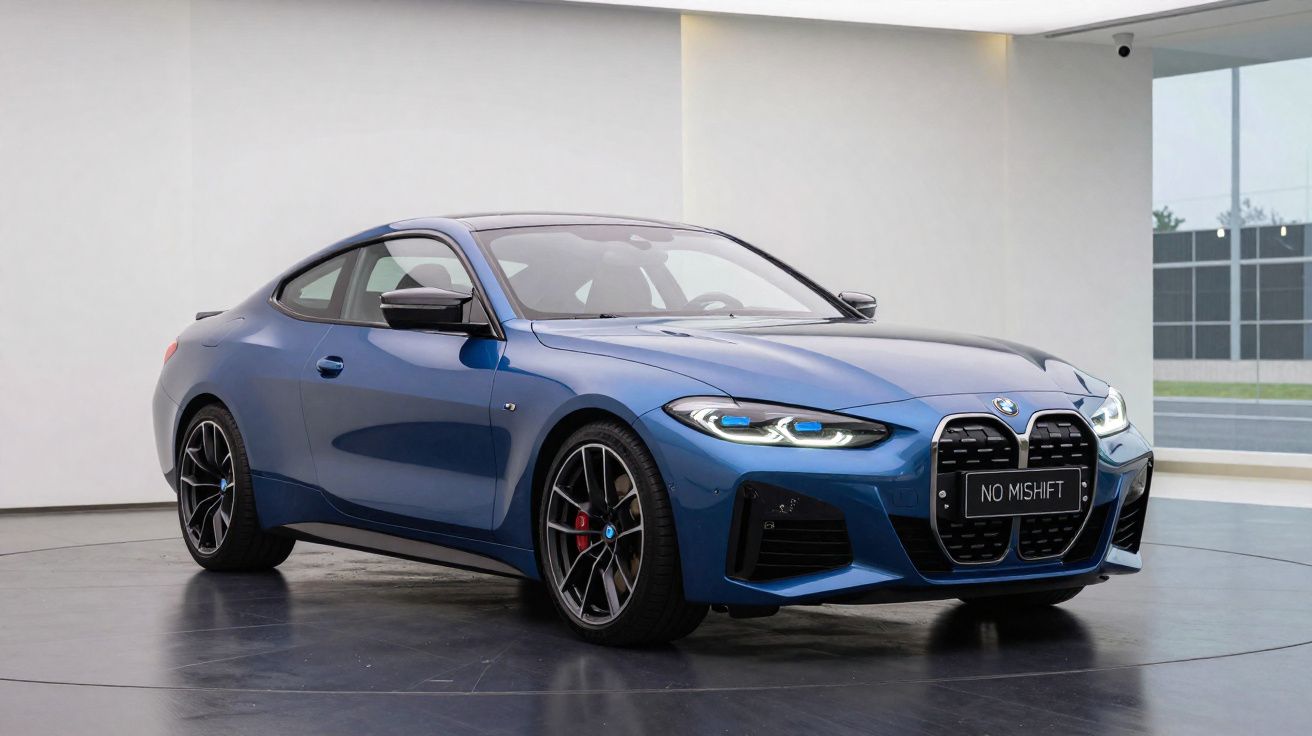
While plenty of manufacturers are quietly deleting the clutch pedal from their line-ups, BMW is pushing in the opposite direction: a new take on the manual gearbox that keeps the hands-on, three-pedal experience intact, but adds electronics as a discreet safety layer to prevent expensive driver mistakes.
BMW manual gearbox: the three-pedal setup still matters
Manual transmissions are being squeezed out by rapid-fire dual-clutch gearboxes and increasingly smart automatics. Even so, BMW continues to treat the three-pedal format as part of its identity-particularly within its M cars.
The challenge is straightforward: even skilled drivers occasionally get a shift wrong. A harsh, poorly timed downshift can trigger an over-rev. A rushed move across the gate can graunch the synchros. And when those errors happen repeatedly, clutches, gears and bearings can wear far sooner than the brochure-friendly lifespan suggests.
BMW’s solution is a “forgiving” manual gearbox: you remain the one choosing the gears, but the car quietly prevents actions that could harm the drivetrain.
Crucially, this is not BMW trying to disguise an automatic as a manual. The concept is a mechanical gearbox with an electronic supervisor-preserving involvement, while trimming the risk.
How BMW’s semi-intelligent manual gearbox works
You can already see the early building blocks in current BMW performance models. The BMW M2 and BMW M3, for example, offer auto rev-matching: on downshifts the car blips the throttle to align engine speed with road speed, making clumsy heel-and-toe attempts look impressively tidy.
BMW engineers are now moving well beyond that comparatively simple feature.
A mesh of sensors watching every input
The prototype approach uses a tightly integrated set of sensors to monitor driver inputs and drivetrain conditions in real time, including:
- gear lever position and the speed of movement through the gate
- clutch pedal travel and the bite point (engagement point)
- engine speed and engine load
- vehicle speed and wheel rotation
- gearbox temperatures and clutch temperatures
All of that information feeds a dedicated control unit, which continuously works out which shifts are safe and sensible at any given moment.
If it spots a genuinely dangerous request-such as selecting second gear at motorway speeds-it can simply refuse to engage that gear.
In other situations, the control unit may allow the gear change but intervene to reduce the shock, adjusting engine speed to prevent a sharp jolt through the drivetrain.
Correcting human error before metal meets metal
In a traditional manual, the driver must do everything: choose the correct ratio, match revs, and manage engagement smoothly. With BMW’s assisted manual, the driver still makes the choice with hand and foot-but the hardware gains a veto when the consequences could be severe.
BMW is reportedly trialling functions on development cars such as:
- over-rev protection via gear lockout – preventing a too-low gear if it would push the engine beyond its safe limit
- smart synchro protection – slowing or delaying engagement when the shift is too aggressive for the gearbox internals
- adaptive rev-matching – varying the size and speed of throttle blips depending on driving mode and clutch technique
This style of supervision can materially cut wear on clutches, synchronisers and the flywheel-particularly on cars that see frequent enthusiastic driving or track days.
Balancing purist feel with a digital safety net
BMW has a tightrope to walk. Enthusiasts tend to dislike electronics that feel intrusive-especially in cars marketed as “driver’s machines”. BMW’s approach is to keep assistance effectively invisible unless it’s needed.
In normal driving, it should feel like a classic BMW manual: direct, mechanical and slightly weighty, with a clear gate.
The key is blending interventions so they don’t feel like the car is overriding you. For example, if the system senses you’re pulling towards an unsafe gear, it could apply subtle resistance or guidance-steering you towards a safer slot without a loud warning or a brutal, abrupt refusal.
Different personalities by drive mode
BMW already links throttle response, steering weight and stability control thresholds to modes such as Comfort, Sport and Sport Plus. The assisted manual gearbox can sit within the same framework.
In day-to-day terms, that could look like this:
| Mode | Shift feel | Electronic intervention |
|---|---|---|
| Comfort | Lighter, smoother engagement | Earlier protection, more smoothing, strong gear lockout |
| Sport | Firmer, quicker response | Later intervention, sharper rev-matching, mild lockout |
| Track / Sport Plus | Heaviest, most direct feel | Minimal interference, over-rev protection only |
Some features-auto rev-matching in particular-already offer an off-switch on certain M models. It’s likely BMW will keep that option for drivers who prefer to blip the throttle themselves.
Why BMW is investing where others have walked away
From a purely financial angle, spending heavily on an advanced manual gearbox can look illogical. Worldwide demand continues to fall, and automatics integrate more neatly with hybrid systems and electric powertrains.
Yet in important markets such as the US, Japan and Germany, there remains a committed group of buyers who insist on a manual. BMW’s M division relies on that audience-buyers of M2s, M3s and coupes who want an unfiltered, physical link between driver and drivetrain.
By making the manual easier to live with-and harder to break-BMW is trying to keep it viable for a few more product cycles.
There is also a branding benefit. Being perceived as the last premium manufacturer still offering a properly engineered manual gives BMW a distinct point of difference against rivals that have gone fully automatic.
An additional, practical upside is resale and ownership confidence. If the gearbox can reduce common abuse-related failures, used buyers may be less wary of a second-hand manual M car with an unknown history-particularly one that’s likely seen spirited driving.
Manual gearboxes in an electrified future
A bigger question sits behind the whole idea: what becomes of this as BMW pushes further into electric and heavily hybridised models?
Electric motors don’t require multiple ratios for efficiency, and most EVs use a single-speed reduction. Even so, BMW engineers have already explored “simulated” manual gearboxes in high-performance EV concepts-giving the driver a lever and a clutch-like input that communicates with software rather than actual cogs.
The assisted manual technology being developed now could translate directly into those simulations. The same logic that blocks bad shifts and manages rev-matching in a petrol BMW M2 could, later on, help deliver believable feedback in an electric iM2 with artificial gears and staged torque delivery.
There’s also a customer-experience angle: as engines disappear, manufacturers will look for new ways to create interaction and skill. A convincing simulated manual-grounded in the same safety logic-could offer engagement without the mechanical vulnerability of a real clutch and synchros.
What “rev-matching” and “over-rev” mean in plain terms
Two terms sit at the centre of BMW’s plan:
- Rev-matching means increasing engine speed during a downshift so the engine and gearbox rotate at compatible rates. When it’s done correctly, the car remains smooth and settled rather than lurching.
- Over-rev occurs when the engine is forced past its safe maximum speed-typically by selecting a gear that’s too low for the current road speed. In a split second it can bend valves, stress pistons and damage bearings.
By automating rev-matching and preventing over-rev situations, BMW’s system targets two of the biggest mechanical risks in spirited manual driving.
What this could mean for everyday drivers
On an ordinary commute, many owners may scarcely notice what the assisted manual gearbox is doing. The gains tend to show up quietly over years: fewer clutch replacements, fewer notchy or reluctant synchros, and less driveline shunt when traffic demands constant upshifts and downshifts.
On a twisty B-road or during track days, the benefit is more immediate. A driver braking late into a corner still has to choose the gear and commit to the shift-but the safety net lowers the odds of a catastrophic mis-shift that ends the session (or the engine) instantly.
There’s also a training effect. If the gearbox repeatedly resists the same kind of shift, it acts as feedback: timing or technique needs improving. In that way, it can become a quiet coach-encouraging cleaner, more mechanically sympathetic driving without turning the experience into a hands-off automatic.
For drivers concerned that electronics are draining the challenge, BMW’s wager is clear: retain the physical movement and responsibility, but use sensors and code to catch the rare, costly mistakes that ruin engines-and empty wallets.


Comments
No comments yet. Be the first to comment!
Leave a Comment