
The press briefing was meant to be forgettable: orderly rows of seats, identical bottles of water set out with care, and branded backdrops so commonplace your eyes glide straight past them. The sort of corporate routine that gets livestreamed on a Tuesday morning while most viewers half-watch with the volume muted.
Then a single line landed, and heads lifted from screens.
A name synonymous with engineering rigour - a marque linked with toughness, accuracy and a near-stubborn dependability - said, without drama, what plenty of insiders will only admit privately: electric cars are a stage in the transition, not necessarily the final destination.
You could sense the air tighten.
Because when a brand built on “forever” suddenly questions the supposed future, people pay attention.
When Toyota, a rock-solid brand, quietly changes direction
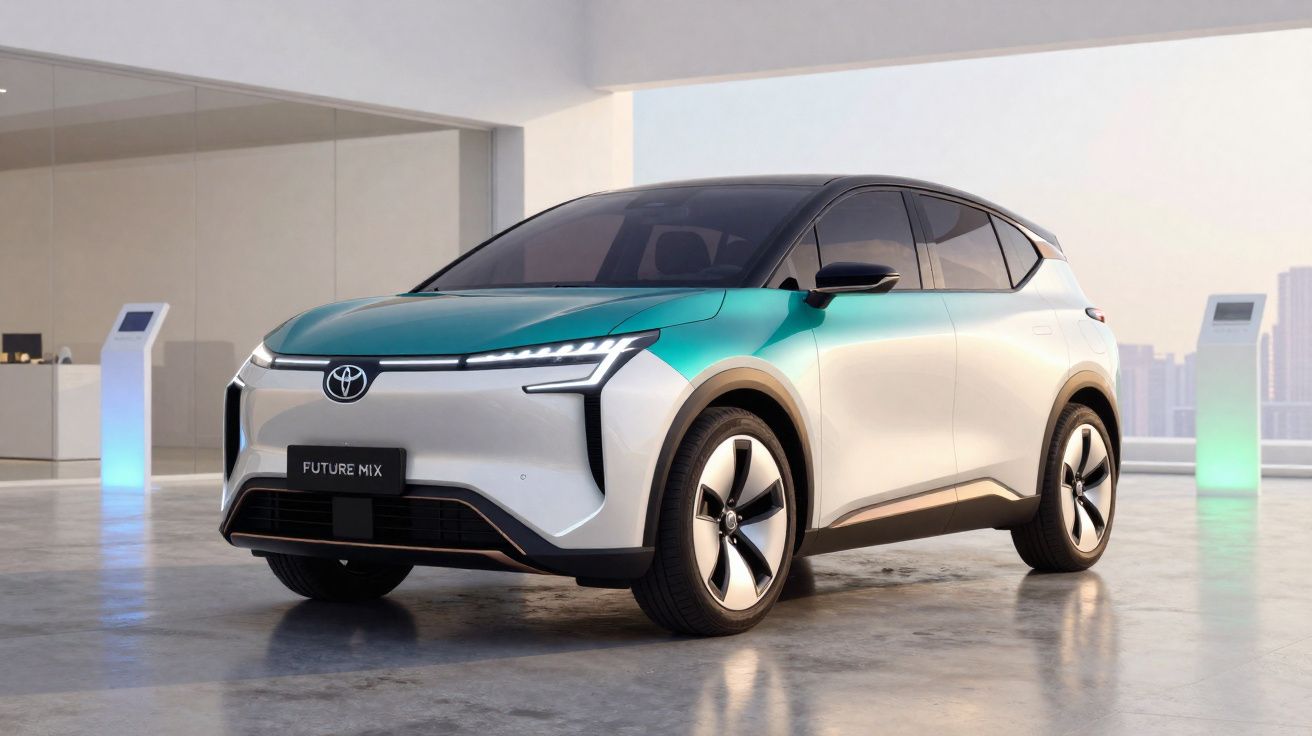
The company is Toyota - the manufacturer that effectively turned reliability into a creed.
For a long time, Toyota resisted the rush towards full battery-electric vehicles while competitors pushed out glossy EVs and headline-grabbing launches. Instead, the Japanese giant doubled down on hybrids, fuel efficiency, and a famously careful attitude to major strategic shifts.
That is why it lands differently when Toyota’s senior leadership repeats, over and over, that EVs on their own will not define the future, and that carbon neutrality requires “multiple solutions”.
This is not a young disruptor chasing attention.
It is the world’s largest carmaker calmly suggesting that the finish line everyone talks about may not be where the real contest ends.
Toyota’s “multiple solutions” plan for carbon neutrality
Listen to Toyota’s latest strategy briefings and the message is consistent: they want a complete toolkit - hybrids, plug-in hybrids, hydrogen fuel cells, synthetic fuels, and, yes, battery-electric vehicles. The key point is that none of these is presented as the single, universally correct answer.
They are investing billions in solid-state batteries, while simultaneously arguing that markets such as India, Africa, and parts of Europe are not structurally positioned to go fully electric as quickly as many policy makers would like.
Toyota also points to numbers that ignore hype. In several regions, EV sales growth is easing. Charging networks remain uneven once you move beyond major cities. And used electric cars in some markets have been losing value faster than many buyers anticipated.
Meanwhile, with far less noise, Toyota’s hybrid sales keep rising - a footnote that irritates critics and comforts finance teams.
On paper, this can sound almost old-fashioned. Why not bet everything on EVs in the manner of Tesla or BYD?
Toyota argues it is playing a different match entirely: risk management on a global scale. The company designs cars for drivers who may never, in their lives, park at a Tesla Supercharger. For taxi drivers who cannot afford to lose time waiting at a post. For countries where the electricity supply can falter when everyone switches on the air conditioning.
Toyota’s engineers return to the same principle: decarbonize as many miles as possible, as quickly as possible, using technology people can realistically adopt today.
That may be less shareable than a futuristic electric SUV reveal - but in Toyota’s view, it is how you shift behaviour for billions rather than merely impress millions.
Two practical realities Toyota keeps pointing at (and the UK feels them too)
In the United Kingdom, the debate is shaped as much by everyday logistics as by ambition. If you have off-street parking, home charging can make a full EV effortless; if you rely on on-street bays or a flat with no dedicated space, it can be a weekly puzzle. Rapid chargers are expanding at motorway services and around major towns, but reliability, queuing and pricing still vary - which is exactly the kind of “on the ground” friction Toyota highlights.
It is also worth separating tailpipe emissions from whole-life impact. Battery production, the electricity mix that powers charging, and battery recycling all influence real-world carbon outcomes. That does not undermine the case for electric cars; it reinforces Toyota’s argument that the route to carbon neutrality is not identical everywhere, and that different technologies may deliver faster progress in different circumstances.
What this means for drivers who feel lost in the noise
So, what should you do if you are standing at a dealer, wondering whether your next car “must” be electric?
Toyota’s position offers a form of permission: you can think in stages rather than in absolutes. Instead of forcing yourself into a full EV that clashes with your day-to-day life, you can start with your actual routine.
- How far do you typically drive on most days?
- Where would you charge - at home, at work, or only in public?
- Who else needs the car, and how predictable are your journeys?
Toyota’s pick-and-mix approach points to a simple idea: the “right” choice is the vehicle that reduces your emissions the most without wrecking your budget or your timetable.
Not the one that wins arguments online.
Plenty of people quietly feel a nagging guilt when they do not immediately jump to an EV - especially if they live in a small town, rent a property, or simply do not have a drive. We all recognise that moment when a slick advert or a viral video makes your older diesel feel like a moral failing.
Toyota’s understated message can be strangely reassuring: transition can be incremental. A hybrid today, a plug-in hybrid later, and a full battery-electric vehicle when your local infrastructure, your grid, and your finances genuinely line up.
And, realistically, almost nobody runs a perfect daily spreadsheet that tracks carbon footprint, charging behaviour, and resale value. Most drivers just want something that starts every morning and does not feel like a leap into the unknown.
At recent briefings, a Toyota executive summed up the company’s view with a faint edge of defiance:
“Battery electric vehicles are a key tool,” he said, “but they are not the only tool. Our goal is not to sell electric cars. Our goal is to reach carbon neutrality for every customer, in every market, with what actually works on the ground.”
That sounds abstract until you translate it into real choices. “What actually works” might look like:
- A straightforward hybrid for long rural commutes where charging is unrealistic
- A plug-in hybrid for households that can charge at home but still do long holiday drives
- A full EV as a second city car rather than the only vehicle in the household
- Hydrogen fuel cells or synthetic fuels for fleets and heavy-duty use
The quiet heresy is this: the future of cars may be messy, mixed, and stubbornly non-binary.
A future that looks less like a revolution, more like a patchwork
When a company like Toyota says outright that electric cars are not the end goal but one route among several, it opens the door to a less glamorous - and arguably more believable - future.
Picture cities running silent EV bus fleets, while remote communities rely on ultra-efficient hybrids. Imagine charging networks existing alongside hydrogen pumps and synthetic fuels depots. In that world, your “green choice” depends as much on your postcode as it does on the latest keynote speech.
It is not the neat science-fiction storyline politicians prefer.
Yet it may better match how real transitions unfold: unevenly, with trade-offs, with technologies overlapping - and refusing to disappear simply because a press release says they should.
And that may be the uncomfortable part. If Toyota’s reading is correct, there will be no single, cinematic moment when the last petrol car disappears into the sunset. Instead, there will be a long, complicated, slightly chaotic stretch in which drivers, manufacturers and governments repeatedly renegotiate what the future of mobility truly means.
| Key point | Detail | Value for the reader |
|---|---|---|
| EVs are a tool, not the end goal | Even industry giants like Toyota treat electric cars as one option among several paths to carbon neutrality | Takes the pressure off seeing full EV adoption as the only “right” choice |
| Mixed technologies will coexist | Hybrids, plug-ins, EVs, hydrogen and synthetic fuels are likely to share the road for years | Helps you plan purchases with a realistic view of how the market may evolve |
| Context matters more than trends | Infrastructure, driving habits and budget shape the best solution for each driver | Encourages decisions based on your life, not just marketing or social pressure |
FAQ
Question 1: Does Toyota really think electric cars are a dead end?
Answer 1: No. Toyota is investing heavily in EVs and new batteries, but it argues that electric cars are one of several solutions - not a single ultimate destination for every market and every driver.Question 2: Why is Toyota pushing hybrids instead of going fully electric?
Answer 2: Toyota’s case is that hybrids can reduce emissions quickly in countries where charging networks and power grids are not ready for mass EV adoption, allowing more people to cut emissions sooner using existing infrastructure.Question 3: Should I delay buying an electric car after this?
Answer 3: Not necessarily. If you have dependable charging access, drive mostly predictable daily journeys, and the costs work in your favour, a full EV can still be a sensible choice. The point is that it does not have to be the only acceptable option.Question 4: Will there still be petrol or hybrid cars in ten years?
Answer 4: Very likely, especially in regions with weaker infrastructure or different regulations. Rules are tightening in many places, but the complete disappearance of combustion engines is likely to take longer than slogans imply.Question 5: How can I future-proof my next car purchase?
Answer 5: Start with your typical mileage, local fuel and electricity prices, charging options, and how long you expect to keep the car. Then compare a hybrid, a plug-in and a full EV based on total cost of ownership - not only the list price and optimistic promises.

Comments
No comments yet. Be the first to comment!
Leave a Comment