
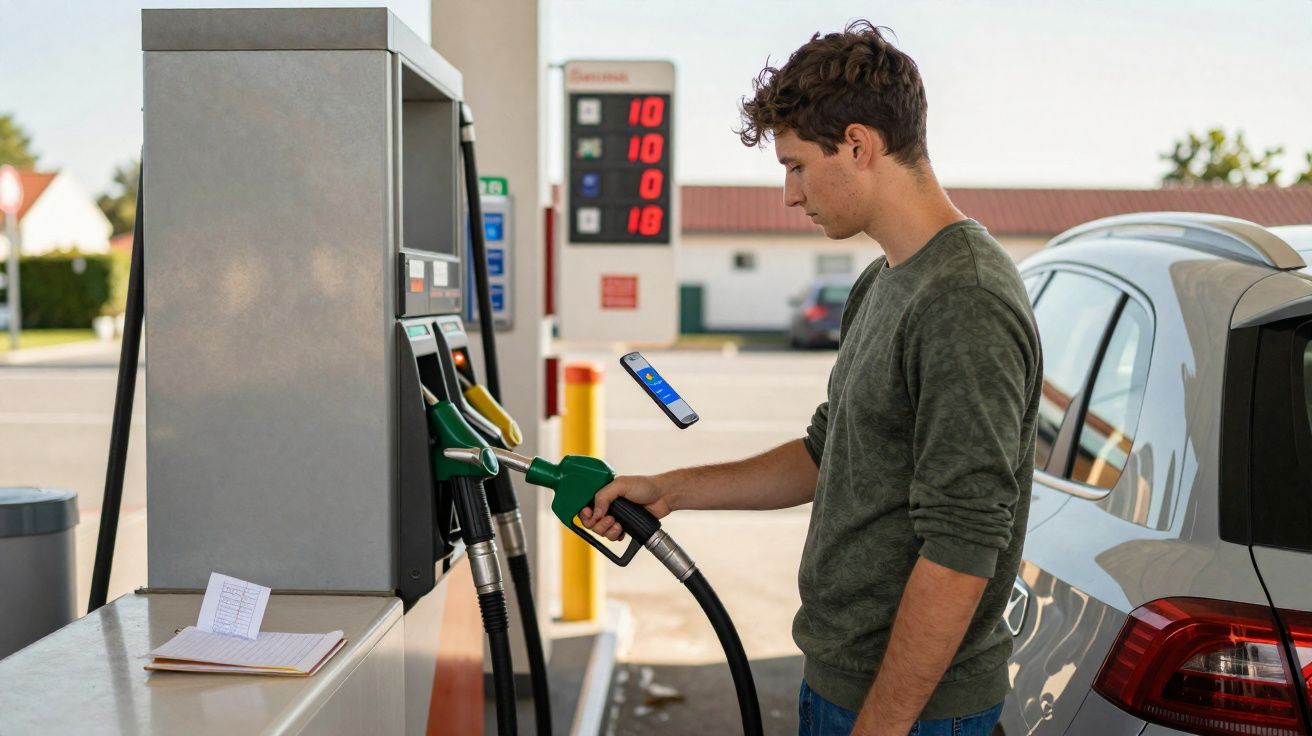
The forecourt sits under stark white LED lighting, the sort that makes every car and every raindrop look unnervingly sharp. A queue of vehicles curls towards the pumps; drivers look half-absent, half-busy doing mental arithmetic. At pump 4, a German family in a Škoda estate doesn’t simply fill up and leave. They open an app, check the price board twice, then pause for a full minute before squeezing the nozzle again.
A couple of cars along, a Dutch motorist watches with raised eyebrows. Same petrol, same station - yet the Germans clearly know something he doesn’t. When the digital sign flicks down by a single cent per litre - yes, within minutes - the driver gives a small nod, finishes fuelling, and heads inside as if waiting for a price change is the most ordinary thing in the world.
This isn’t folklore. German-style refuelling has become a real blend of timing, tools and forecourt habits that can trim a few euros off every tank. And an awkward question is travelling well beyond Germany’s borders:
Is it smart saving… or an unfair edge?
Why German drivers don’t just “fill and go” any more
Spend any time at a busy German petrol station and a pattern emerges. People aren’t only checking the needle on the dashboard; they’re checking their phones. Many motorists won’t even turn in unless they’ve already looked at a price comparison app such as Clever Tanken or Mehr-Tanken. If the number feels off, they keep driving.
Fuel in Germany has stopped being a background expense you barely notice. Instead, it’s turned into a daily game of cat and mouse between motorists and dynamic pricing algorithms. And Germans - famously fond of routines and systems - have quietly made refuelling into something close to a ritual.
Most drivers have felt that sting: you fill up, drive 2 kilometres, and spot the same fuel 3 cents cheaper. In Germany, that frustration has translated into action. People don’t just complain; they plan. Not everyone, obviously - but enough that you can see it in the data.
On an ordinary weekday in Munich, figures from Germany’s cartel office show a familiar pattern: prices tend to jump during the morning commute, then drift down through late morning and early afternoon. Plenty of drivers have learned to work around it. A 2023 survey by the ADAC motoring club found that motorists who mostly refuel between 6 p.m. and 8 p.m. save roughly 6–10 cents per litre compared with the morning high point.
At first, that sounds modest - until you do the maths. On a 50-litre tank, that’s €3–€5 saved in a single stop. Over a year of commuting, regulars say they hold on to €150–€250 that would otherwise disappear into the pump. That’s not “loyalty-card points” territory. That’s a weekend away - or, at the very least, a seriously decent supermarket shop.
A Berlin taxi driver described his approach like this: last fare ends around 5 p.m., he checks three local stations in his app, then makes a detour of perhaps 800 metres to whichever one is undercutting the others. “If I just filled up whenever I felt like it,” he says, “I’d be throwing away a day’s income every month.” It sounds dramatic - until you remember diesel in parts of Europe has been flirting with €2 per litre.
Underneath it all is a blunt but effective reality: in some areas, prices can change up to 10 times a day. Operators watch competitors closely, pushing prices up when demand looks strong and shaving them back when footfall fades. The outcome is a curve that’s oddly predictable: pricey in the morning, gentler later on, with small dips and spikes scattered in between.
Crucially, German drivers aren’t getting secret discounts or special treatment. They’re simply playing with better information. Apps pull near-live prices from the national Market Transparency Unit for Fuels, which requires stations to report changes almost in real time. In theory, that makes a level playing field - but in practice, it only helps the people who bother to look.
Is it unfair? If you pull in blindly at 8:15 on a Monday, it can certainly feel that way. You’re buying the same product from the same pump, yet your total can shift by the hour. The “advantage” doesn’t go to the richest driver; it goes to the organised, the attentive and the slightly obsessive. Seen another way, German-style refuelling is simply disciplined consumer behaviour under the unforgiving glare of algorithm-driven pricing.
The “German method” at the pump: how German-style refuelling works in practice
Once you strip away the mystery, the German method is surprisingly straightforward. The key is avoiding desperation. Many drivers aim to refuel when they’re down to roughly a quarter of a tank, giving themselves a day or two of flexibility - and that flexibility is where the savings begin.
Regulars tend to follow two simple rules:
- Map your routines. People track the routes they repeat - home–work, home–school, home–supermarket. They save three or four familiar stations in their chosen app and watch the patterns for a week or two.
- Prefer late afternoon and evening. They avoid the classic Monday-morning “panic stop” unless there’s no alternative.
It’s less about chasing “the cheapest fuel in Germany today” and more about catching a cheaper window on roads you’d be driving anyway.
Then you notice the small behaviours outsiders misinterpret. Some drivers start pumping, stop, glance up at the big sign, and wait a moment before finishing. They’re not being paranoid; they’ve learned that prices can update at certain moments - often on the hour. Others will buy smaller amounts when prices hit an unusually low dip, rather than running the tank from full to empty in one long cycle.
For many, the real effort happens well before they reach the forecourt. A careful motorist might keep a basic log - date, station, time, price per litre. Nothing elaborate; just a note on their phone. Patterns surface quickly. One place always undercuts rivals on Tuesdays. Another drops sharply after 7 p.m. near a retail park once shoppers have headed home.
Let’s be honest: almost nobody does this every single day. Most people check the app when they remember, or only when they’re travelling farther than usual. Even so, occasional use can still catch meaningful gaps.
In border regions, it can become a competitive hobby. Residents of Aachen time trips into Belgium, while motorists in the south keep an eye on Austria or Luxembourg. That “unfair” advantage is often just someone using geography, timing and information to their benefit.
There’s a downside, too. Push the technique too hard and you end up crawling along on fumes in pursuit of a mythical bargain - turning a sensible strategy into pure stress. Some admit they’ve driven with the range estimate in single digits because “it’ll drop this evening”. That isn’t saving; it’s gambling with your commute.
“Fuel pricing has become a real-time auction without anyone calling it that,” says a Stuttgart-based transport economist. “Those who use live data feel clever. Those who don’t feel tricked. The system is the same for everyone, but the experience is radically different.”
Between those two experiences, a handful of habits often separates calm savers from anxious price-chasers. When you speak to German drivers who seem both relaxed and consistently lucky at the pump, the same themes keep returning:
- They maintain a fuel buffer, so they’re rarely forced to buy at the worst possible moment.
- They stick with a small set of familiar stations rather than crossing town to save 1 cent.
- They use apps as guidance, not as instructions.
The real trick, they’ll tell you, isn’t squeezing the final cent out of the price. It’s sidestepping that sinking feeling of paying noticeably more than the car beside you for exactly the same litres.
A note for UK readers: what transfers, and what doesn’t
For motorists in the UK, the mindset travels well even when the infrastructure differs. The basic principles - avoiding peak-time refuelling, steering clear of motorway service stations when you can, and comparing a few nearby prices before committing - still matter, even if the UK doesn’t mirror Germany’s Market Transparency Unit for Fuels system station-for-station.
What does translate cleanly is the “no long detours” rule. If you’re spending time and fuel to chase a tiny difference, you can erase your savings quickly - and add stress on top. The German method works best when it slots into the journey you were already making.
Don’t ignore the practicalities on the forecourt
One more angle often missed in the obsession with apps: forecourts are shared spaces. If you’re pausing mid-fill to wait for a price change, be mindful not to block other drivers or slow down busy stations at peak times. Good etiquette - moving your car once you’ve finished, paying promptly, and not turning the pump into a personal waiting bay - keeps the “clever” behaviour from becoming antisocial.
So is German-style refuelling fair play - or quietly changing the rules?
Leave a German forecourt and the question hangs around longer than the smell of diesel. If prices can shift ten times a day, is dodging the peaks really “clever”… or simply what you must do to avoid being overcharged in a hyper-optimised system? Some view it as consumer empowerment. Others see a widening gap between people with time, tools and predictable routines, and those whose lives are less flexible.
A mother on shifts, a delivery driver on a tight timetable, a nurse coming off a night shift - they often can’t choose the “best” refuelling window. They pay what the pump says when they arrive. From that perspective, the German habit of playing the daily price curve can look less like a neat trick and more like a quiet reshuffling of who ends up paying the highest rate for the same product.
And yet, when this mindset spreads beyond Germany, something interesting happens. Drivers in France, Italy, Spain - and even the UK - are downloading the same apps, copying the same timing habits, and swapping the same tips. The more motorists treat fuel like a fluctuating airfare rather than a fixed utility, the more pressure there is on stations to compete on transparency and timing.
The irony is hard to miss. A pricing system designed to extract the maximum from demand has inadvertently trained a generation of drivers to compare, resist and share screenshots of suspicious spikes. Friends swap advice in WhatsApp groups. Neighbours talk about “the cheap station two junctions along” as casually as they used to talk about the weather.
Perhaps that’s the real legacy of German-style refuelling: not a secret national hack, but a change in attitude. Fuel becomes a game you’re allowed to play - not just a bill you have to accept. Whether that feels empowering or exhausting depends on the kind of week you’re having.
Next time you’re standing under harsh forecourt lighting with your hand on the nozzle, watch the other drivers for a moment. The ones who pause, check their phones, and look almost suspiciously calm as the digits roll - are they manipulating the system, or simply refusing to be passive in a world of dynamic pricing?
The pump won’t tell you. The receipt won’t either. The answer sits somewhere between your time, your habits, and how much headspace you’re willing to give those glowing red numbers.
Key takeaways
| Key point | Details | Why it matters to readers |
|---|---|---|
| Daily price rhythm in Germany | Fuel is often most expensive during morning rush hours and cheapest in the early evening (commonly 6–8 p.m.), with several smaller dips and peaks through the day. | Knowing the typical daily pattern helps you refuel when prices are usually lower instead of paying an invisible “rush-hour premium”. |
| Using price apps effectively | Apps such as Clever Tanken, Mehr-Tanken and ADAC Spritpreise show live prices pulled from a national database, updating whenever a station changes its sign. | You can compare nearby stations in seconds while staying on your usual route, cutting costs without guesswork or lengthy diversions. |
| Border and motorway strategies | Stations directly on motorways and near borders often charge more; a short drive into town or using a less obvious crossing can reduce the price by 5–15 cents per litre. | On longer journeys, choosing one smart stop off the main route can easily pay for a meal or tolls over a weekend trip. |
FAQ
Is German-style refuelling legal, or is it some sort of loophole?
It’s entirely legal. Drivers are using public price data that petrol stations are obliged to report. There’s no hacking and no “trick pump” - just timing and choosing where to stop.How much can an average driver realistically save using these tactics?
For most commuters, the typical range is €100–€250 per year, depending on mileage and how consistently they follow the routine. High-mileage drivers - taxis, sales reps, delivery vans - can save more because small differences multiply across many fills.Do fuel prices really change that frequently in Germany?
Yes. Many stations adjust prices several times per day, sometimes ten times or more. Each change is often only a few cents, but across a full tank that becomes meaningful money.Is it a waste of time to chase the absolute cheapest station?
If you’re driving well out of your way, it usually is. The German method works best when you compare stations already on your route and use timing - rather than long detours - to reduce the cost.Can the same strategy work in other European countries?
Partly. Several countries now offer similar apps or government transparency portals, though coverage and accuracy vary. The core idea - refuel outside peak hours and avoid motorway stations - generally translates well.




Comments
No comments yet. Be the first to comment!
Leave a Comment