
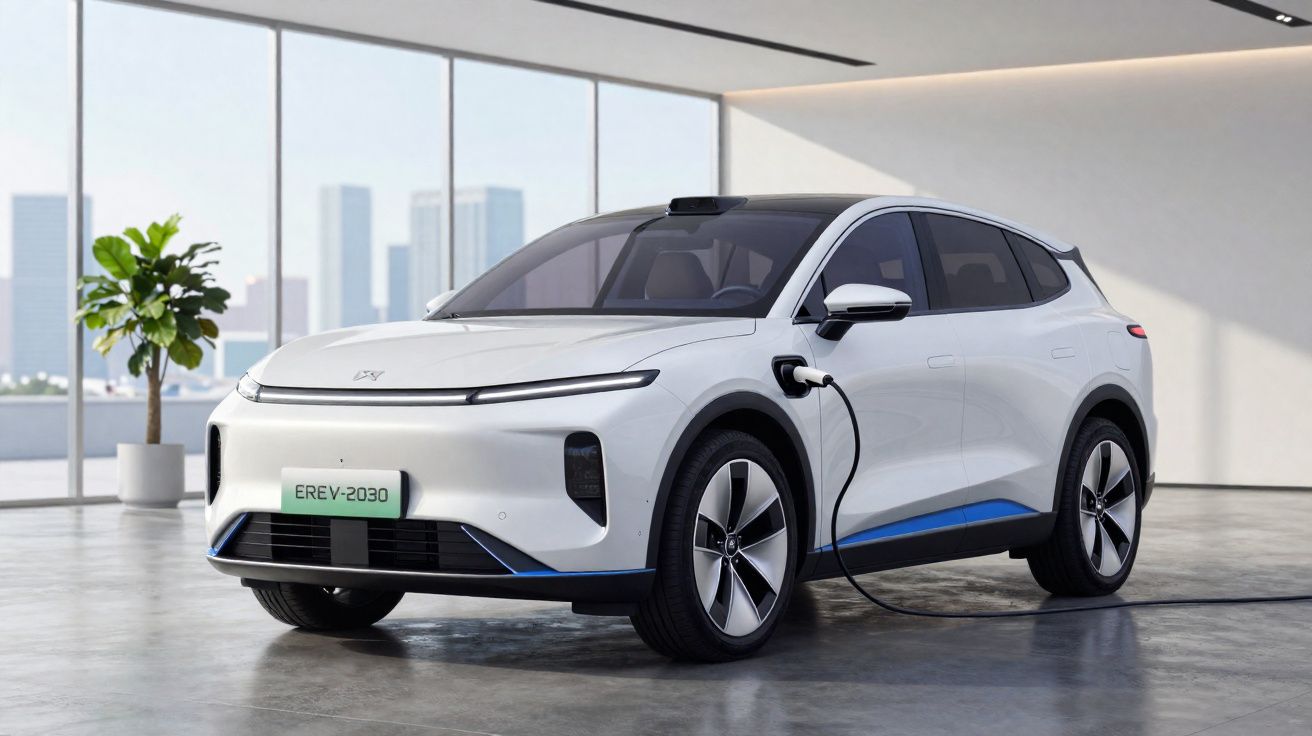
Range anxiety, patchy public charging and ever-tougher emissions rules have created space for a technology many people had written off: the range‑extended electric vehicle - a bridge between full battery power and traditional combustion that is quietly returning to the spotlight.
What a range‑extended electric vehicle (EREV) is in practice
A range‑extended electric vehicle, usually abbreviated to EREV, behaves much like a normal electric car from behind the wheel.
The car is propelled by an electric motor fed by a battery pack, in the same way as a standard EV.
An EREV prioritises electricity: a small petrol engine starts only when the battery is running low, and its job is to generate electricity.
In most cases, real‑world electric range lands at roughly 150–300 kilometres, depending on battery capacity and how you drive.
When the battery charge drops, a compact combustion engine cuts in automatically. The key point is that this engine typically does not drive the wheels. Instead, it works as a generator, sending electricity to the motor and/or topping up the battery. With a full fuel tank, the combined range can climb to around 1,000–1,500 kilometres.
For motorists who regularly rack up long motorway journeys or travel through areas where rapid charging is still scarce, that “keep going” capability can be extremely compelling.
A comeback story: from early misfire to rapid growth in China
The concept itself isn’t new. More than a decade ago, Fisker explored the approach with the Karma, and BMW offered the i3 REx. Both cars drew plenty of attention, but neither turned the configuration into a mass‑market hit.
At the time, charging networks were thin on the ground, batteries were smaller, and the whole idea felt oddly niche - arguably ahead of the infrastructure.
China is where the format truly scaled. A combination of long travel distances, fast urban growth and forceful industrial policy created the conditions for EREVs to move beyond novelty and into the mainstream.
In 2025, Chinese consumers bought roughly 2.4 million range‑extended models, pushing what was once a marginal layout into a major market segment.
Manufacturers such as Li Auto built their brand around the formula, particularly in profitable SUV categories. The pitch was straightforward: electric driving for day‑to‑day city use, plus petrol backup for lengthy holiday journeys - without paying for an ultra‑large battery pack.
Why the United States is warming to EREVs
China’s momentum has been closely watched in the US, where large SUVs and pick‑ups dominate and charging availability can drop sharply once you leave major cities.
One of the clearest signals comes from Scout Motors, a new Volkswagen‑backed brand. Of around 160,000 reservations for its forthcoming off‑road‑styled vehicles, approximately 87% of customers reportedly chose the range‑extender option.
That sort of demand is difficult for American manufacturers to overlook. Ford, Ram, Jeep and Audi are all working on projects that keep electric propulsion at the core, while adding a small petrol engine as a safety net for distance driving or towing.
For a heavy 4×4 that may frequently cross under‑served rural regions, the appeal is simple: charge at home, run on electricity for most of the week, then rely on petrol only when a journey genuinely requires it.
Key reasons buyers are tempted by a range‑extended electric vehicle
- Reduced “range anxiety” on long journeys
- The ability to refuel in minutes at a petrol station
- A lower purchase price than an EV with an exceptionally large battery
- Less dependence on dense, high‑power rapid‑charging networks
- EV‑like driving in town: quiet operation and instant torque
Green concerns: why environmental groups warn of greenwash
While many customers are enthusiastic, climate campaigners are notably more cautious.
Advertising often positions EREVs as “electric cars with a petrol backup used only occasionally”. In practice, emissions outcomes depend heavily on owner behaviour.
If drivers don’t plug in regularly, an EREV can end up operating much like a conventional petrol SUV - only heavier and more complicated.
The NGO Transport & Environment reviewed real‑world usage data for several popular models. Once the battery is depleted and the generator engine is running, average fuel consumption was around 6.4 litres per 100 km, broadly comparable with many conventional combustion vehicles.
If owners charge frequently, petrol use may be confined mainly to the occasional long trip. Without routine charging, however, the car effectively becomes a petrol‑powered heavyweight, hauling a large battery that is rarely used for propulsion.
Engineers disagree on whether the “two‑in‑one” approach is sensible
Among engineers, opinion is split.
Some firms - including Mahle Powertrain - argue that combining a full battery‑electric system with a combustion unit is hard to justify over the long term. In their view, EREVs are a stopgap that will shrink once rapid charging is widespread and battery range improves further.
Running two systems in parallel adds mass, raises costs and increases the number of components that might fail.
Others take a more practical stance. They point out that many drivers - especially outside densely populated centres - still value the certainty of a quick refuel when needed. From this perspective, a small generator engine functions as a convenience feature, smoothing over today’s charging gaps in the way four‑wheel drive or a roof box can make life simpler for certain use cases.
Europe is watching closely - and starting to join the race
Europe currently sits between China’s rapid adoption and America’s cautious ramp‑up.
Public charging is expanding, yet coverage remains uneven: some long‑distance routes are well served, while many rural areas still lag behind. A handful of Chinese‑built range‑extended models are already arriving, giving regulators and buyers a real‑world reference point.
Meanwhile, established groups such as BMW and Volvo, alongside brands like Xpeng, are developing their own interpretations, often with an eye on company‑car fleets where annual mileage can be substantial.
| Aspect | Pure EV | Range‑extended EV | Conventional petrol |
|---|---|---|---|
| Main energy source | Battery only | Battery first, petrol as backup | Petrol only |
| Typical refuelling | Charging point | Charging point + fuel pump | Fuel pump |
| Long‑trip anxiety | High for some drivers | Low, if fuel is available | Low |
| Technical complexity | Medium | High | Low to medium |
Range‑extended electric vehicle running costs, servicing and ownership realities
A practical point that’s easy to miss is that an EREV can change what “maintenance” looks like compared with a BEV. Even if the petrol engine is used infrequently, it is still an engine: it may require periodic servicing, and fuel can go stale if it sits for long periods. Depending on the design, there may also be additional cooling and exhaust components to maintain.
There are also day‑to‑day cost implications. Owners who charge at home overnight can keep most commuting energy on electricity, while those leaning on the generator will see running costs move closer to petrol motoring - with the added weight of the battery affecting efficiency. Warranty terms, residual values and the long‑term health of a battery that is not regularly cycled can all influence the ownership calculation.
How policy and everyday behaviour could determine what happens next
Timing is a major reason EREVs are appearing now. Governments are tightening emissions requirements, yet charging rollout and electricity‑grid upgrades do not always keep pace with ambition.
Manufacturers are under pressure to reduce fleet emissions quickly, without losing customers who are nervous about going fully electric. Range‑extended models can deliver significant “electric miles” in official testing while sidestepping some long‑distance charging pain points.
Even so, real‑world environmental performance comes down to how people actually use the plug.
A nightly‑charged EREV used electrically for most commutes can sharply reduce petrol demand; the same vehicle, if rarely charged, can burn petrol at levels similar to a standard SUV.
Public policy can influence that behaviour. Incentives tied to measured electric usage, dependable workplace charging and smart home‑charging tariffs can all push owners towards using the battery as intended.
Three acronyms people keep confusing: BEV, PHEV and EREV
The terminology around electrified cars is often muddled. Three abbreviations matter here:
- BEV (battery electric vehicle): no engine at all - only a battery and electric motor.
- PHEV (plug‑in hybrid): both the electric motor and the engine can drive the wheels directly.
- EREV (extended‑range electric vehicle): the wheels are driven only by the electric motor; the engine operates as a generator.
In everyday driving, a PHEV may swap frequently between engine and motor. An EREV tends to feel closer to a pure EV, with the petrol unit running more steadily in the background when it needs to generate electricity.
What it might mean for an ordinary household
Imagine a family based in a small town, commuting 40 km each way and making a few trips each year to see relatives several hundred kilometres away.
With an EREV offering around 200 km of electric range, most working days could be completed entirely on battery power, topped up overnight at home. Over a year, electric kilometres would account for the bulk of travel.
On holiday runs, once the battery is low, the generator engine would start and keep the car moving without having to hunt for rapid chargers near busy motorways. Petrol use wouldn’t disappear, but it could be far lower than relying on a conventional petrol SUV for every trip.
For that household, the big trade‑off is whether the added complexity and cost make sense compared with choosing a simpler EV with a larger battery. The answer depends on home‑charging prices, the reliability of local public chargers and how future policies treat fossil fuels.
Risks, benefits and what could shift the balance
The advantages are clear: reduced range anxiety, an easier transition for drivers accustomed to petrol stations, and potentially less demand for battery materials than building very long‑range EVs.
However, the risks are real too. Car makers could treat EREVs as a comfortable halfway point, slowing investment in charging networks and pure electric programmes. Some owners may treat charging as optional, undermining emissions goals.
As rapid charging becomes more widespread and grids are upgraded, the argument may move steadily towards simpler, fully electric vehicles. Until that happens at scale, range‑extended electric vehicles are likely to keep appearing in showrooms and on order lists - parked firmly in the grey area between yesterday’s combustion habits and a truly all‑electric road system.
Comments
No comments yet. Be the first to comment!
Leave a Comment