
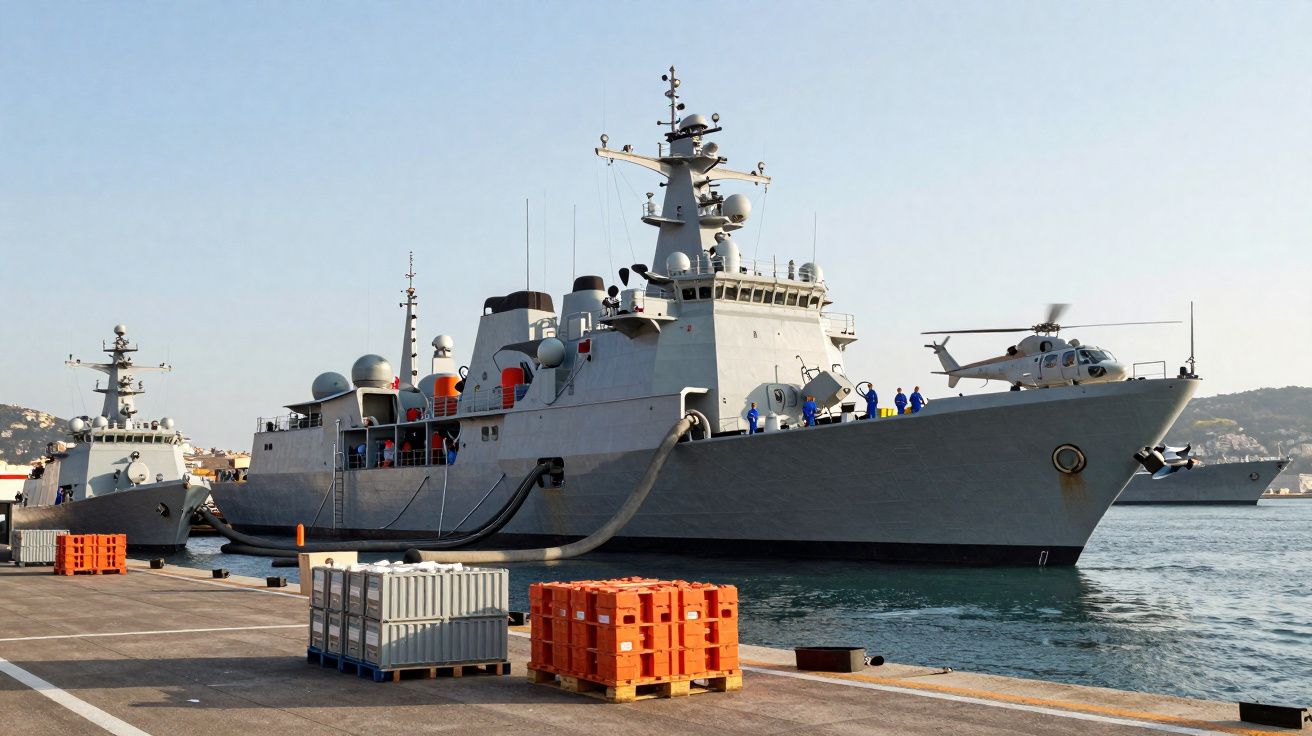
Off Toulon, a vast grey shape has slipped into active duty with little fanfare-built not to trade blows, but to keep others in the fight.
France has commissioned a new generation of support ship: a 31,000‑tonne heavyweight intended to keep carrier groups fuelled, armed and stocked for weeks at a time far from home-reshaping how Paris sustains sea power.
Why fleet support ships matter more than most people think
Warships make the headlines; tankers and supply ships rarely do. Yet again and again in naval history, forces with impressive firepower have stalled simply because they ran short of fuel, food or munitions at the worst moment.
In a crisis in the Baltic, the eastern Mediterranean or the Indo‑Pacific, a French or allied task group may need to remain at sea for weeks, well away from any friendly harbour. A large replenishment vessel can shuttle between the force and a secure logistics hub, extending operations without forcing front‑line ships to peel away for resupply.
There is a downside: a support ship is a high‑value target. Disabling it can paralyse a task group without ever taking on the aircraft carrier or destroyers directly. That is why modern replenishment vessels place heavy emphasis on self‑defence, electronic warfare, decoys and tight coordination with escorts.
A discreet giant arrives in Toulon: BRF Jacques Stosskopf joins the fleet
On 31 July 2025, the fleet replenishment vessel BRF Jacques Stosskopf anchored off Toulon after sea trials, drawing little public attention. Measuring 194 metres and displacing 31,000 tonnes, she now takes her place alongside her sister ship, Jacques Chevallier, which was delivered in 2023.
Together, these two large ships signal a renewal of French naval logistics, replacing the ageing Durance-class tankers that dated back to the Cold War. On paper, the shift can look like a technical upgrade; for French admirals, it is operationally decisive-without fuel and ammunition at sea, even the most advanced combatants become little more than costly steel hulls.
Jacques Stosskopf gives French and allied warships the ability to remain on station for weeks, without relying on a friendly port.
With the aircraft carrier Charles de Gaulle and numerous French destroyers and frigates based at Toulon, the port is the obvious home for the first pair of these new support vessels. Two additional ships are earmarked for Brest on the Atlantic coast by 2030, ensuring that both of France’s principal maritime approaches have a dedicated logistics backbone.
A Franco-Italian bet on shared naval power through FLOTLOG, OCCAR and Fincantieri
Jacques Stosskopf was not conceived from scratch. It is the French adaptation of an Italian design derived from the replenishment oiler Vulcano. Under the joint FLOTLOG programme, Paris and Rome agreed to share design work and certain components, while still customising each ship to meet national requirements.
The programme is managed via OCCAR (a European defence procurement organisation), with Italy’s Fincantieri leading industrial work on the design. For both navies, the arrangement strengthens Europe’s shipbuilding base and avoids each country paying alone for a one-off, bespoke vessel.
Four French ships are planned-two based in Toulon and two in Brest-giving France an enduring logistics presence in both the Mediterranean and the North Atlantic.
The collaboration is also overtly political. By fielding a modern class of large support ships, France underlines its intent to remain among the small group of nations able to deploy a carrier strike group, amphibious forces and escorts at range-without needing to ask others for fuel or stores.
A further, less visible benefit is fleet standardisation: shared design choices and common components simplify support, training and upgrades across a class, which matters when ships are expected to deploy frequently and remain relevant well into the 2030s and 2040s.
Inside a 31,000‑tonne logistics machine
The label “replenishment vessel” is understated. Jacques Stosskopf is effectively a floating fuel depot, warehouse and compact workshop housed within a single hull.
- Up to 13,000 m³ of fuel (naval diesel and aviation kerosene)
- Around 1,500 tonnes of solid cargo (ammunition, spare parts, food, humanitarian aid)
- High‑throughput transfer systems: roughly 1,200 m³ of fuel per hour while underway
- Diesel‑electric propulsion producing 24 MW and speeds of about 20 knots
During replenishment at sea, the ship steams alongside a frigate, destroyer or the aircraft carrier. Hoses are passed across using tensioned cables and fuel is pumped at high rate as both ships maintain course and speed. Solid stores can be moved by cranes and palletised loads, and helicopters can also shift cargo between decks when required.
The hull incorporates a double bottom and side protection, meeting stricter environmental expectations and lowering the risk of pollution if an accident occurs-an especially important safeguard when operating in sensitive waters or near vulnerable coastlines.
In day-to-day terms, the ship’s ability to combine liquid fuel, aviation fuel and solid stores in one platform reduces the number of separate logistics movements a task group needs, which helps sustain tempo and limits exposure to hostile surveillance.
More than a floating petrol station
Although first and foremost a support ship, Jacques Stosskopf is fitted with a contemporary combat system. The Polaris system, paired with a Terma Scanter 6002 surveillance radar and Safran Paseo XLR electro‑optical sensors, provides the crew with a detailed picture of air and surface activity nearby.
This allows the ship to cue and control its own close‑in defensive weapons, exchange tracks with allied units and contribute to the task group’s wider situational awareness. In lower‑threat settings, that reduces dependence on escorts; in a structured naval formation, it makes the ship a useful node in the group’s sensor network.
Equipped mainly for self‑protection and surveillance, the ship is intended to endure in contested waters long enough to keep the fleet supplied.
Backbone of expeditionary forces (NATO and EU interoperability, EMCON)
The new BRFs are not limited to national use. Built to NATO and EU interoperability standards, they can refuel allied warships. European frigates, US destroyers-and, in principle, even non‑NATO partners-could come alongside for fuel and supplies, subject to political decisions.
Dedicated spaces are set aside for an embarked staff, allowing the vessel to act as a temporary command node during multinational deployments. Onboard workshops and specialist teams can also repair equipment and support the upkeep of helicopters and small craft.
The ship is additionally able to operate in EMCON (emissions control) profiles, reducing its radar and radio output. That matters increasingly as adversaries refine their ability to detect, track and target forces by electromagnetic signature-an issue at the forefront of any high‑end maritime conflict.
Key dates and ships in the French BRF programme
| Ship | Delivery | Home port | Status |
|---|---|---|---|
| Jacques Chevallier | 2023 | Toulon | Operational |
| Jacques Stosskopf | Late 2025 | Toulon | Being accepted into service |
| Émile Bertin | Early 2030 | Brest | Under construction |
| Gustave Zédé | Before 2031 | Brest | Planned |
This four‑ship package sits at the centre of France’s latest military spending law, which explicitly targets the preservation of “maritime sovereignty” and freedom of action. The older replenishment ships lacked the capacity, survivability and endurance increasingly expected for operations near contested areas or across the Indo‑Pacific.
By renewing its support fleet, France keeps its aircraft carrier and escorts credible tools for long‑range operations well into the 2030s and 2040s.
Preparing for a new generation of carrier groups
The schedule is deliberate. France is developing its next‑generation aircraft carrier to replace Charles de Gaulle in the 2030s. A larger, more capable carrier operating heavier aircraft will demand more fuel, more munitions and a greater volume of spare parts.
Jacques Chevallier, Jacques Stosskopf, Émile Bertin and Gustave Zédé are being built with that future in mind. Their design anticipates higher replenishment throughput, more demanding aviation fuel requirements and the expanding logistics footprint of modern, networked combat ships.
They are also shaped for so‑called hybrid conflicts, where conventional naval engagements sit alongside cyber attacks, GPS jamming, drone swarms and information warfare. In that kind of cluttered environment, logistics ships that combine resilience, discretion and strong situational awareness become pivotal.
From peacetime missions to high-end conflict
In peacetime, a ship like Jacques Stosskopf can underpin humanitarian assistance and disaster relief. Its fuel, fresh water production, cargo space and medical facilities can support relief efforts near damaged coastal areas-particularly where port infrastructure is degraded or unusable.
In a high‑end conflict, the same attributes take on a harsher purpose. Several replenishment ships could rotate between a distant theatre and a secure base, forming a sea‑based “logistics bridge”. If one vessel is forced to withdraw, others can keep the chain functioning, allowing the carrier group to hold position rather than retreating to resupply.
Two concepts drive the logic of such ships: endurance and autonomy. Endurance is how long a task group can stay deployed without major support from land. Autonomy is the political and military freedom to operate without depending on another nation’s ports or tankers. Jacques Stosskopf strengthens both-not only for France, but for any coalition Paris chooses to support.






Comments
No comments yet. Be the first to comment!
Leave a Comment