
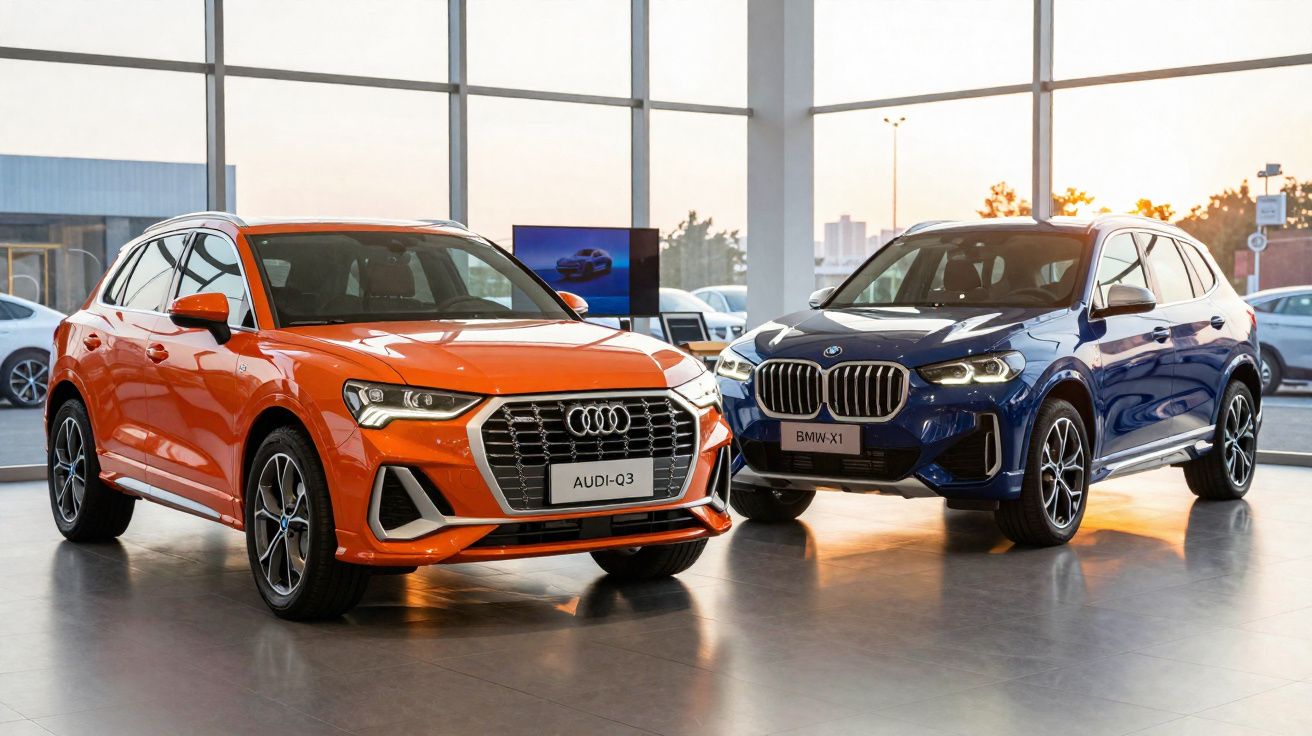
The idea of €50,000 sounds like no-compromise luxury-yet in reality, at this price point every centimetre of space, every tick-box option and every litre of fuel still matters.
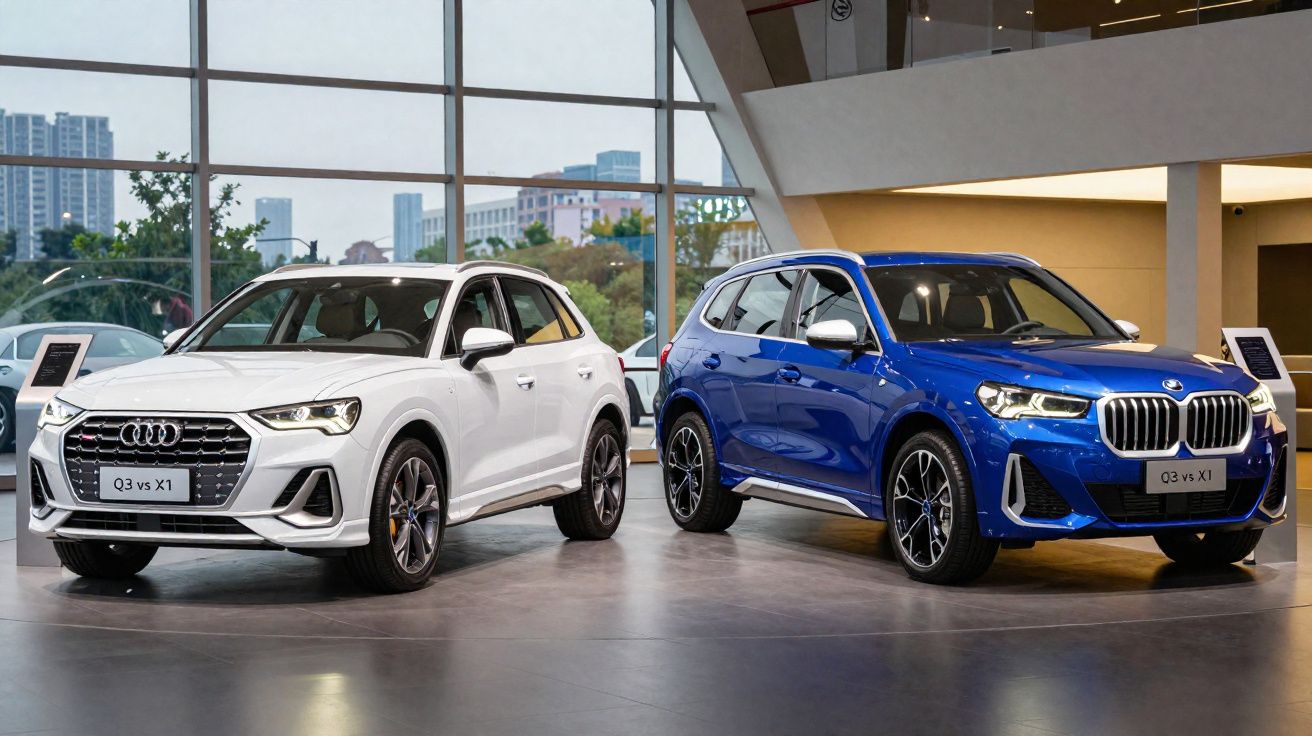
For 2026, many buyers end up weighing up a deceptively tricky choice: a new Audi Q3 with a 150 PS petrol engine versus a BMW X1 with a 170 PS three-cylinder. Both target the same compact-SUV audience and both sit around the same money, but Audi and BMW pursue noticeably different strategies once you look beyond the headline figures.
The €50,000 price band: how closely matched the Audi Q3 and BMW X1 really are
In its third generation, the Audi Q3 starts in Design trim with the 150 PS TFSI and mild-hybrid tech from €43,850. In the test configuration, however, Audi pushes it into the sportier S line look-and at that point it lands at around €50,000 before adding any extras.
BMW positions the X1 sDrive20i with its 170 PS three-cylinder higher from the outset: €50,900 in M Sport trim. On paper it is the pricier car versus a similarly focused Q3, yet the standard equipment quickly makes it feel more upmarket for the money.
In day-to-day reality, the cars’ personalities are shaped less by list price and more by how Audi and BMW handle trim levels and optional equipment.
That difference becomes obvious with the test cars. The Audi Q3 keeps its options bill relatively restrained at €3,100-paint, larger wheels, a black styling pack and privacy glass largely account for it.
The BMW X1, by contrast, shows how quickly a configurator can snowball: €14,750 of options including electrically adjustable seats, a panoramic roof and a heated steering wheel. That pushes the X1 close to €65,000-but it also genuinely delivers a cabin that feels “a class above”.
Cabin and everyday use in the Audi Q3 and BMW X1: where “premium” actually shows
Materials and atmosphere: which one feels more expensive?
Inside the Audi Q3, the overall impression is sturdy and neatly finished, but also slightly plain. The test car in S line relies largely on cloth upholstery: perfectly acceptable in quality, yet not particularly special to look at. Simple-looking trim pieces reinforce that functional, no-nonsense feel.
In M Sport, the BMW X1 leans harder into visual drama: Alcantara seats with blue stitching, matching interior inlays and a sportier steering wheel. Importantly, many of these touches are part of the M Sport specification rather than costly add-ons.
Even without spending heavily on options, the X1 gives the impression of stepping into a higher-priced class-whereas the Q3 comes across as competent rather than covetable.
Controls and infotainment: screen size versus usability
The Audi takes a clear win with its central touchscreen. It responds more quickly, the layout feels more coherent, and it is less of a maze. Core items-driving modes, assistance systems and navigation-are easy to find and adjust without hunting.
BMW counters with a modern, large display, but sometimes makes simple tasks harder than they need to be. The menu structure can feel overloaded, with key functions buried in sub-menus. One particularly odd quirk: the “Personal” drive mode offers surprisingly limited customisation, while “Sport” allows more nuanced tweaks-for example to steering weight or stability-control settings.
Space: rear-seat comfort versus boot capacity
Both SUVs offer a sliding rear bench, allowing you to trade legroom for luggage space depending on the day. With the bench pushed fully back, the BMW X1 provides slightly better knee room-especially welcome for taller passengers on longer journeys.
When it comes to the boot, the advantage flips the other way:
- Audi Q3: 550 litres
- BMW X1: 466 litres
If you regularly need to load a pushchair, a dog crate or holiday luggage, that gap is hard to ignore. The Q3 simply swallows more without immediately resorting to folding seats.
In everyday life, the X1 feels like the more refined lounge, while the Q3 behaves like the more useful storage space at the back.
Even so, the overall “living with it” score still tilts towards BMW here: the X1’s cabin ambience and perceived quality come through strongly, even without an all-out options spend.
Engines and driving feel: three-cylinder BMW X1 versus four-cylinder Audi Q3
Engine character and refinement
On paper, the BMW X1 appears to be at a disadvantage: it uses a 1.5-litre three-cylinder, while the Audi Q3 runs a 2.0-litre four-cylinder. For many buyers, “four cylinders” still sounds automatically more refined.
From cold, the BMW does briefly sound like a typical three-cylinder-slightly gruff in tone. That impression fades within seconds, and in normal driving the X1 actually comes across as better insulated and quieter overall than the Q3.
Press the accelerator harder and the three-cylinder becomes more audible again, but it also feels keener to rev and noticeably more lively. The Audi unit, by comparison, builds speed in a more linear, restrained way-competent, but less animated.
Key performance figures compared
| Model | Power | Cylinders | Character |
|---|---|---|---|
| Audi Q3 TFSI 150 | 150 PS (approx. 148 bhp) | 4 | Very linear, unobtrusive |
| BMW X1 sDrive20i | 170 PS (approx. 168 bhp) | 3 | Punchier, more eager to rev |
In measured acceleration, the BMW pulls away clearly: over the standing-start kilometre, the X1 is almost two seconds quicker than the Q3. It is also more responsive in rolling acceleration, which you feel when overtaking on A-roads or merging onto a motorway.
Each time you lean on the throttle, the X1 feels more alert, more immediate and more efficient-while the Q3 comes across more like a good-natured cruiser.
Suspension, comfort and grip
Both test cars run on 19-inch wheels, and neither is fitted with adaptive dampers. Around town, both the Q3 and X1 feel on the firm side, with sharp edges and potholes making themselves known.
As speeds rise, the differences become clearer. The BMW X1 does a better job of smoothing out imperfections and feels calmer on the motorway while still remaining tightly controlled. The Audi Q3 stays safe and predictable, but it feels less polished and lets more of the road surface through.
Tyres also play a part. The X1 wore Pirelli P Zero tyres and delivered strong traction, particularly in the wet. The Q3 on Bridgestone Turanza tyres was more likely to relinquish grip on damp roads, especially when accelerating hard out of corners.
One area where the Audi hits back is braking: from higher speeds, the Q3 bites harder and inspires plenty of confidence through the pedal.
Budget reality: options, taxes and running costs
The configurator trap
With both models, the final bill can climb dramatically. A particularly extreme example comes from a long-term test Audi Q3: loaded with extra equipment, its price rose to €82,320, enabled by more than €20,000 in options.
On the BMW X1, the options list seems to top out at around €15,000-still a significant amount, but more contained. For both cars, the principle remains the same: even everyday conveniences such as keyless entry or push-button start-features that can be standard on cheaper brands-often cost extra here.
If you tick boxes without a plan, both the Q3 and X1 can quickly end up priced where a well-equipped executive car used to sit.
Fuel use, CO₂ and range
On CO₂ emissions, the Audi sits above the BMW. In some markets that can trigger a higher tax penalty at purchase, nudging long-term costs slightly against the Q3 even if the gap is not huge.
Real-world fuel consumption also favours the X1 by a small margin across town driving, A-roads and motorway work. The Audi consistently needs a little more fuel. Ironically, the BMW has the smaller fuel tank, which caps range-but it can still manage around 650 km between fill-ups before you need to stop.
A UK buyer’s extra reality check: servicing, insurance and resale
Beyond fuel, it is worth planning for the ownership costs that rarely show up in a quick comparison. In the UK, insurance groupings, tyre replacement costs for 19-inch fitments and the price of manufacturer servicing plans can shift the monthly running-cost picture more than many expect.
Residual values also matter in this segment. Highly optioned cars may be easier to sell, but they do not always return anything close to what the options cost new-so choosing the right trim line (such as S line or M Sport) can be a smarter way to secure desirability without over-investing in extras.
Strengths and weaknesses at a glance
BMW X1 sDrive20i M Sport - where it shines
- Strong comfort levels, especially at higher speeds
- High-quality cabin feel, particularly in M Sport
- Generous rear-seat legroom
- Lively engine with clearly noticeable mild-hybrid assistance
BMW X1 sDrive20i M Sport - where it irritates
- Complicated operating logic with menus that can be hard to navigate
- Three-cylinder sound at cold start and under full throttle
- Digital instruments with a design that takes getting used to
Audi Q3 TFSI 150 S line - its key upsides
- Excellent infotainment with smooth, intuitive operation
- Larger, more usable boot for everyday life
- Strong, confidence-inspiring braking feel, particularly from higher speeds
Audi Q3 TFSI 150 S line - where it falls short
- Noticeably weaker performance than the X1
- Instrument cluster feels relatively narrow
- Firm ride at low speeds is hard to ignore
Which SUV suits you best in 2026?
If you prioritise driving enjoyment, comfort and a more premium-feeling cabin, the BMW X1 is the more complete blend. It is the more dynamic car, it feels pricier inside, and it is a touch easier on fuel.
The Audi Q3 makes more sense for buyers who frequently carry bulky luggage, want an infotainment system that is clear and logically laid out, and appreciate strong braking confidence. Its personality is more understated-almost conservative-and for some people that restraint is exactly the appeal.
Overall, the BMW X1 (2026) comes across as the more convincing all-round package, while the Audi Q3 wins through specific strengths such as luggage capacity and user-friendly controls.
How to avoid the wrong buying decision
Configurators, brochures and YouTube videos only tell part of the story. With cars like the Q3 and X1, a back-to-back drive on roads you know is genuinely worthwhile: a potholed urban section, a faster motorway stretch and a twisty A-road quickly reveal how the engine, suspension and noise levels work together.
It also helps to picture your real routines. Is the car often loaded with two adults and lots of holiday luggage? Or is there almost always a teenager in the back with a sports bag? Honest answers make it clear whether the Q3’s bigger boot or the X1’s roomier rear seating is the better fit.
Finally, be realistic about your tolerance for in-car tech. If layered menus annoy you quickly, you will likely feel more at home with Audi’s system. If you prefer a more futuristic cockpit and can accept a longer learning curve, BMW’s approach may suit you.
By 2026, both are highly developed compact SUVs. The BMW X1 plays its strongest cards in driving feel, comfort and perceived quality, while the Audi Q3 responds with practicality and ease of use. The X1’s clearer win in this comparison does not make the Q3 a poor choice-it simply means your priorities need to be very clear before you sign.


Comments
No comments yet. Be the first to comment!
Leave a Comment