
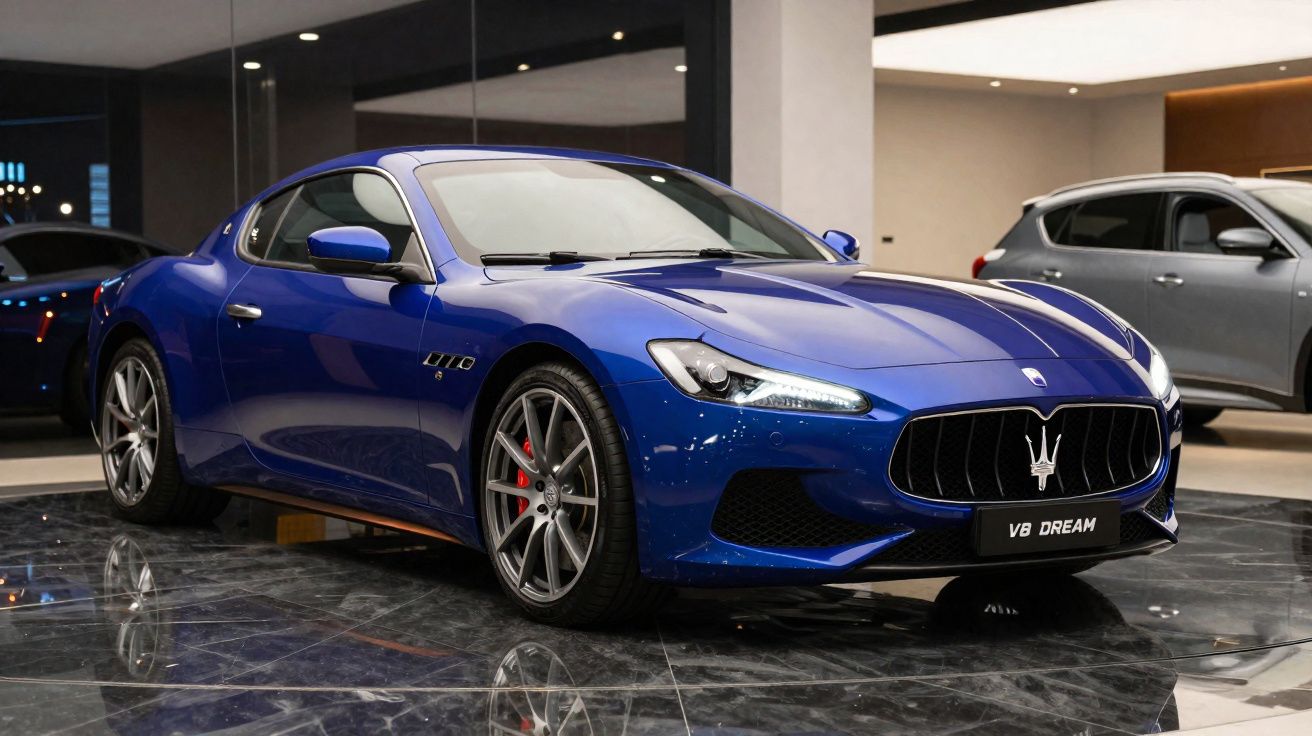
On Europe’s used-car market, Maserati GranTurismo models are now appearing for less money than a well-specified new Dacia Duster. It sounds like pub talk, yet it can be traced back to a specific listing-and it underlines just how savagely high-end cars can depreciate.
A Maserati GranTurismo at Dacia Duster money
The example causing the stir is a 2009 Maserati GranTurismo advertised at €24,990-roughly the same bracket as a new, sensibly configured Dacia Duster. In this price range, most brand-new compact SUVs offer a little over 130 bhp and a cabin dominated by hard plastics, rather than 400+ bhp and leather trim.
A luxury coupé that once sat around the €100,000 mark can fall to the price of an honest everyday SUV-and it’s easy to see the temptation.
When the GranTurismo first went on sale, it carried a price tag well above €100,000. That gap between new and used values illustrates, in the clearest possible way, how brutal depreciation can be for powerful luxury machines. For buyers who love rare and emotional cars, it creates a brief opportunity: you can shop in a budget normally reserved for entirely different vehicle categories.
Pininfarina styling rather than plastic appeal
Among 2000s coupés, the Maserati GranTurismo remains one of the most recognisable shapes. Penned by Pininfarina, it leans heavily into traditional Italian proportions: a long bonnet, a flowing roofline and broad rear shoulders. Where today’s SUVs prioritise practicality, the Maserati is designed for theatre-often the best moment of the drive is the glance back after you’ve parked and walked away.
This particular car is also said by the seller to be largely in original condition. Many GranTurismo examples have picked up loud, non-approved exhausts or visual modifications over the years. If you prefer the clean, classic look, an unaltered starting point is a meaningful plus.
A bold colour combination instead of everyday grey
The listed car wears a dark red exterior, matched with a beige interior and red accents. It stands out from the black/grey/silver palette that dominates most used listings. It may feel braver for daily use, but for an emotive grand tourer it suits the character.
- First registered: 2009
- Price: €24,990
- Mileage: 99,000 km
- Exterior colour: dark red
- Interior: beige with red detailing
Ferrari-developed V8 power under the bonnet
What makes the GranTurismo compelling sits up front. Maserati fitted a 4.2-litre naturally aspirated V8, developed with Ferrari in Maranello. Output is 405 bhp with 460 Nm of torque. The engine shares its underlying DNA with Ferrari units from that era, but it was tuned to fit the GranTurismo brief: eager revs and a distinctive soundtrack, while still being capable of covering long distances in comfort.
A Ferrari-developed V8 in everyday use is something you almost never see at this sort of asking price.
A later 4.7-litre variant arrived with more performance, yet the philosophy stayed the same: a high-revving, naturally aspirated V8 instead of a turbocharged downsized engine. That layout remains highly valued by enthusiasts thanks to its crisp throttle response and the kind of sound modern turbo engines rarely replicate.
How robust is it in the long run?
Among people who know these cars, the V8 has a reputation for handling very high mileages when it is serviced correctly. Seeing GranTurismos with 100,000–200,000 km is not unusual-provided oil changes have been done on schedule and routine servicing hasn’t been postponed.
On early cars, the bigger talking point tends to be the gearbox choice. Some of the first models used a sequential automated manual that can feel harsh and has, in certain cases, caused headaches. From 2009, Maserati moved to a conventional ZF six-speed automatic, widely regarded as more durable, smoother in traffic and better aligned with the relaxed grand-touring nature of the car.
The catch: inspection, taxes and the true cost of ownership
The low headline figure comes with a condition attached. This GranTurismo started life in Dubai and was imported to Germany later on. The seller states that taxes and duties have been paid, but the car is offered without a current German roadworthiness certificate (MOT-style inspection) and without registration. Organising the inspection is therefore down to the buyer.
Without a fresh roadworthiness pass, the price drops noticeably-but the risk rises that hidden problems only show up at the test centre.
The dealer’s view is that this detail alone pulls the car around €5,000–€7,000 below typical German-market pricing. The deal does include four new tyres, and delivery to the buyer is available if requested. Even so, the next owner should budget for workshop time-and accept the uncertainty of what an inspector may find.
What does a Maserati GranTurismo cost to run day to day?
The purchase price is only the entry fee. After that comes the reality check. A V8 Italian coupé demands more attention-and more money-than an inexpensive, sensible SUV.
| Item | Likely ballpark | Notes |
|---|---|---|
| Comprehensive insurance | much higher than a Dacia | power output, vehicle value and country of origin can affect premiums |
| Servicing | high hundreds to low thousands | specialists often required; genuine parts can be expensive |
| Fuel consumption | often 15 litres/100 km or more | higher again with enthusiastic driving |
| Wear items | brakes, suspension and tyres can be very costly | wide sizes and high-performance components |
Tyres and brakes, in particular, can push running costs sharply upwards. The GranTurismo typically runs very wide, low-profile tyres, and a quality branded set can quickly land in the four-figure territory. Frequent urban driving can also accelerate brake wear.
Who a Maserati GranTurismo makes sense for
If you’re shopping for a new Dacia Duster or another sensible car, you’re usually prioritising predictable fixed costs, warranties and uncomplicated everyday use. A used Maserati GranTurismo speaks to a different kind of buyer-someone willing to step outside their comfort zone and allocate part of their budget to emotion rather than pure logic.
High-mileage motorway drivers or commuters covering long distances can quickly run into fuel and vehicle-tax figures that are difficult to justify with a V8. By contrast, as a weekend car or second vehicle doing only a few thousand kilometres a year, the costs become easier to control.
- Leisure drivers with a garage and access to an independent sports-car workshop
- Collectors chasing an iconic 2000s design
- Car enthusiasts deliberately choosing character over a new but emotionally bland SUV
Risks to understand before you book a test drive
Anyone seriously considering a GranTurismo should clarify a few basics upfront. A complete service history from Maserati or a recognised specialist is vital. If stamps and invoices are missing, there’s a real chance expensive maintenance has been deferred-and a “bargain” can turn into a financial trap.
Imports deserve extra scrutiny too. Checking the underside, electrical systems and signs of corrosion is sensible. Cars from very hot climates are often relatively light on rust, but heat and sand can leave different kinds of ageing, such as faded interior materials or plastics that have become brittle.
Scenario: Maserati instead of Dacia - a quick back-of-the-envelope
Consider a hypothetical buyer planning to spend about €25,000 on a new Dacia Duster, perhaps on finance or lease, with warranty cover included. Instead, they buy the Maserati GranTurismo for the same upfront money, paying cash and accepting there is no warranty. In year one, the luxury coupé might realistically bring:
- Major service (oil, filters, spark plugs): €1,200–€2,000
- Insurance uplift versus a Dacia: €500–€1,000
- Higher annual vehicle tax due to the large V8: several hundred euros
- A contingency fund for surprises: sensibly another €1,000–€2,000
In return, the driver gets a car capable of delivering that special, spine-tingling feeling on every outing-while giving up factory warranty protection, low operating costs and the reassurance that any small garage will have the right parts on the shelf.
Two extra realities buyers should factor in
First, specialist support matters. Even when a GranTurismo is mechanically healthy, you’ll typically want a workshop that understands the model-particularly for diagnostics, suspension work and sourcing the correct parts. Planning ahead (and knowing where your nearest specialist is) can make ownership far more enjoyable.
Second, think about exit strategy. Depreciation is the reason the car looks so tempting today, but future resale will still depend heavily on condition, evidence of proper servicing, and whether the car remains close to standard specification. Keeping paperwork organised and avoiding questionable modifications can protect value in a way that spreadsheets rarely capture at purchase time.
Why the used market has shifted this way
Several forces are helping create deals like this. New cars-even in entry-level segments-keep getting more expensive as safety tech, driver aids and emissions requirements push prices upward. At the same time, high-CO₂, high-capacity petrol cars are losing mainstream appeal in many countries because taxes and restrictions can make daily use harder to justify.
Luxury coupés such as the Maserati GranTurismo therefore end up in a narrow niche: too thirsty for rational buyers, too exotic for fleets, and too impractical for families. Inside that niche, enthusiasts can take advantage-driving a Maserati V8 while, next door, someone collects a brand-new Dacia from a showroom.
Anyone choosing this route should do the maths with a clear head-and also accept that not every decision can be reduced to a spreadsheet. A Ferrari-developed V8 at Dacia Duster money simply plays by different rules than a three-cylinder compact SUV with a warranty booklet.


Comments
No comments yet. Be the first to comment!
Leave a Comment