
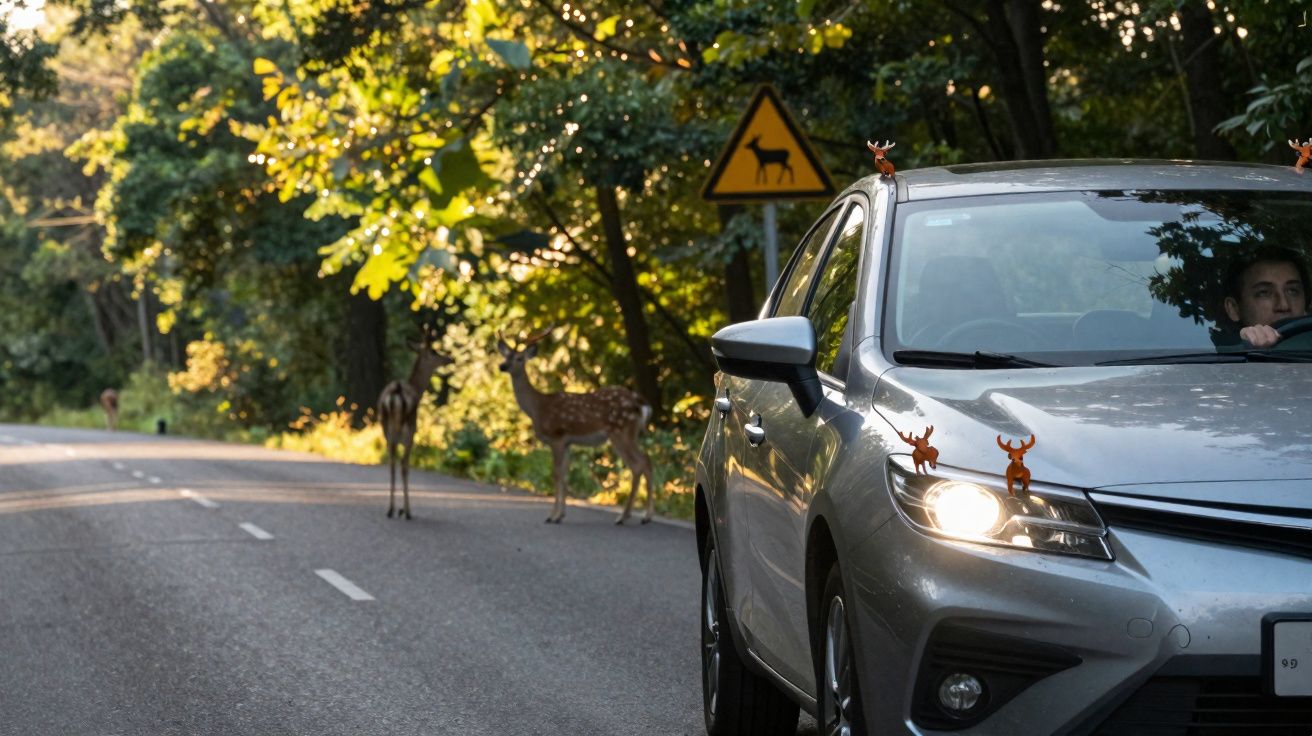
Driving rural roads at first light or at dusk often comes with an uneasy thought: at any moment a roe deer or stag could appear in front of the car as if from nowhere. For years, one supposedly simple fix has been doing the rounds: cheap deer whistles fitted to the front of the vehicle, said to warn animals in time. But do these mini-gadgets actually deliver on their promises - or are they simply overpriced plastic superstition?
How deer whistles are meant to work
These small attachments typically come as two black or clear plastic tubes that you stick to the front of the car - often using nothing more than an adhesive pad. Once you reach roughly 50 km/h, air is forced through the openings, and manufacturers claim this produces special high‑frequency tones that animals can hear but humans cannot.
The idea is that an invisible “warning belt” travels ahead of the car and drives wildlife away before it steps onto the road.
Sellers commonly quote frequencies of around 16–20 kilohertz, which sits right at the upper edge of human hearing. Roe deer and red deer are said to be far more sensitive in this range. Some versions combine a steady note with a fluctuating one, supposedly to stop animals becoming accustomed to the sound.
The appeal for drivers is obvious:
- Often priced at just £5–£15 per pair
- Can be fitted in seconds, with no tools
- Creates the reassuring feeling that you’ve “done something” to prevent wildlife collisions
If you commute through wooded areas, it’s easy to see why people try them. However, while the marketing is confident, the scientific evidence is decidedly underwhelming.
What studies actually say about deer whistles
Over many years, several universities and transport authorities in the United States and other countries have tested these whistles. The approach is usually similar: compare vehicles equipped with deer whistles against those without, analyse collision figures, and observe wildlife responses in controlled settings.
The overall conclusion is consistent: the data provides virtually no meaningful indication that deer whistles prevent collisions. In one frequently referenced investigation covering thousands of miles of driving, crash rates for cars with whistles and cars without were almost identical.
| Study measure | Vehicles with whistles | Vehicles without whistles |
|---|---|---|
| Collisions per 100,000 miles | 3.2 | 3.1 |
| Visible animal reaction | 12% | 11% |
| Effective “warning distance” | under 3 metres | - |
Researchers specialising in acoustics highlight further problems: the whistles are simply too quiet, their tones are masked by a car’s own wind noise, and the sound dissipates rapidly into the surrounding air.
Measurements show the whistle noise is often only detectable a few metres in front of the vehicle - far too little distance for animals to respond in time.
On faster roads in particular, the combined noise of engine, tyres, and oncoming traffic overwhelms any faint high-frequency signal. What may be measurable under laboratory conditions is, in real life, like trying to hear a whisper in a gale.
Deer biology versus plastic: why roe deer react differently than expected
Manufacturers often point to deer having better hearing than humans. It’s true that deer can detect higher frequencies. But the critical question isn’t whether a sound is theoretically audible - it’s how loud it is when it reaches the animal, and whether it carries any meaning.
Several factors work against the hoped-for effect:
- The whistles produce very low sound levels.
- High-frequency sound is heavily damped by air and vegetation.
- Deer are often distracted by stressors (foraging, avoiding predators, rutting season) and filter out background noise.
- Wild animals can habituate to repeated sounds and eventually stop responding.
Wildlife biologists observing roadside behaviour frequently report that deer in busy areas largely ignore vehicle noise. Anyone who drives the same forest edge regularly will have seen it: animals sometimes stand at the verge while cars stream past. Against that backdrop, an extra whistle can easily become just another meaningless sound.
Common driver misconceptions
After fitting deer whistles, some drivers place more trust in the gadget despite the lack of proven benefit. That can lead to dangerous assumptions:
- “I’ve got whistles, so I’m safer” - and you unknowingly drive a little faster.
- “The animals will hear me in time” - and you stop anticipating sudden jumps into the road.
- “There’s a warning sign, but I’ve got whistles” - and you don’t slow down enough.
In many cases, deer whistles create a false sense of security rather than genuine protection.
If that false reassurance delays your reaction by even a single second, the consequences can be severe. At 80 km/h, a second is the difference between a near-miss and a serious collision.
What genuinely reduces the risk of wildlife collisions
Rather than relying on plastic whistles, road-safety specialists recommend a blend of driver behaviour, vehicle technology, and infrastructure. Three measures stand out.
1. Reduce speed in wildlife crossing areas
The most effective “technology” is still your right foot. In known wildlife crossing zones - indicated by warning signs or by dense woodland immediately alongside the road - lowering your speed buys precious reaction time. Dropping by just 10–20 km/h can substantially shorten stopping distances and dramatically reduce impact energy.
- At 80 km/h, braking distance on a dry road is roughly 57 metres.
- At 60 km/h, it falls to around 35 metres.
Driving more slowly also makes it easier to spot reflective eyes or movement at the roadside and to ease off the accelerator early.
2. Use your eyes and lights properly
The next big lever is attention. At dusk and at night, keep actively scanning the verges, not only the centre of your lane. Where there is no oncoming traffic, main beam and modern LED headlights can help you pick up animals sooner.
Key rules to follow:
- Dip your headlights if a deer is directly ahead, as dazzling it can make it appear to “freeze”.
- Briefly dip and sound the horn to encourage the animal to move away.
- Assume there may be more animals behind the first, particularly with roe deer and wild boar.
3. Use modern driver-assistance systems sensibly
Newer vehicles increasingly offer night-vision systems, forward cameras, and automatic emergency braking. Some manufacturers have tuned these systems specifically for larger wildlife. In tests, they have avoided collisions or at least significantly reduced impact speed.
They are not magic: wet leaves, snow, tight bends and other conditions can limit sensors. Combined with appropriate speed, though, they can measurably improve your odds - unlike simple clip-on whistles.
What to do if you hit an animal anyway
Even with the greatest care, not every collision can be avoided. If it happens, the priorities are clear:
- Brake firmly, hold the steering wheel, and do not swerve if there is oncoming traffic, trees, or other hazards.
- Switch on hazard lights, put on a hi-vis vest, and set out a warning triangle.
- Call the police or the relevant wildlife officer/warden; do not touch the animal - even if it appears dead.
- Take photos (damage, surroundings, the animal) to document everything for your insurer.
If you frequently drive through high-risk areas, check your comprehensive insurance cover. Many policies include collisions with deer and other “wild animals”, and some also extend to larger birds or cattle. The exact wording in the policy conditions is often decisive.
Why deer whistles still sell
Given how weak the evidence is, it’s fair to ask why so many cars still wear these little tubes. The answer is more psychological than technical. People want simple solutions to complicated risks. A £5 gadget is more tempting than accepting you may need to drive slower long-term or change your route.
They are also difficult to “disprove” in everyday life: if you remain accident-free for a while, it’s easy to credit the new purchase - even if no animal would have crossed your path anyway. This mental trap, known as confirmation bias, keeps the myth alive.
Practical tips for commuters driving through woodland (deer safety)
If you travel through wildlife-rich areas every day, a few practical rules of thumb can make a real difference:
- Review your route: is there a slightly longer option that’s better lit and has clearer verges?
- Take extra care in autumn during the rut, especially early morning and early evening.
- Clean your windscreen and headlights regularly to maintain maximum visibility.
- Keep brakes and tyres in excellent condition so you can stop as effectively as possible.
A note on road layout and local reporting
Two additional habits can strengthen your defences. First, pay attention to the road environment: narrow lanes with high hedges, wooded cuttings, and bends that hide the verge all increase surprise encounters - treat them like permanent risk zones, even if there’s no wildlife sign. Second, use local knowledge. Community alerts, local authority updates, and even repeated sightings on the same stretch of road can tell you where crossings are most common, allowing you to adjust speed before you reach the danger area.
If you get these fundamentals right, you reduce your risk far more than any deer whistle ever could. At best, the little add-ons are bumper decoration; real safety depends on attention, judgement, and a healthy respect for how unpredictable wild animals can be.

Comments
No comments yet. Be the first to comment!
Leave a Comment