
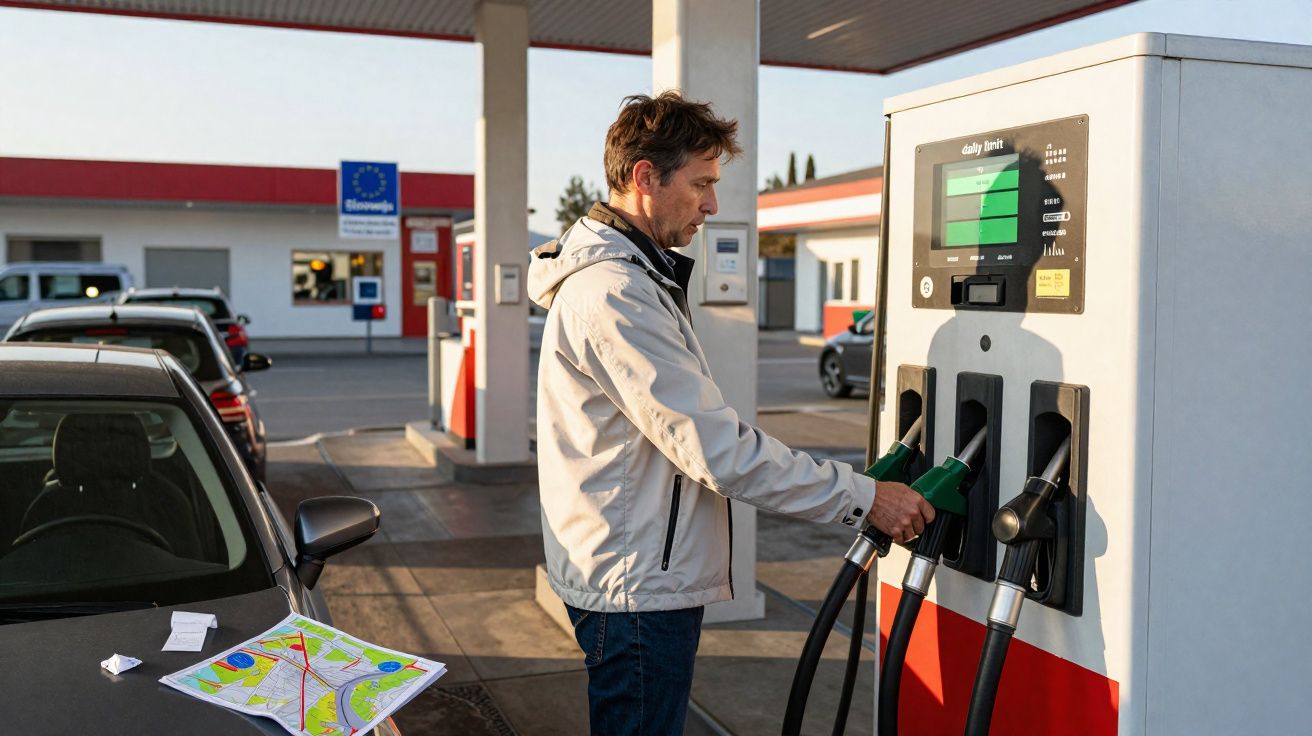
Slovenia has moved quickly in response to the fallout from the conflict involving Iran and the closure of the strategically crucial Strait of Hormuz. With oil prices surging and drivers in many countries rushing to fill up, Ljubljana has introduced a cap on how much fuel can be bought per day-applying both to residents and to motorists arriving from abroad.
Slovenia fuel rationing rules in force from 22 March
From Sunday 22 March, Slovenia became the first European Union member state to bring in an official petrol and diesel rationing system. The decision follows the latest tensions linked to Iran and the blockage of the Strait of Hormuz, a sea passage used for roughly a quarter of the world’s oil trade.
In Slovenia, private individuals may now buy only 50 litres of fuel per day, while companies and farmers may purchase up to 200 litres.
These daily limits apply nationwide at every filling station. Forecourt operators are required to monitor sales and, once the limit is reached, to stop dispensing fuel. The restrictions cover both petrol and diesel.
The government stresses that this is a precautionary step rather than a response to an immediate shortage. National reserves are described as well stocked, and officials insist Slovenia currently has sufficient fuel. The purpose of rationing is to prevent panic buying from draining storage and creating real supply problems.
Why the Persian Gulf conflict is felt in Europe
Market anxiety has been triggered by the closure of the shipping route at Hormuz. According to media reports, the strait-about 212 kilometres long and roughly 50 kilometres wide-normally carries 12 to 13 million barrels of oil per day, equivalent to around a quarter of global oil trade.
When this corridor is blocked or perceived as unsafe, oil prices tend to spike on exchanges. Traders start pricing in tighter supply, shipping companies avoid the passage or reroute vessels, and transport costs rise. That pushes up the price of crude oil-and ultimately increases the cost of petrol and diesel across Europe.
- Around 25% of global oil trade passes through the Strait of Hormuz
- 12–13 million barrels per day are affected
- Result: higher crude prices and more expensive fuel at filling stations
In several countries, the jump in prices has already led to queues and congestion at fuel stations. Many drivers try to brim their tanks before prices climb further-exactly the kind of wave Slovenia is trying to dampen.
Regulated pump prices turn Slovenia into a fuel magnet
A second driver of the decision lies at home: Slovenia operates regulated fuel prices. Even with the Middle East crisis, petrol and diesel have remained cheaper than in neighbouring countries such as Austria and Italy.
Most recently, the government capped Euro Super 95 petrol at €1.47 per litre, while diesel was limited to €1.53 per litre. In Austria, media reports suggest petrol prices are edging towards €1.80 per litre, with diesel approaching €2.00.
The gap-sometimes more than €0.30 per litre-has sparked a surge in “fuel tourism” to Slovenian filling stations.
Drivers from Austria and northern Italy have been willing to make significant detours to fill up more cheaply. The larger the difference, the more attractive a border crossing becomes for a full tank-particularly for commuters, professional drivers, and people living near the frontier.
How Slovenia is countering “fuel tourism”
Ljubljana found itself dealing with two pressures at once: domestic hoarding that threatened to strain national reserves, and an additional rush of vehicles arriving from abroad.
Rationing is designed to take the heat out of this combination. In parallel, the government is encouraging fuel retailers to apply even stricter limits to foreign customers. However, the precise approach is left to individual filling-station operators.
In practice, this may look like:
- 50-litre daily limit for Slovenian private customers
- 200-litre daily limit for company vehicles and agricultural businesses
- Potentially lower caps for foreign-registered vehicles, if a filling station chooses to apply them
This approach aims to keep Slovenia’s supply position steady without outright shutting off access for motorists from other countries.
Border tensions: opportunity or nuisance?
In Slovenia’s border areas, the influx of foreign vehicles has produced mixed reactions. Local media report that many residents experience the long queues and added traffic as a burden. People who only want a quick top-up can find themselves stuck behind lines of cars with foreign number plates.
Others view fuel tourism as a useful source of extra income. Visitors who come to fill up from Austria or Italy often turn it into a short day out-stopping for a meal, having a coffee locally, or buying from nearby shops.
For some towns close to the border, cheaper fuel has effectively become an economic factor-with both benefits and drawbacks.
These frictions are familiar in other European border regions too, such as between Germany and Poland or the Czech Republic, where cheaper fuel, tobacco, or alcohol draws shoppers from across the frontier while also generating resentment.
How the situation could develop next
Slovenia’s Prime Minister has sought to reassure the public, repeating that stocks are full and that there is no reason to panic. The daily purchase cap is intended to prevent panic behaviour, not to trigger it.
Even so, other European governments are likely to watch Slovenia closely. If tensions in the Middle East intensify further, or if shipping routes remain disrupted for an extended period, more EU states may consider similar tools.
| Country | Measure | Aim |
|---|---|---|
| Slovenia | Daily limit 50/200 litres | Protect stocks, curb fuel tourism |
| Other EU countries | No formal rationing yet | Monitor the situation, possible price measures |
Historically, governments facing comparable shocks have tended to rely on tax changes, short-term subsidies, or releasing strategic reserves to soften price rises. A formal rationing framework like Slovenia’s remains unusual within the EU.
What rationing means in practice for drivers
For everyday life in Slovenia, the immediate question is whether 50 litres per day is enough. For most private motorists, it will likely feel ample: routine commuting or occasional driving rarely comes close to that threshold.
The pressure is greater for high-mileage drivers, small haulage firms, and farmers. A 200-litre daily limit can become restrictive, particularly during harvest periods or on long transport routes. Many businesses will need to plan more carefully and consolidate trips.
At the same time, the policy underlines how dependent mobility still is on oil. Even a limited cap on access to petrol and diesel is enough to unsettle households and companies.
Background: why the Strait of Hormuz is so sensitive
The Strait of Hormuz links the Persian Gulf to the Gulf of Oman and the Indian Ocean. Countries such as Iran and Oman sit along its shores, but economically the entire world depends on the route remaining open.
Because so many oil tankers pass through this narrow channel, markets react sharply to any military tension in the area. Even rumours of potential blockades can push up insurance premiums and lead shipping firms to adjust routes.
For European consumers, this shows up as higher pump prices. Every litre bought at a filling station sits at the end of a complex global supply chain-from oil fields, to tankers, to refineries, and then on to distribution networks.
Extra practicalities: enforcement, receipts, and cross-border travel planning
Although the daily limits apply nationally, the on-the-ground experience may vary between filling stations because operators are responsible for monitoring purchases. Drivers should expect staff to check transactions more closely and, in some cases, to rely on receipts or other records to help ensure the daily cap is not exceeded.
For travellers passing through Slovenia-particularly those who previously planned a border stop to take advantage of regulated fuel prices-the safest approach is to assume that queues and tighter checks are possible during peak hours. Allowing extra journey time and identifying multiple potential filling stations along the route can help avoid last-minute problems.
What motorists can do now
Anyone driving in or through Slovenia should adapt to the new rules. Stockpiling extra fuel in large containers in the boot is likely to be impractical under the limits. A better response is to plan refuelling stops and cut unnecessary journeys.
Practical options include:
- Sharing rides to reduce fuel use
- Choosing less congested routes to avoid idling in traffic and wasting fuel
- Checking tyre pressure and vehicle servicing to improve efficiency
- Adjusting speed-especially on motorways, where higher speeds significantly increase consumption
The current moment is a stress test for Europe’s energy policy. Slovenia illustrates what it looks like when a country responds to a looming shortage not only through price measures, but through clear volume limits. How long rationing stays in place-and whether other EU countries follow-will ultimately depend on whether the situation in the Gulf eases or escalates further.


Comments
No comments yet. Be the first to comment!
Leave a Comment