
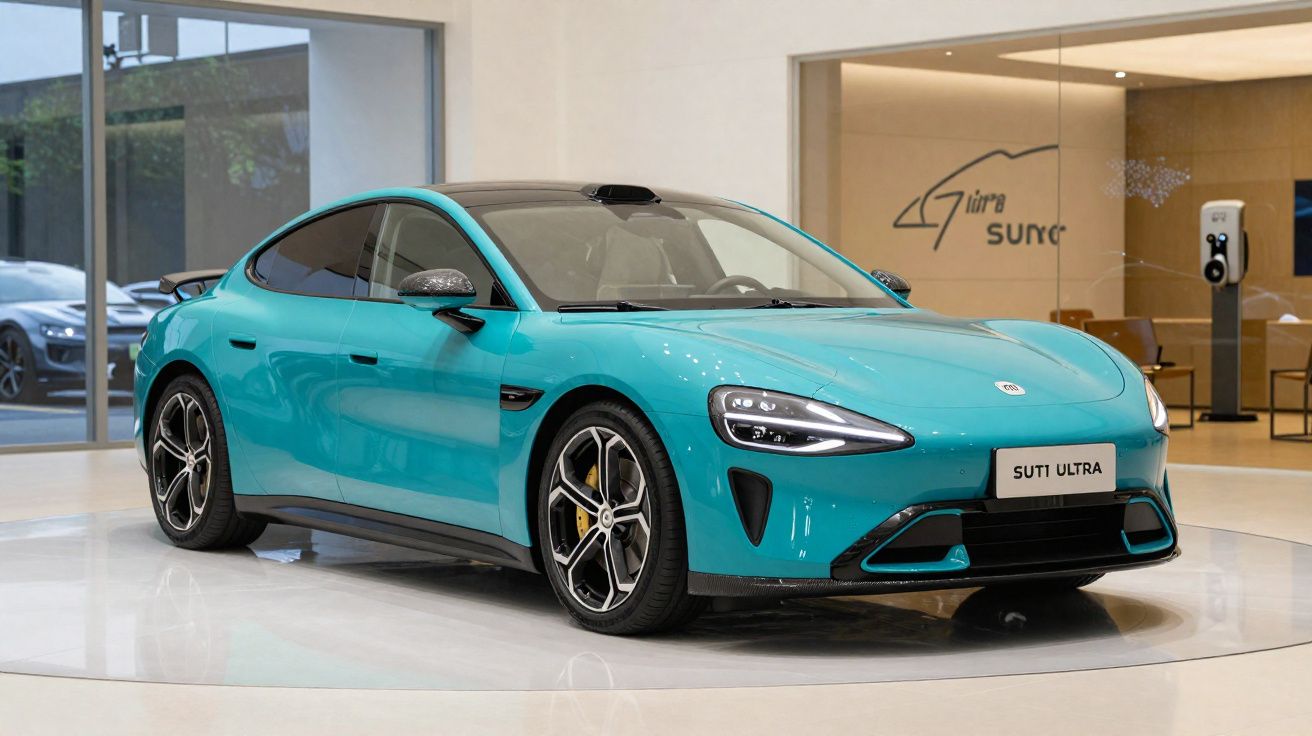
What looked, not long ago, like a Nürburgring publicity play has taken a decisive turn: the Xiaomi SU7 Ultra now holds full road registration in Germany. That single administrative milestone matters because it signals something much bigger than a headline lap time-Xiaomi, a brand best known for smartphones, is edging closer to a genuine European market launch and taking aim at established premium EV names.
From a Munich number plate to a serious European foothold for the Xiaomi SU7 Ultra
The pivotal moment arrived in early July 2025, when the first Xiaomi SU7 Ultra was registered in Munich under European road-traffic rules. Wearing the German registration M SU7088E, the car is being used by Xiaomi as a development and validation vehicle rather than a customer delivery.
Xiaomi has already put that car to work on a roughly 800 km real-world test route linking Berlin, Hamburg and Frankfurt. During a run on an unrestricted Autobahn section, it reportedly reached 260 km/h-legally and outside the controlled conditions of a circuit. While the registration is technically a one-off approval, it strongly implies that the brand has effectively cleared the key hurdles for European homologation, which is a prerequisite for any later retail sales.
From Nürburgring Nordschleife record runs to everyday-road credibility
Xiaomi has only been in the car business for around three years, yet it chose a bold starting point: a large, fully electric saloon positioned in territory usually dominated by Porsche, Tesla and others. The SU7 range is intended to be sporty, and the Xiaomi SU7 Ultra sits at the top as the high-performance technology showcase.
That strategy became widely visible on the Nürburgring Nordschleife. Over the summer, an Ultra prototype recorded a 6:22.091 lap-an attention-grabbing benchmark in the EV world. The later production-spec car then posted 7:04.957, which placed it at the sharp end of the production electric saloon leaderboard on that circuit. In that context, cars such as the Porsche Taycan Turbo GT and even the hypercar icon Rimac Nevera stopped being “untouchable references” and instead became the comparisons Xiaomi invited.
The Xiaomi SU7 Ultra has positioned itself among the quickest electric saloons on the planet-now not just on a racetrack, but officially on European public roads.
Supercar-style figures: 1,548 PS, 350 km/h and more than 600 km range
On paper, the Xiaomi SU7 Ultra reads like a supercar proposition. Xiaomi lists the following headline specifications:
- Power: 1,548 PS from a fully electric drivetrain
- 0–100 km/h: 1.98 seconds (announced)
- Top speed: up to 350 km/h
- Battery: 93.7 kWh CATL Qilin II
- Range: 630 km on the Chinese CLTC test cycle
That range figure needs European context. CLTC testing typically produces more optimistic results than WLTP, which is the standard used for official consumer figures across Europe. Analysts therefore expect the Ultra’s realistic WLTP-equivalent range to land at just over 500 km-still a strong number given the power on offer.
Beyond the Ultra halo model, Xiaomi is also preparing several more “everyday” SU7 variants. These are expected to span roughly 320 to 690 PS and, depending on battery choice, are claimed to reach up to 902 km on CLTC. Converted into a WLTP-like expectation, that is often discussed as roughly 722 km, which would put pressure on many established premium EVs.
How the Nürburgring becomes a marketing stage
Chinese manufacturers have taken different routes into Europe-some leaning on major football sponsorships, others trying to win on price alone. Xiaomi’s approach is clearly brand-led: Nürburgring records, striking styling, big performance numbers, and then (eventually) an entry price designed to look surprisingly attainable.
The Nürburgring matters because it carries global status, but it resonates especially strongly with German enthusiasts. Perform there and you are instantly treated as a serious player. That is exactly the point Xiaomi is trying to make: the SU7 Ultra is meant to prove the company can deliver far more than value smartphones.
Europe from 2027: premium feel at a fighting price
Xiaomi is now openly talking about a European launch in 2027. The SU7 saloon is expected to be the core model, supported by an SUV called the YU7. To avoid stumbling over European expectations, Xiaomi has established a development and design centre in Munich, where engineers and designers are focusing on areas such as suspension tuning, driver-assistance behaviour and cabin execution for local tastes.
For non-Ultra SU7 versions, Xiaomi is reportedly targeting a premium positioning with an unusually low entry point. Figures around €35,000 for simpler trims have been discussed. If that pricing holds, the SU7 would land directly in the competitive space occupied by the Tesla Model 3, Hyundai Ioniq 6 and BMW i4, while promising more equipment and range for similar-or less-money.
A premium electric saloon offering more than 700 km of WLTP range at a mid-market price could significantly disrupt the segment.
What this could mean for European manufacturers
Xiaomi’s Nürburgring push is part of a broader pattern. Another Chinese brand, for example, has already captured attention with cars such as the BYD Yangwang U9, underlining how quickly performance bragging rights are becoming contested territory. The evolving Nürburgring timeline illustrates just how intense the race has become-and why European marques may need to respond faster.
That pressure lands on Porsche, BMW, Mercedes, Audi, and also Tesla. They must keep advancing their technical edge, but they also face a pricing dilemma. If a newcomer can pair sports-car performance and long range with a starting point near €35,000, established margin structures begin to look vulnerable.
What “homologation”, CLTC and WLTP actually mean
Terms such as homologation, CLTC and WLTP appear frequently in SU7 Ultra coverage. Understanding them makes the Munich registration far easier to interpret.
| Term | Meaning |
|---|---|
| Homologation | Technical approval that allows a vehicle to be used on public roads under a specific market’s rules, such as the EU. |
| WLTP | Worldwide Harmonized Light Vehicle Test Procedure; the European standard used for official efficiency and range figures. |
| CLTC | China Light-Duty Vehicle Test Cycle; a Chinese test cycle that usually reports higher range figures than WLTP. |
Successfully navigating German approval strongly suggests Xiaomi has already mastered a long list of EU requirements-crash safety, driver-assistance functions, lighting regulations, software security, charging compatibility and more. For potential buyers, that matters because it signals intent: this is not only about showy laps at the Nürburgring.
Risks, opportunities and the question of everyday usability
Even with eye-watering specifications, one practical question remains: how usable is a 1,500+ PS saloon day to day? On normal roads, that output is rarely exploitable. The more meaningful battlegrounds are likely to be charging performance, the quality and cadence of software updates, the breadth of the service network, and ultimately residual values-areas where newcomers often need time to mature.
At the same time, Xiaomi brings a distinct strength from consumer electronics: connected services, polished infotainment and tight smartphone integration. If those capabilities translate cleanly into an automotive experience-without compromising reliability-they could be particularly compelling to tech-forward drivers already invested in the Xiaomi ecosystem.
One further European reality is aftersales confidence. Warranty terms, parts availability, repair lead times and insurer attitudes can shape ownership costs just as much as range and acceleration figures. A strong service footprint-whether built directly or via partners-may prove as decisive as any Nürburgring result.
In the end, success in Europe will depend on a balanced package: keen pricing, credible support, usable real-world range and a safety record that builds trust. The Xiaomi SU7 Ultra appearing on European roads with official registration is the moment the story shifts from Nürburgring spectacle to a genuine test of whether Xiaomi’s record-chasing can become a lasting presence in the premium EV market.


Comments
No comments yet. Be the first to comment!
Leave a Comment