
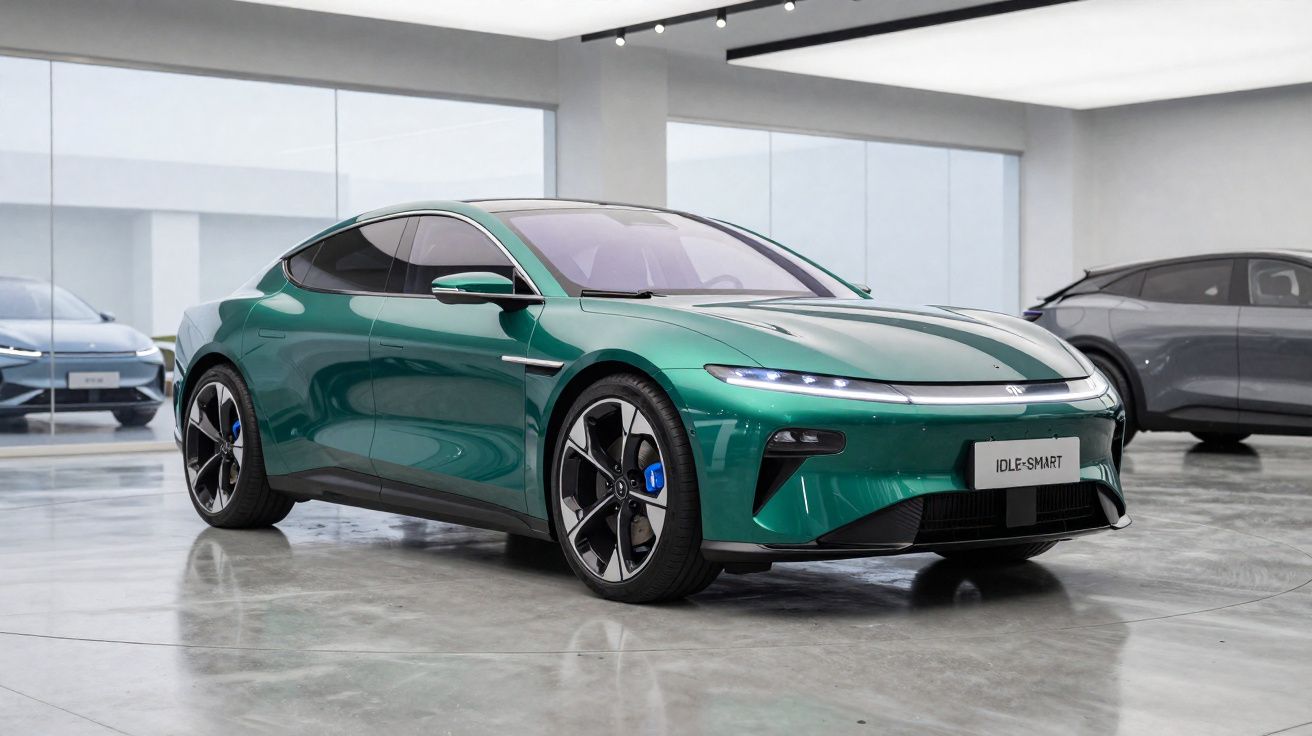
Some motorists enjoy the hush when the engine cuts out at the lights. Others hit the off switch without thinking.
Car makers promote idle-stop (often labelled a start-stop system) as an easy way to reduce fuel spend and CO₂ with no change in driving style. The reality is more nuanced: what you save depends heavily on your routes, traffic patterns and how long you spend stationary.
What a start-stop system (idle-stop) actually does
An idle-stop system shuts the engine down when the vehicle comes to a standstill, then restarts it as you pull away. While the engine is off, the car’s electrical systems remain powered, so essentials such as lights, power steering, airbags, the infotainment system and the heating and cooling controls continue to operate.
The exact trigger points differ by transmission type:
- Manual gearboxes: the engine typically stops once you select neutral and release the clutch; pressing the clutch again brings the engine back to life.
- Automatics: keeping your foot on the brake commonly initiates shutdown; easing off the brake restarts. The transmission separates the driveline from the engine so the car doesn’t stall.
In urban traffic, reputable tests by European motoring organisations commonly indicate around 10–15% lower fuel consumption with idle-stop enabled.
That band is largely explained by how often you stop. Lots of brief halts at traffic lights and queues can add up. By contrast, on long motorway runs there’s little to gain because you rarely spend time idling.
How much money are we really talking about?
To put the headline claim into pounds and litres, start with a typical annual usage pattern. A petrol car returning roughly 36 mpg (UK) (about 7.8 L/100 km) and travelling around 7,800 miles (about 12,550 km) per year would use roughly 1,000 litres of fuel annually. If idle-stop trims 10–15% of consumption in predominantly urban use, that equates to roughly 100–150 litres saved.
At around £1.45 per litre, that works out at approximately £140–£210 per year.
Your outcome will vary. A city-heavy routine usually increases the saving, whereas a rural commute with fewer junctions and queues tends to reduce it.
| Scenario | Typical time spent idling | Potential fuel saving | Illustrative cash saving | Notes |
|---|---|---|---|---|
| Urban commute | 15–25% | 10–15% | £140–£210/yr | Frequent traffic lights and stop-start queues |
| Suburban mix | 8–12% | 5–8% | £70–£140/yr | A moderate number of stops |
| Mostly motorway | 2–4% | 0–3% | £0–£40/yr | Stationary time is uncommon |
Assumes ~7,800 miles (12,550 km) per year, ~36 mpg (UK) / ~7.8 L/100 km, and £1.45 per litre. Swap in your own mileage, consumption and local fuel price to personalise the estimate.
Why the system sometimes refuses to cut the engine
Idle-stop is not meant to activate at every single halt. The control software constantly weighs up battery condition, cabin comfort requirements and safety considerations. If the car decides the margins are tight, it simply keeps the engine running.
Common reasons include:
- Low battery voltage or a battery nearing the end of its life.
- Very cold or very hot conditions, particularly when heating or air conditioning demand is high.
- The engine is not yet up to operating temperature.
- Steep gradients or challenging parking angles.
- Signs you may be manoeuvring or parking: seatbelt unfastened, door open, bonnet open, steering on full lock.
- Parking assist or other driver-assistance features currently operating.
- A trailer connected.
If the vehicle judges that stopping the engine would harm comfort, safety or emissions control, it will continue running.
Some cars will also pause idle-stop during emissions-related events (for example, diesel particulate filter regeneration) or when the 12V system needs additional charging.
Wear and tear: truth versus myth
A common worry-especially among drivers used to older vehicles-is that repeated restarts will rapidly wear out starter motors and batteries. In modern cars, the components are typically engineered for this duty cycle: reinforced starters, tougher ring gears and AGM/EFB batteries designed for far more start events than conventional lead-acid units.
There is, however, a cost trade-off. These upgraded batteries are usually more expensive to replace than standard types, and starters can cost more too. Manufacturers design the system as a package, aiming for the fuel saving over years of ownership while allowing for the extra workload in service schedules.
If restarts become sluggish or inconsistent, don’t keep forcing it. Have the battery tested: a borderline 12V battery is one of the most common reasons the vehicle disables idle-stop on its own.
Should you switch idle-stop off?
Many cars provide a dashboard button that disables idle-stop for the current journey. Some owners attempt to turn it off permanently, but that approach can create complications.
Germany’s ADAC has cautioned that disabling a factory-fitted idle-stop system may affect a vehicle’s type approval and can lead to insurance issues after a collision.
Requirements and enforcement differ by country and insurer. In the UK, if you are considering any modification, it’s sensible to check both legal expectations and your policy wording. If you simply want a break from the system for a particular situation, using the manufacturer’s built-in, temporary override is generally the least risky option.
When a quick manual override can be useful
- Stop-and-creep queues where pauses are under 3–5 seconds and you keep inching forward.
- Busy junctions or tight manoeuvres where instant response feels more predictable with the engine running.
- Severe cold where you depend on engine heat for demisting and the windows keep misting up.
- Steep hill starts if you are still learning how your car’s hill-hold behaves.
A practical rule of thumb: if you expect to be stationary for more than about 10 seconds, stopping the engine will usually save fuel; below that, the benefit diminishes.
Getting the most from idle-stop
A few small habits can help idle-stop deliver more consistent savings and reduce the chances it drops out unexpectedly:
- Look after the 12V battery. Repeated short trips can leave it undercharged; a longer run now and then-or a smart charger in winter-helps.
- Use air recirculation during hot spells. The cabin cools more quickly, reducing the load and allowing longer engine-off periods.
- Reduce electrical loads when stationary. Maximum fan speed, heated seats and the rear demister all draw heavily.
- Keep servicing up to date. Clean oil and healthy sensors support faster, smoother restarts.
- Combine idle-stop with eco-driving. Anticipate lights, leave a bigger gap and lift off early instead of braking late.
Idle-stop and UK anti-idling expectations
Although idle-stop is primarily about efficiency, it also aligns with increasing pressure to reduce unnecessary idling. Many UK councils discourage or enforce against engine idling near schools and busy kerbsides, and some areas run anti-idling campaigns to improve local air quality. If your car’s idle-stop works reliably, it can make it easier to comply without constantly thinking about it-particularly in town centres and around drop-off points.
Another practical angle is noise. In dense urban streets or quiet residential areas, the reduced engine noise while waiting can make the cabin calmer and the surroundings less intrusive, even when the fuel saving itself is modest.
What about hybrids and 48-volt systems?
Mild hybrids build on idle-stop using a more powerful starter-generator and a small battery (often a 48-volt system). They can switch the engine off sooner, restart more smoothly and provide extra torque as you pull away. In stop-start driving, that typically increases the benefit without changing your charging habits.
Full hybrids go further still. They can move off on electric power and keep the engine off at low speeds for longer stretches. If most of your time is spent in congestion, these systems raise the upper limit of what idle-stop introduced.
A quick pocket calculation you can do
- Take your annual distance (miles, or convert to kilometres).
- Work out your average fuel consumption (mpg (UK) or L/100 km).
- Estimate what share of your driving is urban.
- Apply a city saving of 10% (conservative) up to 15% (optimistic), then multiply by your urban share.
- Multiply the litres saved by your local £/litre price.
Example: 16,000 km a year at 7.4 L/100 km uses about 1,184 litres. If half your driving is urban and idle-stop cuts 12% of that portion, you save roughly 71 litres. At £1.45 per litre, that’s about £103 per year saved while waiting at red lights.

Comments
No comments yet. Be the first to comment!
Leave a Comment