
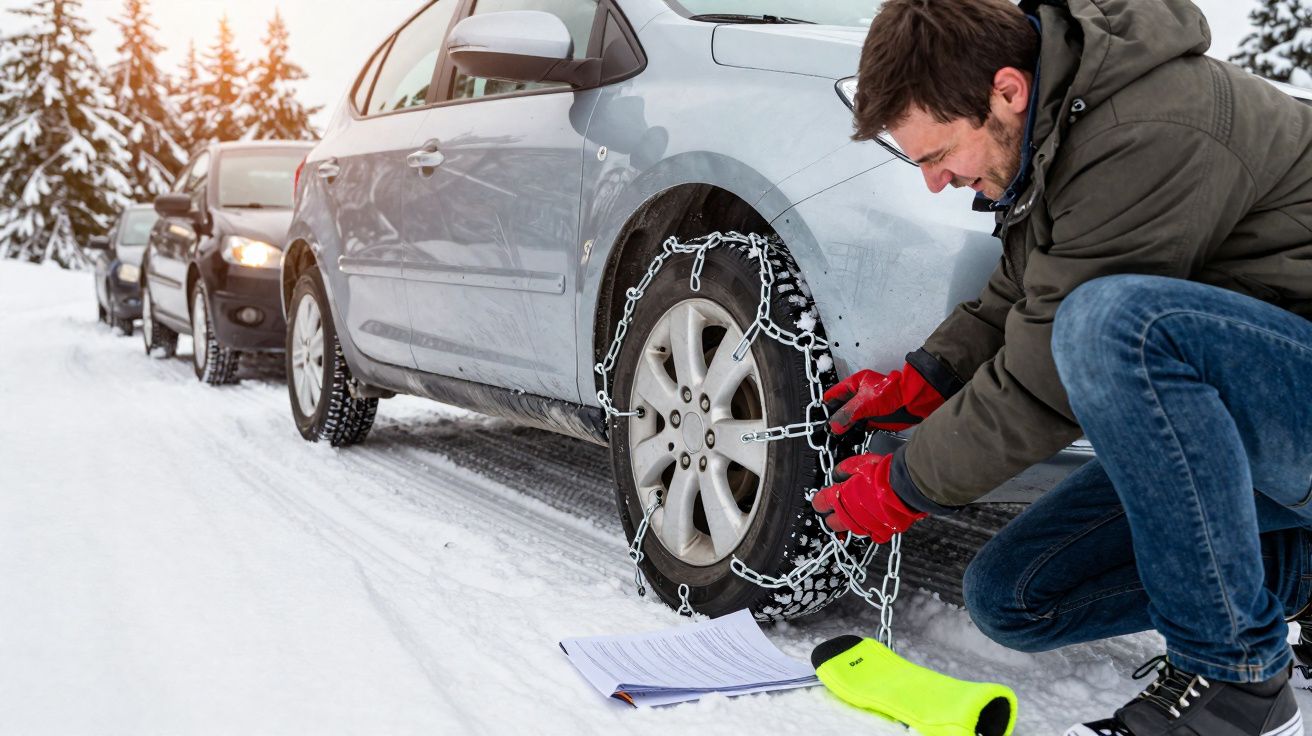
Snow chains are often treated as mandatory kit the moment snow settles and the mountain pass turns white. In brochures they look straightforward, safe and almost fool-proof. Anyone who has had to fit them in a blizzard on the edge of an unlit country road discovers the less glossy reality: stress, freezing hands, fiddly hardware - and some overlooked risks for your car, your nerves and your wallet.
Snow chains fitting in a snowstorm: practice can quickly turn into a nightmare
On paper, installation is a handful of simple steps; in real life, the first fitting attempt can be a genuine test of patience. Plenty of drivers have never tried their chains on their own vehicle. Instead, they’re squinting at the instructions in sub-zero temperatures while snow blows straight into their face.
The scene is usually the same: numb fingers, bulky gloves, a head torch or phone light, and a slippery hard shoulder. The steel links twist and snag, the clasp refuses to lock, and traffic rushes past far too close for comfort.
If you fit snow chains for the first time only when you truly need them, you nearly always pay in stress, lost time and avoidable mistakes.
Many systems also require you to move the car briefly so the chain seats properly around the tyre. That means rolling a short distance forwards or backwards, climbing out again into slush, tightening, then checking whether everything is correctly aligned. On narrow mountain roads with poor visibility, that routine can become risky very quickly.
Compatibility: not every snow chain suits every car
Modern cars with large alloy wheels and tight wheel arches can be awkward when it comes to snow chains. Sometimes there simply isn’t enough clearance between the tyre, suspension strut and wheel housing. Traditional steel chains may then scrape against suspension components.
It gets more painful once electronic systems are involved. If a chain runs where it shouldn’t, it can snag sensor wiring or damage components linked to ABS and ESC. The result can range from warning lights on the dashboard to expensive repairs.
- Check the vehicle handbook: is there an approval for snow chains?
- Use snow chains only with approved tyre sizes
- Make sure your wheels are “chain-compatible” and choose the exact chain type specified
- If in doubt, ask the manufacturer or a garage before you buy
Retailers often push “universal” models. That sounds convenient, but “universal” does not automatically mean “fits your car”. Realising on an Alpine holiday that a chain binds inside the wheel arch is the definition of being left out in the cold.
Driving with chains: noisy, bumpy and slow
Once the chains are on, the car immediately feels different. Each wheel rotation can send noticeable thumps through the steering wheel, seat and bodywork - particularly when the road isn’t covered by an unbroken layer of snow.
The ride becomes harsher, road noise increases dramatically, and fine vibrations can become genuinely tiring over time. If you have to cross several passes or cover long stretches with chains fitted, you’ll feel it physically and mentally within an hour.
Speed is the other hard limit. Depending on the model, the advised maximum is typically 30–50 km/h. If you’re in a hurry or setting off late, expect the journey to take far longer than planned.
With snow chains, any fast road becomes the slow lane. Rushing adds risk - for the chains, the car and everyone inside.
Limited lifespan: steel does not like asphalt
Many people assume a set of snow chains will last almost forever because they’re used infrequently. That’s only partly true. Chains wear extremely quickly the moment they run on exposed tarmac without continuous snow cover.
The metal links grind against the road surface with every metre. They flatten, deform and can ultimately snap. If you drive long distances over mixed conditions - snow, slush and dry patches - you can push a set of chains to its limits within just a few winters.
Loose or broken links aren’t merely ineffective; they can become dangerous if they whip around inside the wheel arch or catch on brake lines.
Hidden danger: damage to your own vehicle
Most drivers fear losing control on ice. The next concern should be damage caused by incorrectly fitted or damaged snow chains.
If the chains aren’t tight enough, they can strike the tyre sidewalls, alloy wheels or suspension parts as you drive. That can leave gouges in wheel rims, tear rubber, or hit dampers and axle components.
A slack chain can turn into a rotating hammer inside the wheel arch - with predictably unpleasant consequences.
There’s also a legal and financial angle: in some areas you can be penalised for driving with chains on fully cleared roads. Metal links can scar the surface and leave ruts, which is exactly why road maintenance teams dislike motorists who keep chains fitted “just in case”.
Snow chains: legal requirements and practical essentials to carry
Rules vary across Europe, and signage can make snow chains compulsory on certain routes in poor weather - particularly in mountainous regions. If you drive abroad in winter, it’s worth checking local requirements before you travel so you’re not forced into a panicked roadside fitting.
Equally important is what you keep with the chains. A pair of waterproof gloves, a kneeling mat, and a small torch can turn a miserable job into a manageable one. These aren’t luxuries; they’re the difference between fitting chains properly and cutting corners because you’re cold, wet and rushing.
Use snow chains correctly: avoid the common mistakes
Check before winter - don’t learn during a severe weather warning
A simple step that’s frequently ignored: do a first trial fit on a dry driveway or car park. You’ll quickly find out whether the instructions make sense, whether all parts are present, and how much force the fasteners actually need.
If you also mark which chain goes on which side, and the correct orientation of the clasp, you can save valuable minutes when conditions are worsening.
Choose the right driving strategy
With chains fitted, smooth inputs are key. Hard acceleration, sharp braking and aggressive steering shorten chain life and increase the chance of a chain loosening.
A practical rule of thumb:
| Situation | Recommended action |
|---|---|
| Deep, continuous snow cover | Fit chains; drive slowly and steadily |
| Mixed surface (partly clear, partly snowy) | Use chains only where essential; remove them between sections |
| Fully cleared road | Remove chains immediately to avoid damage |
Snow socks as an alternative: comfort instead of clatter
Textile traction aids - often called snow socks - are widely seen as a modern alternative. They pull over the tyre like a sleeve, are lighter to handle, and are usually more intuitive to fit.
Because there’s no metal, the risk of scratching alloy wheels or damaging the wheel arch is reduced. Many newer vehicles with minimal clearance cope far better with these systems.
The drawback is durability: the fabric wears very quickly as soon as it touches dry tarmac. Snow socks are best for genuine snow-covered surfaces and short sections, such as a steep driveway or a rural lane.
Snow socks win on comfort; classic snow chains win under sustained, extreme use on Alpine routes.
How to choose the right system for your everyday driving
If you live in lowland areas and only see snow occasionally, you may be better off with good winter tyres and a set of snow socks in the boot rather than heavy steel chains. In mountainous regions with frequent snowfall, a high-quality snow chain system that matches your car precisely is usually the better investment.
It helps to be honest about your typical use:
- Occasional trips to a ski resort: simple, quick-fit solutions are often enough
- Work journeys over passes and high roads: robust, tested snow chains, with fitting practised in advance
- Mostly city driving with rare slush: focus on quality winter tyres, with chains kept as an emergency backup
If you choose winter equipment calmly using these criteria - and practise once before the first snowfall - you drastically reduce the odds of a frustrating breakdown in a storm. Snow chains remain a powerful tool, as long as you understand their limits, their quirks and their pitfalls.






Comments
No comments yet. Be the first to comment!
Leave a Comment