
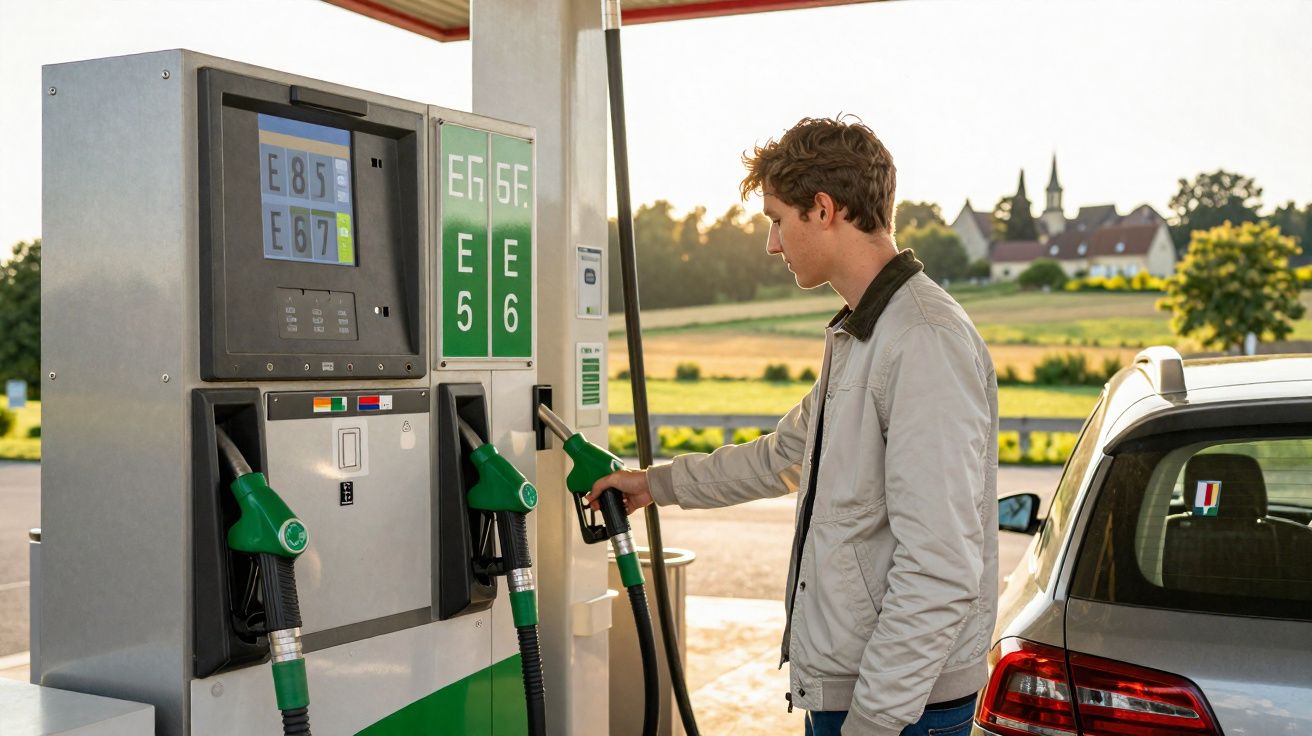
French motorists, squeezed by high fuel costs and mixed policy signals, are increasingly opting for an alternative that has been sitting in plain sight on the forecourt.
Across France, Superethanol‑E85-a long-overlooked petrol–ethanol blend once treated as a niche curiosity-has moved into the mainstream. In doing so, it is reshaping the fuel landscape and reigniting arguments about what a “clean” car should look like in the 2030s.
A 15% surge that shifts the debate on Superethanol‑E85 in France
Industry figures show that in 2025, French bioethanol consumption climbed by around 15%, reaching more than 19 million hectolitres. Superethanol‑E85 now represents roughly one third of that total-meaning one in every three litres of ethanol used in France ends up in an E85 tank.
Superethanol‑E85 has gone from a niche fuel to a serious contender, rising 15% in 2025 and expanding to more than 4,000 filling stations across France.
All of this is happening in a slightly paradoxical context: climate policy remains politically contentious, EU rules on car CO₂ targets keep evolving, and battery‑electric models dominate headlines. Yet for many households, a very familiar piece of infrastructure-the pump-has become the place where they can cut both fuel bills and tailpipe emissions without changing how they drive day to day.
Why French drivers are switching to E85
Price does the persuading at the pump
The central appeal is straightforward: cost. In 2025, a litre of Superethanol‑E85 averaged about €0.73. By contrast, widely used SP95‑E10 sat near €1.69 per litre. Even allowing for slightly higher fuel use per kilometre, the difference is hard to overlook.
Industry modelling sets out the annual impact:
- At 13,000 km per year, choosing E85 instead of SP95‑E10 saved about €705, assuming 25% higher fuel consumption.
- At 20,000 km per year, the saving increased to around €1,085 under the same assumption.
If the extra fuel use on E85 is closer to 20%, the savings rise further-to roughly €739 at 13,000 km and €1,137 at 20,000 km.
For many families, E85 can keep several hundred euros in the household budget each year, even after accounting for higher fuel consumption.
Those numbers help explain why around 418,000 motorists have adopted Superethanol‑E85 since it was introduced in 2006. About 62% do so using petrol cars fitted with an approved flex‑fuel conversion kit, while 38% drive factory-built flex‑fuel vehicles.
From hard-to-find oddity to everyday availability
For years, the standard criticism of E85 was availability: drivers simply could not rely on finding it. That objection is weakening quickly. By 2025, more than 4,000 service stations in France offered Superethanol‑E85, equating to roughly 42% of the country’s stations.
The network has become dense enough that 93% of French motorists live within 10 kilometres of an E85 pump. In many areas it now appears on the same forecourt as diesel and conventional petrol-no longer requiring a special detour.
Climate benefits, without claiming perfection
A lower life‑cycle footprint than fossil petrol
The French sector is careful not to present bioethanol as fully carbon‑neutral. Emissions still arise from crop cultivation, processing and transport. Even so, the overall life‑cycle balance compares favourably with purely fossil fuels.
In 2025, the bioethanol used on French roads replaced around 1 million tonnes of oil equivalent. That substitution is estimated to have avoided about 2.7 million tonnes of CO₂, which analysts liken to the yearly exhaust emissions of roughly 1.3 to 1.4 million cars.
A key concept is the carbon cycle: the CO₂ released at the exhaust was previously absorbed by plants as they grew. The loop is not fully closed-tractors use diesel and factories consume energy-but across the full life cycle, emissions remain substantially below those of conventional petrol.
Still a small share of the overall road-fuel mix
Even after rapid growth, E85 remains a modest component of France’s road‑fuel picture. Total road‑fuel consumption reached around 47.5 million cubic metres in 2025. Diesel stayed dominant at about 32 million cubic metres, just over two thirds of the total. Petrol products totalled 15.6 million cubic metres, up 5.7% year on year.
| Fuel type | 2025 volume (million m³) | Share of road fuels |
|---|---|---|
| Diesel | 32.0 | 67.3% |
| Petrol (all grades) | 15.6 | 32.7% |
| Bioethanol (all uses) | 1.9 | ~4.0% |
At roughly 1.9 million cubic metres, bioethanol accounts for just under 4% of road fuels. The stream is widening, but the wider system is still largely organised around diesel-even as diesel’s share gradually declines.
A distinctly French supply chain
From farm fields to the fuel tank
Each litre of E85 is backed by a value chain that is largely domestic. French farmers supply the raw materials-sugar beet, cereals and other crops. The sector provides an additional outlet for around 55,000 farm holdings, helping to steady incomes at a time when food‑commodity prices can be volatile.
Industrial jobs and co‑products
On the industrial side, the bioethanol sector supports roughly 9,000 full‑time equivalent jobs. Sugar factories and starch plants convert crops into ethanol while also extracting value from co‑products and residues that might otherwise be worth less. In practice, E85 helps pay for both main outputs and side streams, improving the use of each tonne harvested.
Bioethanol in France is not a purely theoretical “green” concept; it supports tens of thousands of farms and nearly 9,000 industrial jobs.
A practical point often overlooked: administration, insurance and servicing
One reason some drivers hesitate is not the fuel itself but the paperwork and perceived risk. Where cars are retrofitted with an approved flex‑fuel conversion kit, motorists tend to look for reassurance that the installation is recognised, that documentation is in order, and that insurers and servicing networks will treat the vehicle normally. Clear, consistent information-especially about certified equipment and compliant installation-can be as important as price.
Servicing habits also matter. E85 use can prompt questions about maintenance schedules, diagnostics and winter starting behaviour. Drivers often want a simple message: which engines are compatible, what changes (if any) to routine maintenance are recommended, and how to avoid problems linked to non‑approved hardware.
What motorists say they want
A recent IFOP survey of 1,000 people in France, conducted for the national bioethanol collective, illustrates how drivers view their next vehicle. The internal combustion engine still dominates preferences, either alone or as part of a hybrid powertrain. Around 76% of respondents favour some form of combustion engine: petrol leads at 52%, while diesel remains the choice for 24%.
Only 10% say their next car would be fully electric-well below the trajectory implied by EU ambitions. Among future petrol buyers, about 17% are considering vehicles able to run on E85, whether hybrid or purely combustion-based, suggesting meaningful headroom for flex‑fuel growth.
High awareness, but doubts persist
An information gap on a crowded forecourt
Superethanol‑E85 is no longer obscure. The same IFOP polling indicates that 76% of French people have already heard of it, and 58% view E85 as a credible alternative to fossil fuels, alongside battery‑electric vehicles.
Even so, the barriers to wider uptake are often psychological rather than technical:
- About 30% of respondents cite lack of knowledge as the main obstacle.
- Another 30% believe there are too few service stations-despite most motorists living within 10 kilometres of an E85 pump.
The pumps exist and the price gap is substantial, yet many drivers still assume E85 is scarce or complicated.
That disconnect points to a communications challenge for industry and public authorities alike. Many drivers are highly price‑sensitive but also cautious about engine reliability and warranty implications. More straightforward guidance on compatible models and certified flex‑fuel conversion kits could reduce those concerns.
Brussels signals room for “cleaner combustion”
After 2035: not batteries alone
On 16 December 2025, the European Commission proposed revisiting CO₂ rules for light vehicles. The draft revision creates a pathway for selling combustion‑engine cars after 2035, provided they run on fuels that meet strict climate criteria-including blends that incorporate bioethanol.
The Commission explicitly frames sustainable biofuels as a complement to electrification. For France’s E85 ecosystem, that brings renewed visibility. One potential beneficiary is the plug‑in hybrid designed to operate primarily on E85: battery range for everyday trips, paired with lower‑carbon liquid fuel for longer distances.
The push towards fully renewable E85
From lower‑carbon fuel to near‑neutral
The next objective for the French industry goes beyond crop‑based ethanol. Work is progressing on an E85 blend that would be 100% renewable, anchored to a precise definition of “CO₂‑neutral” fuels. In that model, all carbon in the fuel would originate from the atmosphere-captured by plants or taken from industrial flue gases-then used to create e‑fuels.
Technical standards are being discussed at the European Committee for Standardization to adapt E85 specifications to these new components. If the shift succeeds, future flex‑fuel plug‑in hybrids could operate without any fossil petrol at all, while delivering life‑cycle emissions comparable with-or in some cases lower than-those of a pure battery‑electric car, depending on the electricity mix.
How E85 stacks up in day‑to‑day driving
A realistic annual budget for a French commuter
Consider a commuter travelling 18,000 km per year in a small petrol hatchback. Using SP95‑E10 at €1.69 per litre, with average consumption of 6.5 l/100 km, annual fuel spending comes to about €1,980. Switching to E85 at €0.73 per litre, and allowing for 25% higher consumption, reduces yearly fuel costs to roughly €1,100.
Even after paying for an approved flex‑fuel conversion kit-typically €700 to €1,400 installed-the payback period is often two to three years.
This route is not free of risk. Some older engines may be incompatible, and non‑certified kits can void warranties or lead to mechanical issues. Winter cold‑start behaviour and the presence (or absence) of E85 on motorways also affect real‑world convenience. Even so, for a sizeable share of the fleet-particularly newer petrol cars-the sums are becoming increasingly compelling.
Key terms that keep recurring
- Superethanol‑E85: a fuel containing 65% to 85% ethanol, blended with petrol, and used only in compatible flex‑fuel engines.
- SP95‑E10: standard unleaded petrol containing up to 10% ethanol by volume, approved for most modern petrol engines.
- Flex‑fuel vehicle: a car designed so its engine and fuel system can run on any mixture of E85 and conventional petrol.
- Flex‑fuel conversion kit: an added electronic module that adjusts injection and engine parameters so some petrol cars can safely operate on E85.
Pure electric cars continue to gain ground-accounting for about 24% of new vehicle sales in France in December 2025-but the rise of E85 suggests French drivers are not committing to a single technological route. Increasingly, they are hedging: mixing plug sockets with pumps, weighing cost against carbon, and choosing whatever keeps both the household budget and emissions trajectory moving in the right direction.

Comments
No comments yet. Be the first to comment!
Leave a Comment