
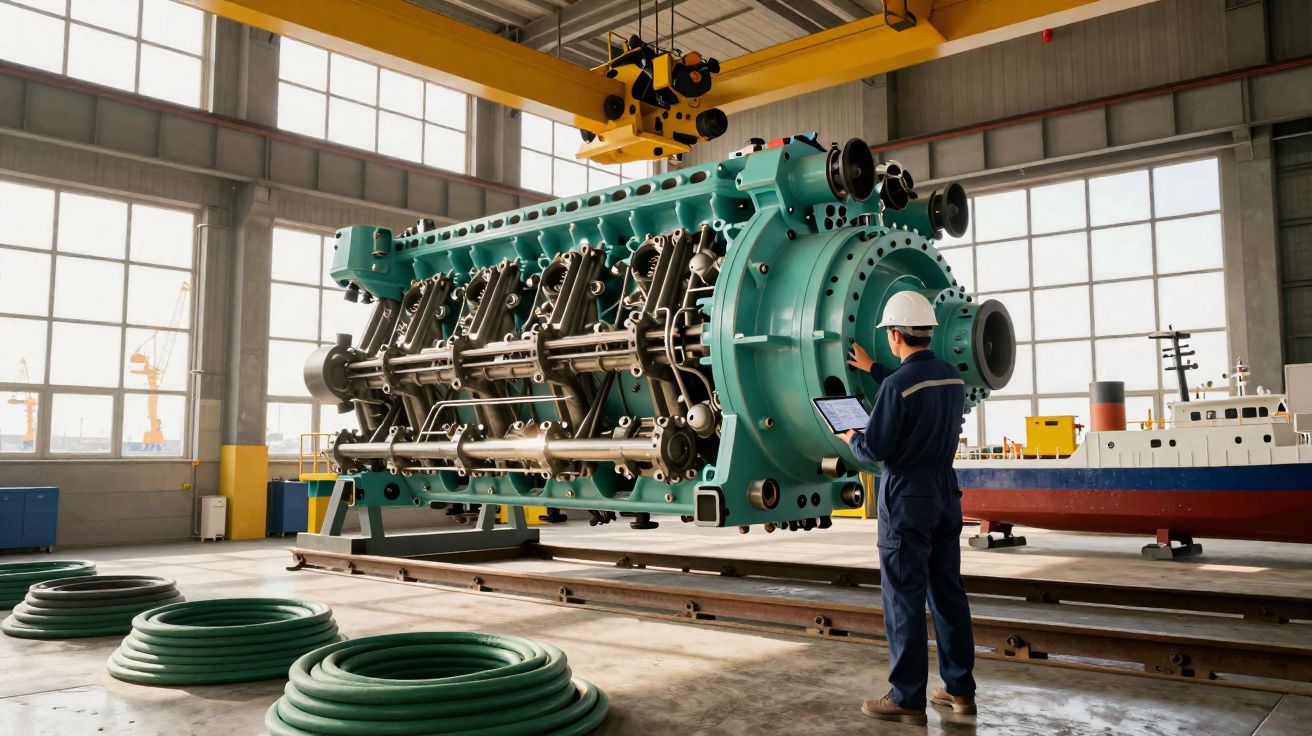
On France’s Atlantic seaboard, a long-established engine works is quietly gearing up for what could be its most intense period of activity since the post-war industrial surge.
At Saint-Nazaire, a site famed for producing diesel engines that can outweigh a fully laden passenger aircraft is moving into a new chapter under its German owner Everllence. The factory is benefiting from two powerful, parallel demand waves: safety-critical equipment for nuclear power and the push towards low‑carbon shipping.
From S.E.M.T. roots to the Everllence Saint-Nazaire engine works
Heavy engineering is woven into daily life in Saint-Nazaire. The engine plant traces its origins to 1946, when the Société d’Études des Machines Thermiques (S.E.M.T.) began developing and manufacturing large diesel engines for ships and power generation.
Over the decades, the initials S.E.M.T. became synonymous with marine propulsion and industrial prime movers. While the original company ceased to exist in 2006, both the site and the name endured through a succession of owners and are now part of the German energy group Everllence, previously MAN Energy Solutions.
Today, roughly 600 people are employed at the Saint-Nazaire facility. Rather than marking its 80th anniversary with symbolic gestures, the plant is being prepared for a tangible step-change: expanded industrial capacity, upgraded production equipment and renewed office space.
Everllence intends to turn Saint-Nazaire into an industrial “war machine”, increasing output by roughly 40% by 2028.
Why demand is surging: nuclear resilience and low‑carbon shipping
The growth plan is rooted in a straightforward reality: in two sectors that rarely accelerate together-nuclear energy and maritime transport-operators increasingly need engines that are exceptionally robust and able to operate on multiple fuels.
In nuclear facilities, the priority is absolute reliability under extreme conditions. In shipping, the pressure comes from tighter emissions rules and the high cost of replacing entire fleets, which makes retrofits and fuel flexibility especially valuable.
Nuclear engines designed for worst‑case events
Within a nuclear power station, Everllence engines (along with those from a small group of competitors) perform a vital job that is largely invisible during normal operations. They are not used to drive the main turbines or generate routine electricity for the grid.
Instead, they are installed as a final layer of protection-engineered to start rapidly if multiple systems fail and the plant loses external power.
These large engines are deployed as:
- emergency diesel generator sets
- backup power supplies for essential safety systems
- autonomous electricity sources when the external grid is unavailable
If the incoming power supply is lost, the engines must start within seconds. Once online, they provide electricity for:
- cooling systems for the reactor and spent fuel pools
- safety and containment pumps
- instrumentation and control systems that enable operators to maintain oversight
They are designed to cope with “design‑basis accidents” and scenarios beyond that baseline, including earthquakes, flooding and widespread grid disturbances where seconds and minutes matter. In this context, reliability is not a branding claim-it is embedded in the relevant standards and validated through demanding test regimes.
The IAEA estimates global nuclear capacity could climb from around 377 GW today to almost 1,000 GW by 2050, drawing emergency equipment suppliers such as Everllence into a long investment cycle.
Each new reactor project-and every programme extending the working life of existing plants-requires qualified, proven backup power solutions. For Saint-Nazaire, that means sustained demand rather than a short-lived spike.
Maritime transition: regulation driving investment
In commercial shipping, the forces at play differ, but the impact is similarly profound. International rule-makers are tightening requirements around CO₂ and air pollutants from the global fleet.
The International Maritime Organization (IMO) is targeting a 40% reduction in carbon intensity by 2030 and 70% by 2040, with the ambition of climate neutrality around mid-century. In Europe, Brussels is also bringing shipping into carbon pricing, with cargo vessels above 5,000 tonnes gradually paying for their emissions through the market mechanism.
For shipowners and charterers, the economics are stark:
- new vessels designed to be low‑carbon-ready can cost 30–50% more than conventional equivalents
- alternative fuels such as advanced biofuels or e‑methanol may cost two to five times as much as heavy fuel oil
- fleet renewal could require investment of up to US$28 billion per year
- fuel supply chains and infrastructure could demand up to US$90 billion per year
In this environment, scrapping large numbers of serviceable ships is financially punishing. Retrofitting engines and propulsion systems often offers a more realistic route to compliance.
Converting Everllence 51/60DF engines: 320‑tonne giants ready for low‑carbon fuels
Everllence’s strategy is to modify its largest four‑stroke engines so they can operate on liquid biofuels and other low‑carbon options, rather than waiting for an all‑new hydrogen- or ammonia-powered fleet that could take decades to arrive at scale.
A prominent example is the 51/60DF series: a multi‑fuel engine that can weigh up to about 320 tonnes per unit in marine arrangements, and exceed 400 tonnes in the largest power-generation variants.
Core characteristics of the MAN 51/60DF‑type engine include:
- four‑stroke architecture with very high power density
- layouts including inline 6‑cylinder, V‑12 and V‑18
- output up to roughly 20,700 kW at 500–514 rpm
- capability to operate on diesel, heavy fuel oil, natural gas or advanced biofuels
- direct starting in gas mode using around 1% pilot fuel
With a 510 mm bore and 600 mm stroke, the engine firmly sits in the “mega‑engine” bracket-suited to large cargo vessels, floating power barges and emergency units protecting critical infrastructure.
By prioritising conversions and fuel flexibility, Everllence gives shipowners a path to lower emissions without redesigning entire vessels or reworking propulsion architecture from scratch. For Saint-Nazaire, that translates into higher throughput: output is being lifted from 48 to 72 large engines per year, with around 24 additional units scheduled in 2025 alone.
The French factory is increasingly positioned as a global hub for XXL engines that comply with stricter climate rules while allowing existing ships and infrastructure to remain in service.
Scaling up: a factory refit and 6,000 m² of renovated offices
Meeting the rising workload is not simply a matter of assembling more engines. Everllence is reshaping the Saint-Nazaire operation end-to-end.
On the production side, investment is focused on:
- upgraded assembly and machining capabilities
- improved internal logistics and material flow across workshops
- test facilities adapted to new fuels and hybrid configurations
Alongside the shop floor, the plant’s “white-collar” environment is also being modernised. Around 6,000 square metres of office space will be fully refurbished over a two-year period.
This substantial upgrade linked to the site’s 80th year has three practical aims:
- improved working conditions and more collaborative areas
- increased appeal to hard-to-find engineering and digital specialists
- support for a shift towards more design work, systems integration and innovation
The ambition is for Saint-Nazaire to do more than assemble engines: management wants project teams on site developing control systems, conversion kits for alternative fuels and lifecycle services tailored to nuclear operators and shipowners.
A related challenge-and opportunity-will be skills. As fuel systems, software and compliance demands become more complex, the site’s growth will increasingly depend on training pathways for technicians, controls engineers and test specialists, as well as strong links with local education and apprenticeship programmes.
Saint-Nazaire and the port ecosystem: an Atlantic energy hub
Geography strengthens the business case. The Everllence facility sits opposite the Grand Port Maritime de Nantes Saint-Nazaire, a major gateway for energy flows on the French Atlantic coast.
In 2025, the port handled 26.4 million tonnes of cargo, including 18 million tonnes of energy products such as oil and LNG. More than 3,000 ships call each year, supporting close to 28,700 direct jobs across 1,460 hectares.
Within this dense industrial setting, the engine plant operates near major players including Chantiers de l’Atlantique, EDF, TotalEnergies and ArcelorMittal. It also has access to a dedicated quay, enabling 48/60 and 51/60 engines-sometimes weighing as much as a small locomotive-to be loaded directly onto specialist vessels or barges.
| Key figures for Saint-Nazaire energy hub | Value |
|---|---|
| Annual port traffic (2025) | 26.4 million tonnes |
| Energy-related traffic | 18 million tonnes |
| Ships handled per year | 3,068 |
| Direct jobs on site | ~28,700 |
| Port area | 1,460 hectares |
The region is also aligned with France’s France 2030 industrial strategy via the ZIBaC Loire Estuaire programme, funded with €8.2 million to back projects in hydrogen, CO₂ capture and biofuels. Everllence’s portfolio fits neatly into this direction of travel, supplying heavy-duty machinery compatible with emerging low‑carbon energy chains.
Engines, energy security and climate targets
Behind the talk of “war machines” and 320‑tonne blocks of steel sits a practical dilemma: modern societies want climate neutrality while still demanding reliable, uninterrupted energy.
In nuclear power, emergency engines represent the last line of defence. In shipping, multi‑fuel engines can reduce emissions while global trade remains dependent on long-distance sea transport. Companies such as Everllence operate precisely where these constraints overlap.
Fuel choices, however, introduce trade-offs. Switching a large ship from heavy fuel oil to sustainable biofuel can reduce CO₂, but it also raises questions around feedstock availability, land use and price volatility. For nuclear standby power, moving from conventional diesel towards synthetic or bio-derived fuels may cut lifecycle emissions, yet it must be proven not to compromise performance in extreme scenarios.
For those unfamiliar with the terminology, “dual‑fuel” describes an engine capable of running on either a gaseous fuel (such as natural gas or biomethane) or a liquid fuel (such as diesel). A small portion of the liquid-known as pilot fuel-ignites first and helps the gas burn cleanly and efficiently. This arrangement allows operators to respond to fuel price swings and regulatory shifts without replacing the engine itself.
In practical terms, a vessel using a 51/60DF‑type engine might operate mainly on LNG initially, then transition to bio‑LNG or e‑methane blends, and later undergo further retrofits as standards tighten. A nuclear site can rely on comparable technology in standby, recognising that fuel flexibility may become increasingly relevant if carbon pricing expands to backup generators or particular fuels become politically contentious.
For Saint-Nazaire, that uncertainty is not entirely a drawback. As long as policy and investment continue pushing towards low‑carbon energy and stricter safety expectations, demand for large, adaptable engines is likely to remain strong-and the plant entering its ninth decade appears set to be busier than ever.



Comments
No comments yet. Be the first to comment!
Leave a Comment