
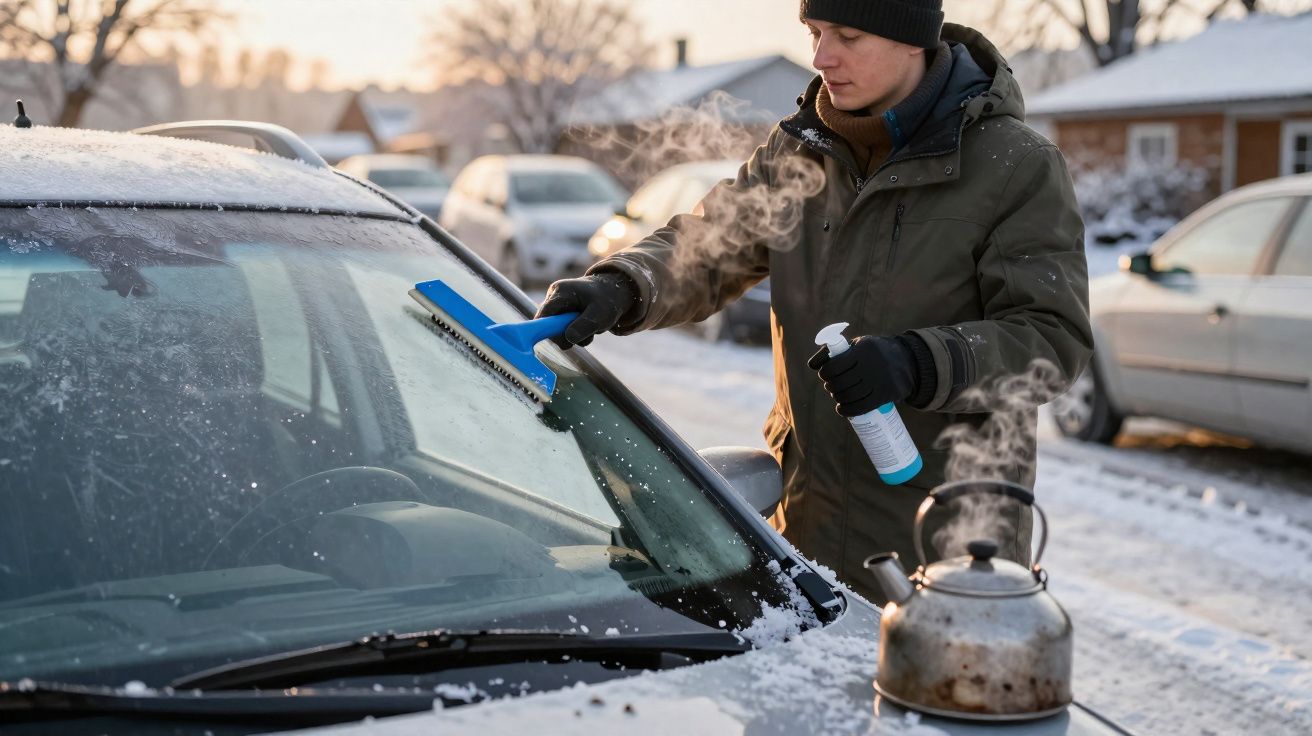
Your breath turns to mist, your fingertips are already stinging, and the windscreen looks as though someone has iced it like a cake. You’re running late - again. Back in the kitchen, the kettle is still warm and, for a brief moment, a tempting thought lands: what if you just poured hot water over the ice and cracked on with your morning?
You can almost hear the satisfying hiss as the frost gives up instantly. No scraping. No waiting. No standing there with frozen toes while the clock keeps shouting at you. Just a quick shortcut between you and a normal start.
And then you remember what your neighbour said last winter - the sharp crack, like a gunshot, followed by a repair bill that hurt more than the weather ever could.
Suddenly, that kettle doesn’t feel like such a clever idea.
Why hot water on a frozen windscreen is a bad idea
At first glance, hot water on an iced-up windscreen looks like the smartest trick in the world. One splash and the problem vanishes. The ice melts, visibility returns, and anyone still scraping away with a loyalty card seems to be doing things the hard way.
In practice, it’s much less satisfying. On a freezing morning the glass is already stressed: it has contracted in the cold, and it’s effectively “tightened up”. Tip hot water on top and you create an abrupt temperature difference that glass simply doesn’t cope with well. It can flex suddenly - and sometimes that flex becomes a crack.
That’s why mechanics wince when they hear people boast about their “hot water hack”. They’ve seen how often it ends with a damaged windscreen.
Garages and insurers have watched this play out for years. After cold snaps, UK repair centres regularly report a noticeable jump in cracked windscreens - and the same cause crops up again and again: drivers trying to speed up de-icing with hot water from the tap or kettle.
The storyline is always familiar. A parent trying to make the school run. A new driver heading to an early shift. A couple setting off for a weekend away. The hot water goes on, a hairline crack appears near the edge, and then it slowly creeps across the glass like a lightning bolt moving in slow motion.
It doesn’t always fail dramatically in the moment, either. Sometimes the harm is subtle: tiny micro-cracks form first (often impossible to spot from the driver’s seat), and then every pothole, vibration and cold night helps them spread. Weeks later, you’re told the whole windscreen needs replacing - and it all traces back to that one rushed, icy morning.
The science is simple. Glass expands as it warms and contracts as it cools. In winter, your windscreen can be tens of degrees colder than the water you’re about to pour. When hot water hits the outside surface, that outer layer tries to expand quickly while the inner layers remain cold.
That mismatch creates uneven stress through the glass. If there’s already a weak point - even a tiny stone chip you’ve forgotten about - the stress concentrates there. Because the windscreen can’t expand evenly, it releases the strain the only way it can: by cracking.
It’s the same principle as putting an ice-cold glass dish into a hot oven. Nobody is shocked when it shatters. A windscreen is laminated safety glass and tougher by design, but it isn’t immune to sudden temperature shock.
Safer ways to clear an icy windscreen (without the hot-water shortcut)
If hot water is the fast route to an expensive problem, what should you do when the car looks like an ice cube and time isn’t on your side? Start with the least glamorous tool you have: a few minutes.
Get the engine on, set the heater to demist/defrost at low to medium, and let the temperature rise gradually from the inside. Steady warmth is what the glass can tolerate.
While that’s working, tackle the outside properly with a plastic ice scraper. Skip the bank card, the metal kitchen utensil and - definitely - your bare hands. Start at the edges and work towards the centre, clearing manageable patches rather than trying to “power through” the whole screen in one go. It may feel slower, but you’re cooperating with the glass instead of forcing it.
If you’re organised, add a de-icer spray before you scrape. A homemade option (water mixed with isopropyl alcohol in a spray bottle) can help loosen the frost without shocking the glass. Used sensibly, it’s kinder to your wipers than aggressive scraping and avoids the big temperature swings that cause damage.
When the frost looks welded on, prevention usually beats last-minute heroics. A purpose-made windscreen cover, an insulated screen protector, or even an old towel secured under the wipers can save real time. In the morning you lift it off, shake it out, and you’ve dodged most of the hassle.
If you don’t have a driveway and you park on the street, a small routine helps: keep a scraper, de-icer and decent gloves somewhere easy to reach. Some drivers lift their wiper arms away from the glass overnight so they don’t freeze in place. Others park facing east so the morning sun (when it appears) gives a little natural help.
One more practical point that’s easy to overlook: it’s not just the windscreen that matters. Clear all windows, mirrors, lights and number plates properly before you set off. In the UK you’re responsible for having a clear view of the road - and a peephole scraped into the driver’s side simply isn’t enough for safe driving.
It’s also worth checking your winter basics: top up with proper winter screenwash (not plain water, which can freeze in the jets), and replace worn wiper blades before they start smearing grime across the glass. Good wipers and screenwash won’t remove thick ice alone, but they make demisting quicker and keep visibility stable once you’re moving.
“The worst cracks we deal with usually come from people who are rushing,” says a veteran windscreen fitter. “They’re not careless - they’re cold, they’re late, and hot water feels like the ‘smart’ shortcut right up until the glass gives way.”
That’s the trap with winter shortcuts: they look harmless. They even feel satisfying. For a moment, you get control back on a morning that’s already hard work - and then you’re left with a bill you really didn’t need.
To keep things simple (and avoid the kettle temptation), it helps to carry a basic winter kit:
- A sturdy plastic ice scraper with a comfortable grip
- A commercial or homemade de-icer spray
- A microfibre cloth for wiping the inside of the glass
- A windscreen cover or old towel for overnight protection
- Thin, grippy gloves that still keep your fingers warm
The calm payoff of clearing your windscreen the slow, safe way
There’s a quiet sort of relief in accepting that winter driving begins five or ten minutes earlier than you’d like. Once you build that time in, the whole situation changes. You’re not charging outside half-awake and half-dressed, trying to “beat” the frost. You step into the cold with a plan - and a clear line on what you won’t risk.
You start the engine, set a gentle demist, and crack the side windows slightly to let moist air escape. Instead of reaching for the kettle, you take the scraper. The ice comes away in thin layers. The interior mist gradually clears. Your shoulders drop. Breathing steadies. The car stops being something you have to conquer and becomes something you ease into.
That calm is worth far more than the minute you thought hot water might save. A windscreen isn’t just a sheet of glass: it’s a key structural part of the car and a vital safety barrier. Treating it carefully isn’t about being “by the book” - it’s about sparing your future self a problem that would feel painfully avoidable.
| Key point | Detail | Why it matters to you |
|---|---|---|
| Risks of hot water | Thermal shock to glass already weakened by cold, especially where there are micro-chips | Explains why the “quick trick” can cause an immediate crack or damage that shows up later |
| Safe methods | Gradual heating from inside, mechanical scraping, de-icing sprays, windscreen covers | Gives a realistic plan for icy mornings without stress or breakage |
| Prevention and routine | Keep a winter kit ready, allow five to ten extra minutes, make small daily adjustments | Improves comfort, protects your car, and helps avoid costly windscreen replacement |
FAQ: hot water, de-icing, and winter windscreen care
Can I use lukewarm water instead of hot water to defrost my windscreen?
Lukewarm water lowers the risk, but it doesn’t remove it. If the glass is extremely cold or already chipped, even a moderate temperature difference can create enough stress to start a crack. Scraping plus gentle interior heating remains the safer approach.Is pouring hot water on side windows as risky as on the windscreen?
Yes. Side windows can be thinner and are often toughened rather than laminated, which can make them react badly to sudden temperature changes. The same rule applies: avoid hot water on any frozen car glass.Do commercial de-icing sprays damage the glass or wipers?
Reputable de-icers are designed to be safe on glass and on most wiper rubbers when used as directed. Damage is more commonly caused by using the wrong scraping tools or forcing frozen wipers across the screen.Is it bad to start the car and leave it idling to defrost the windscreen?
Many people do it in very cold weather, but it can raise concerns around emissions and local anti-idling expectations. A short warm-up combined with active scraping is usually quicker and more efficient than leaving the engine running for an extended period.What’s the best way to stop the windscreen fogging up inside in winter?
Use the demist/defrost setting with the air conditioning on (if your car has it), even in cold conditions, because it dries the air. Keep the inside of the glass clean, open a window slightly to vent moisture, and try not to breathe directly onto the screen when you first get in. Realistically, nobody does all of this perfectly every day - but each step helps a bit.





Comments
No comments yet. Be the first to comment!
Leave a Comment