
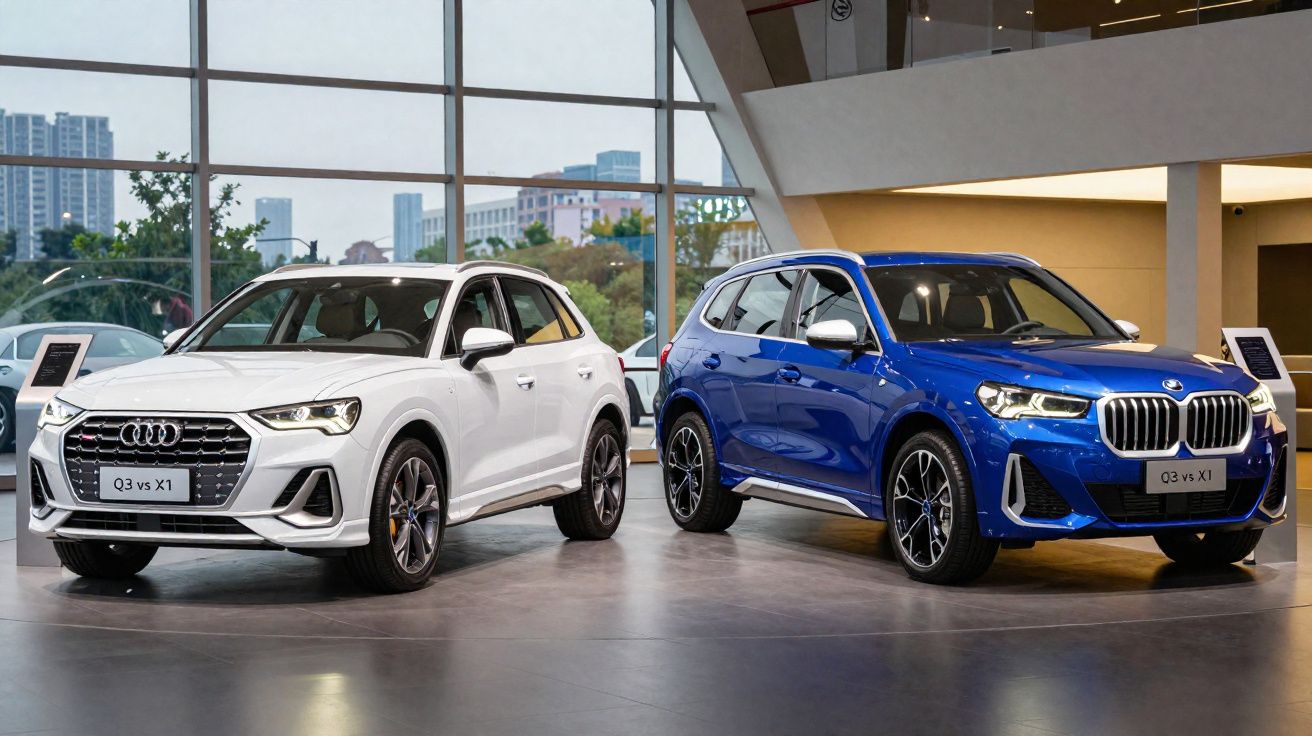
€50,000 Entry Point: Two Bestsellers Face the 2026 Reality Check - and One Pulls Away Clearly
Both present themselves as do-it-all compact premium SUVs for families, commuters and high-mileage drivers. The Audi Q3 TFSI 150 Hybrid S Line and the BMW X1 sDrive20i M Sport sit close together on list price, promise premium polish and bring modern tech. Yet on the road, inside the cabin and when you scrutinise the spend, the differences are far bigger than the brochures suggest.
On the spec sheet, the Audi Q3 and BMW X1 look surprisingly similar - in day-to-day use, they feel worlds apart.
Concept and pricing: two routes to the same goal
Audi launches the third-generation Q3 with a 1.5-litre petrol engine, mild hybrid support and 150 hp. In sporty S Line trim, it’s listed at around €50,000 before options. There is a cheaper Design version below that, but in reality many Q3 buyers quickly end up well beyond this point - especially if they choose the sought-after plug-in hybrid variant.
BMW pitches the X1 sDrive20i M Sport as the natural rival: a three-cylinder, 170 hp, also with mild hybrid assistance, and effectively the same starting point at €50,900. On paper, it’s a straight fight.
Where the gap opens is less about list price and more about options strategy. In the test cars referenced here, the Q3 carried only about €3,100 in extras, while the X1 totalled a hefty €14,750. In other words: BMW tends to pull customers upwards through paid packages, whereas Audi (in this particular configuration) stayed comparatively restrained.
Interior and everyday use: where does it genuinely feel premium?
Materials, ambience and controls
Even in basic M Sport guise, the X1 creates a notably upmarket impression. Alcantara seats with blue contrast stitching, well-judged trim inlays and a clean, modern dashboard design make it feel a class above what you might expect for this size. With extras such as a panoramic roof, electrically adjustable seats and a heated steering wheel, the X1 moves perceptually closer to the brand’s mid-size saloons.
The Audi Q3 comes across more reserved. Fabrics feel less plush and the decorative surfaces read as functional rather than eye-catching. There’s nothing seriously wrong with the build quality, but the immediate “wow” factor simply doesn’t arrive. Next to the BMW, the Q3 plays the conservative, understated card.
On usability, however, Audi flips the script. The Q3’s central display responds quickly, menus are logically structured, and key functions are easy to reach without tunnelling through layers of sub-menus. The X1’s infotainment looks more contemporary, but it can be more demanding: settings such as driver profiles or assistance systems are buried deeper than you might like, and some drive modes are less configurable than their labels imply. Over time, that can become a daily irritation.
Space, seating comfort and boot capacity
Rear passengers in both SUVs sit behind a sliding rear bench. With the bench pushed all the way back, the BMW X1 offers a little more knee room, creating the airier feel. For families with taller teenagers, that extra space can matter.
Boot space is where the Audi Q3 answers back emphatically: 550 litres plays 466 litres in the BMW’s favour. If you regularly load a pushchair, holiday luggage or sports kit, the Audi’s additional volume is a tangible advantage - particularly when the car is full of people.
More rear-seat space in the BMW, more boot space in the Audi - your routine could decide the winner.
Despite the smaller boot, the X1 edges the overall mark for “interior and everyday use”, because its design execution, perceived quality and equipment feel more cohesive and more premium - even if the Q3’s operating logic is the calmer companion.
On the road: BMW X1 sDrive20i M Sport three-cylinder vs Audi Q3 four-cylinder
Engine character and performance
In theory, Audi’s four-cylinder has the image advantage. In practice, it’s more nuanced. The BMW’s three-cylinder is only clearly noticeable immediately after a cold start; once warmed, it settles down impressively. Under load it sounds purposeful without becoming tiring, and it responds eagerly to throttle inputs. The mild hybrid system sharpens take-off and improves mid-range urgency, particularly when pulling away and during overtakes.
By comparison, the Q3 feels more restrained. The 150 hp petrol unit is smooth, but delivers its performance in a more linear, less punchy way. Acceleration and in-gear response are noticeably behind the BMW; even on paper, the difference over the standing-start kilometre is almost two seconds. In everyday driving, the X1 simply feels more lively.
Suspension, steering and brakes
Both test cars ran on 19-inch wheels and did without adaptive dampers. Around town, that makes both feel on the firm side, with small imperfections coming through clearly. As speeds rise, the BMW changes character: it rides more calmly, filters joints and undulations more effectively, and still feels stable. Whether on the motorway or a country road, the X1 inspires confidence.
The Audi Q3’s set-up feels harder overall and not as composed. It remains safe and predictable, but it doesn’t deliver the same relaxed assurance as the BMW. Tyres also played a role here: the X1 wore Pirelli P Zero tyres with excellent wet grip, while the Q3 ran Bridgestone Turanza tyres that struggled more for traction under strong acceleration.
The Audi’s clear win comes under braking. Its stopping performance feels sharper, particularly from higher speeds. Anyone frequently travelling fully loaded with passengers and luggage will appreciate that extra bite.
Dynamically, the BMW X1 is clearly ahead - only under braking does the Audi hit back.
Budget and running costs: premium always comes with a bill
List price, options and consumption
A quick configurator session confirms what many buyers already know: both brands play the familiar options game. Even features such as keyless entry - long standard on cheaper cars - can attract (sometimes hefty) surcharges on both Q3 and X1.
The Audi Q3 can accumulate more than €20,000 in extras, pushing a fully loaded example close to €80,000, as demonstrated by a long-distance test vehicle. The BMW X1 is slightly more restrained at the top end, with roughly up to €15,000 of configuration headroom.
Running costs tilt mildly towards the BMW: the Q3 posts slightly higher CO₂ figures and fuel consumption, which makes tax exposure and fuel spend a touch less favourable. The X1 counters with a relatively small fuel tank, meaning you’ll stop more often, but an overall range of over 650 km remains perfectly viable for long trips.
- Q3 TFSI 150 Hybrid S Line: cheaper entry point, expensive when fully equipped
- X1 sDrive20i M Sport: higher base price, less room to escalate at the top
- Slightly lower consumption in the BMW, but with a smaller tank
An extra consideration for 2026 buyers: driver assistance and ownership planning
For many households, the decision in 2026 won’t be driven by engines alone. If you do lots of motorway miles, it’s worth paying close attention to which driver assistance systems are standard versus bundled into packs - and, crucially, how intuitive they are to adjust day to day. A system you can quickly understand and trust tends to get used; one that’s buried in menus often doesn’t.
It’s also sensible to plan beyond the showroom sticker: service packages, tyre replacement costs (especially with 19-inch fitments), and the impact of large option spend on resale can all shift the true cost of ownership. In this class, buying “cleverly specified” often matters as much as buying the “right” badge.
Strengths and weaknesses at a glance
| Model | Strengths | Weaknesses |
|---|---|---|
| BMW X1 sDrive20i M Sport | Ride comfort, refined engine behaviour, high-quality cabin, strong rear-seat space | Complex menu structure, three-cylinder sound not to everyone’s taste, small fuel tank |
| Audi Q3 TFSI 150 Hybrid S Line | Larger boot, excellent central display, powerful brakes | More subdued performance, firm low-speed ride, less premium cabin impression |
What does this mean for buyers in 2026?
If you’re shopping for a compact premium SUV with a petrol engine in 2026, you’ll almost inevitably end up cross-shopping the Audi Q3 and BMW X1. The key takeaway is how dramatically specification changes the car. A sparsely equipped Q3 feels noticeably less special than a fully optioned one that suddenly plays in a different league - albeit at a very different price point.
With the BMW X1, the M Sport line already delivers much of what customers expect: sporty styling, convincing materials and a solid standard equipment baseline. Additional packs can polish the package without immediately catapulting the car out of its price bracket - and with smart choices, you can create a very rounded overall proposition.
With the Q3, equipment levels decide whether it feels merely “solid” or genuinely desirable.
It’s also worth being precise about terminology. In both cars, mild hybrid means a small electric motor supports the combustion engine, but it does not allow extended pure-electric driving. The system helps pull-away response, can reduce fuel use in stop-start traffic, and recuperates energy under braking. If you want meaningful electric range, you’ll need the plug-in hybrid version - or move straight to a fully electric SUV.
Even so, a modern petrol engine remains attractive to many drivers: no searching for chargers, familiar refuelling habits, and acceptable consumption with sensible driving. That’s exactly the niche the Q3 TFSI 150 and X1 sDrive20i target.
Everyday verdict: which suits which driver?
The BMW X1 is the pick for drivers who prioritise an eager, engaging feel, a visibly more premium cabin and strong comfort. If you often cover long distances, regularly carry four people, and don’t mind the character of a three-cylinder engine, it fits extremely well.
The Audi Q3 makes sense for anyone who values straightforward infotainment, a larger boot and strong brakes. Families travelling with lots of holiday luggage - and dog owners - will welcome the extra cargo space. And if you want an exceptionally comprehensive equipment list, the Q3 can be configured into a very complete car - provided you’re willing to pay for it.
Head-to-head in 2026, the BMW X1 takes the overall win, because it delivers the more convincing all-round package in more areas. The Audi Q3 remains a serious alternative, particularly for buyers who deliberately prioritise storage space and user-friendly controls and can live with its more modest performance.



Comments
No comments yet. Be the first to comment!
Leave a Comment