
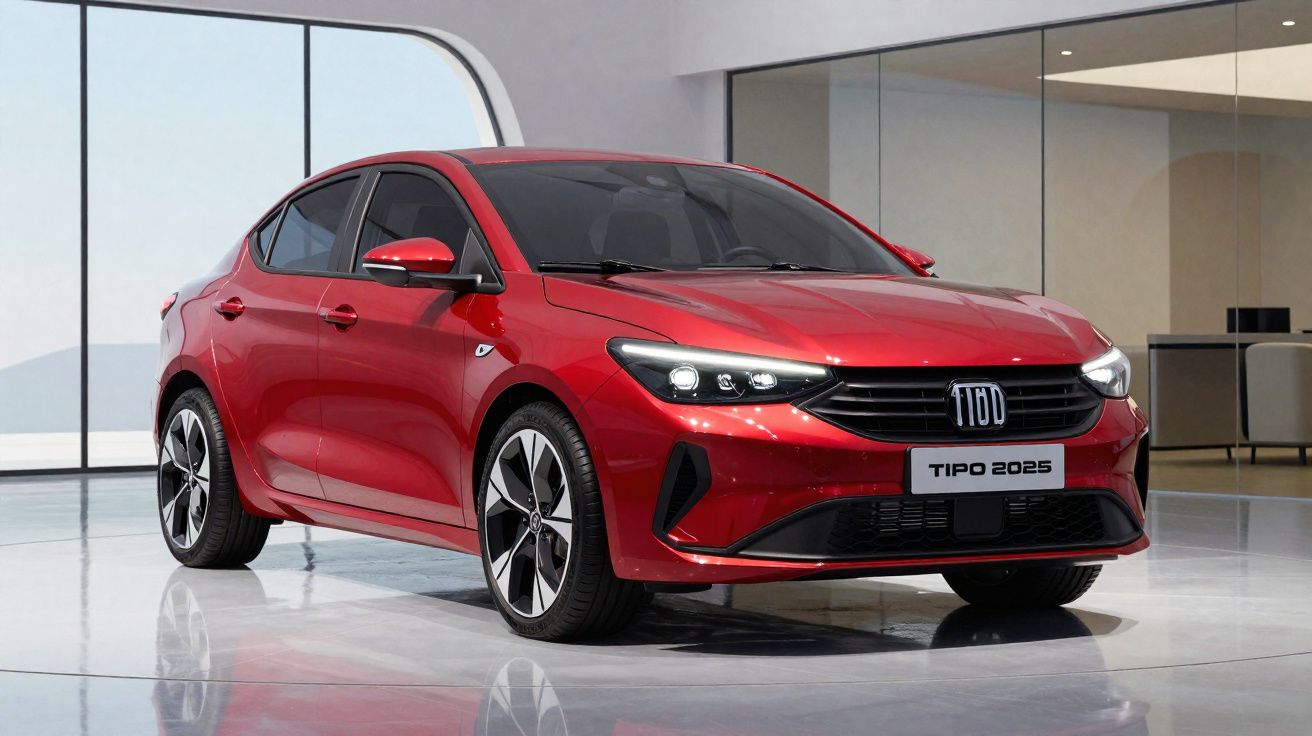
In the closing months of 2025, the most level-headed purchase may well be neither the newest electric SUV nor a fashionable crossover, but a straightforward Italian hatchback that polishes traditional strengths: generous room, low running costs and a list price that still begins below €20,000 (around £17,000).
Fiat Tipo: the compact that won’t join the tech circus
The Fiat Tipo has never chased poster-car status in the family hatchback segment. It is not engineered to go viral, and it does not try to masquerade as a near-premium gadget on wheels. Its appeal is rooted in fundamentals: clean, sensible styling, useful dimensions and an interior that feels reassuringly conventional rather than “spaceship”.
It is sold as either a five-door hatchback or an estate. In terms of footprint, the hatch is about 4.37 m long, while the estate sits at roughly 4.57 m. Those measurements translate into the kind of cabin space that used to be routine-before many “compact” cars grew outside while becoming tighter within.
In the rear, passengers benefit from strong legroom and genuine head clearance, aided by relatively upright glass areas instead of coupe-like rooflines. If you’re transporting children, colleagues or clients, that matters far more than whether the cabin lighting cycles through 64 shades.
In a class obsessed with image, the Tipo leans on practicality-especially in estate form, with roughly 520–550 litres of boot space.
Cargo capacity is one of the Tipo’s standout points. The hatchback already copes well with everyday luggage, but the estate comfortably clears the 500-litre threshold, nudging into territory occupied by some mid-size SUVs. A low load lip, wide aperture and square-edged shape mean pushchairs, suitcases or tool boxes fit in without meticulous “Tetris” packing.
The diesel that refuses to die: 1.6 Multijet in the Fiat Tipo
Although most manufacturers have quietly retired diesel options in this category, Fiat continues to offer a 1.6-litre Multijet diesel in the Tipo, producing about 130 hp. It won’t dominate at the traffic lights, but it delivers a well-judged mix of everyday shove and restrained fuel use.
On the motorway, the Tipo settles into an easy cruise-even with a family and a boot full of kit. Because peak torque arrives early, the car needs fewer gearchanges, and long journeys are typically calmer and less noisy. For drivers routinely covering 20,000–30,000 km a year, that efficiency is not theoretical: it shows up in monthly spending.
Driven sensibly, the 1.6 Multijet can come in under 5.0 L/100 km in mixed driving, making around 1,000 km between fill-ups realistic.
With consumption commonly sitting around 4.6–5.0 L/100 km (conditions depending), a full tank can equate to roughly 1,000 km-about 1,000 km (620 miles)-or more. That kind of range is increasingly unusual as petrol engines shrink and many first-wave EVs demand more frequent charging, particularly in cold weather.
For motorists in rural areas-or anywhere public charging remains sparse or unreliable-the diesel Tipo occupies a very clear niche. There is no route planning, no apps, and no waiting for a rapid charger: just a long-range fuel tank and familiar mechanicals most independent garages already understand.
Petrol and LPG for drivers who want other options
Diesel is not for everyone. Fiat also sells the Tipo with a small 1.0-litre turbo petrol unit at around 100 hp, targeted at town work and mixed driving. In selected markets, there is also an LPG (autogas) version. LPG models usually cost more to buy, but can significantly reduce fuel bills where autogas is widely available and taxed favourably.
- 1.6 Multijet 130: best for high-mileage drivers and motorway-heavy commuting
- 1.0 turbo petrol: better aligned with city use and shorter, more varied trips
- LPG version: most appealing where autogas is inexpensive and filling stations are common
This spread of powertrains underlines the Tipo’s philosophy: it avoids betting everything on a single trend. Rather than pushing buyers into mild-hybrid talking points or expensive half-steps towards electrification, Fiat focuses on simple, proven choices.
A price that undercuts trend-led rivals
The Tipo’s pricing is what drags it back into the frame for cost-sensitive shoppers. In late 2025, a diesel City trim is advertised at roughly €19,700 in France (including tax)-about £16,800 at typical exchange rates. For that money you get a 130 hp diesel, dimensions similar to a traditional Volkswagen Golf-era family hatch, and a specification that covers everyday needs.
Importantly, the kit list is not stripped out. Even in lower trims you can expect air conditioning, a central touchscreen, core driver-assistance features, cruise control and alloy wheels. It is not a rolling smartphone, but it is also a long way from an old-school hire car.
With dealer incentives and pre-registered (“0 km”) stock, some diesel Tipo deals dip below €16,500 (about £14,100), landing in budget-brand territory.
That is where the value proposition becomes hard to ignore. Clearance offers can bring certain diesel hatchbacks or estates down into the €15,700–16,500 band (around £13,400–£14,100). At that level, the Tipo is competing not only against mainstream compacts, but also against cut-price crossovers-and even some so-called budget marques that may deliver less space with weaker engines.
What you gain as you climb the trim ladder
Move up to trims such as City Life and (RED) and you’ll typically find extra comfort and convenience rather than gimmickry. Larger 7-inch or 10-inch touchscreens, built-in navigation, reversing cameras and front/rear parking sensors improve day-to-day usability without turning the car into a rolling technology demo.
| Trim level | Key features | Target buyer |
|---|---|---|
| City | Air conditioning, touchscreen, basic safety aids, 16-inch wheels | Cost-focused private buyers, fleet users |
| City Life | Larger screen, reversing camera, parking sensors, upgraded interior | Families wanting comfort and convenience |
| (RED) | Distinct styling details, added equipment (market dependent) | Drivers wanting a touch more flair without luxury pricing |
The overall strategy is refreshingly clear: a straightforward pricing structure without a maze of confusing option packs-useful for anyone who simply wants to understand what they’re paying for and what the monthly cost will be.
Who the 2025 Fiat Tipo actually suits
The 2025 Tipo is aimed squarely at drivers feeling squeezed by rising prices and increasing complexity. It targets people who want a brand-new car, but have no desire to commit to a long, expensive lease on a heavily optioned EV that does not match their routine.
It fits freelancers travelling nationally, sales representatives, families watching the budget closely, and small businesses operating a couple of vehicles. For those groups, the Tipo’s appeal is straightforward: predictable running costs, a properly usable cabin and equipment chosen for real life rather than showroom one-upmanship.
For many motorists now, the real decision isn’t diesel versus electric-it’s an affordable monthly budget versus a financial migraine.
Unlike some low-cost electric models that depend heavily on incentives and can involve lengthy delivery delays, the Tipo is often available quickly from stock. That matters if your current car is on its last legs and you need a replacement in weeks, not after half a year waiting for a build slot.
Running the numbers: a simple cost-of-ownership example
Consider a typical European driver travelling 25,000 km per year, mainly on motorways and A-roads. At approximately 4.6 L/100 km, a diesel Tipo would use around 1,150 litres annually. If diesel costs, for example, €1.80 per litre, yearly fuel spending would be roughly €2,070.
Now set that against a similarly sized petrol crossover consuming 7.0 L/100 km. Over the same distance, it would need about 1,750 litres per year. At €1.85 per litre, annual fuel spend rises to over €3,200. The gap readily exceeds €1,000 per year, which in many European countries is comparable to a month of take-home pay.
Over a five-year period, that difference can fund a family holiday, pay for home efficiency upgrades or simply soften the impact of general living-cost increases. It is a key reason why the Tipo-despite lacking glamour-still deserves consideration from rational buyers.
Key terms and trade-offs buyers should understand
Two phrases are commonly used when discussing cars like the Tipo, and they’re worth defining. Residual value is the amount the car is likely to be worth when you sell it or part-exchange it. TCO (total cost of ownership) combines the full picture: purchase price, fuel, insurance, servicing, tyres and taxes.
A low sticker price does not automatically mean low overall costs if the car is thirsty or depreciates heavily. The Tipo’s case rests on a modest upfront outlay, efficient engines and generally affordable servicing-though it is unlikely to retain value like a premium badge. For many private buyers, the cheaper purchase price and day-to-day fuel savings often outweigh the softer residuals.
Regulation is the final piece of the puzzle. Many cities continue to tighten rules around older diesel vehicles. The Tipo’s modern diesel, equipped with up-to-date emissions controls, typically rates more favourably than older diesels, but anyone living in a major urban area should still check future local policy before committing. In many suburban and rural regions, the bigger priority remains simple: the ability to cover around 1,000 km on a tank without having to hunt down a charger.
Two extra UK-market considerations: clean-air zones and everyday running costs
If you are buying with the UK in mind, it is wise to verify the exact emissions standard and local clean-air-zone requirements before signing. Rules can differ between cities, and what is acceptable today may tighten in future. Checking compliance early helps you avoid paying for a car that becomes inconvenient for occasional city trips.
It is also worth pricing insurance, tyres and routine servicing in advance, because these can meaningfully affect TCO. The Tipo’s mainstream mechanicals and wide parts availability generally help keep maintenance straightforward, and choosing a trim that matches your needs (rather than chasing extra gadgets) can make the monthly budget easier to manage.


Comments
No comments yet. Be the first to comment!
Leave a Comment