
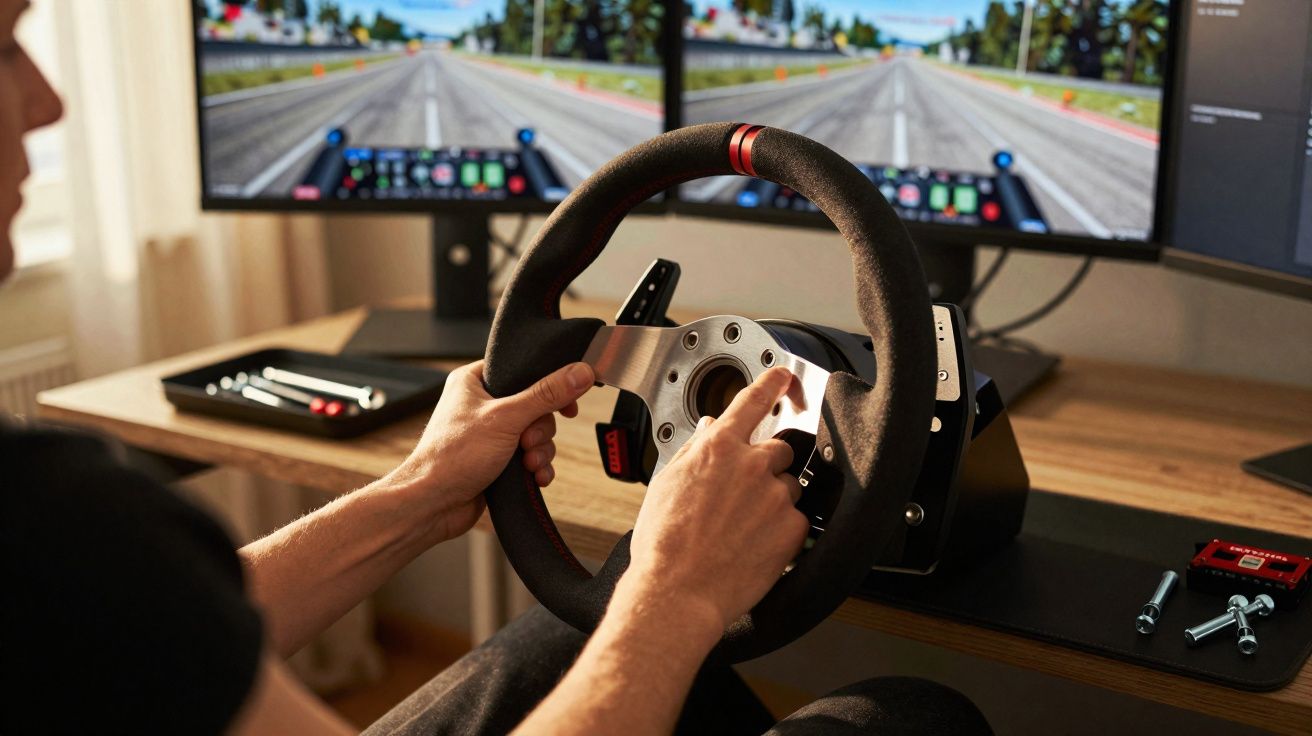
A relatively small box, a handful of loose parts, and not a complete steering wheel in sight.
That alone is enough to tell you you’re dealing with something different.
Your first encounter with the Fanatec ClubSport Wheel Rim GT3 doesn’t begin with the familiar ritual of snapping a wheel onto the base and heading straight out of the pits. It starts with a moment of uncertainty, an Allen key in your hand, and the clear feeling you’re stepping over a line in sim racing: moving from “plug and play” to “build it yourself”.
From ready-made wheel to custom rim: a mindset shift
For years, custom rims felt like a space reserved for the truly committed-people who enjoy taking things apart almost as much as driving. The old logic was straightforward: if you only want to race, you buy a complete wheel; if you want to tweak everything, you go modular.
With the ClubSport Wheel Rim GT3, that label begins to crumble. This isn’t a full steering wheel at all-it’s a GT3-style rim that relies on other Fanatec components to become functional. That changes what you’re really buying: instead of picking a finished product off a shelf, you start thinking in terms of a setup project.
The rim stops being a secondary accessory and becomes the starting point for a wheel built to your preferences.
What the Fanatec ClubSport Wheel Rim GT3 actually is
Shape, materials, and intent
In practical terms, the GT3 is a 318 mm diameter rim made from CNC-machined, anodised aluminium, fitted with 50 Shore A rubber grips. That Shore A rating points to rubber that’s firm without being harsh. In the hands, it delivers a secure, confident grip that stays comfortable over longer stints.
| Spec | Detail |
|---|---|
| Model | Fanatec ClubSport Wheel Rim GT3 |
| Type | GT3 rim, no electronics and no Quick Release |
| Diameter | 318 mm |
| Weight | 700 g (with bracket) |
| Materials | CNC anodised aluminium and 50 Shore A rubber grips |
| Compatibility | ClubSport Universal Hub V1/V2, Podium Hub |
| Official price | €99.99 |
On its own, it does nothing-there’s no electronics, no buttons, no paddles, no Quick Release. The design philosophy is simple: the rim is the “bodywork”, while a Hub provides the controls and electronics, and QR2 handles the fast connection to a Direct Drive wheel base.
The parts that bring it to life
To turn the rim into a complete, usable wheel, you’re looking at a modular stack such as:
- ClubSport Universal Hub V2: provides electronics, paddle shifters, connectors, and Button Clusters.
- QR2: the quick-fit system that lets you swap wheels in seconds.
- Button Clusters / modules: repositionable button blocks, adjusted to suit a GT-style rim layout.
Fanatec isn’t just selling a rim-it’s selling a modular ecosystem that nudges you towards gradual, step-by-step upgrades.
Building your first Fanatec rim: tedious job or behind-the-scenes satisfaction?
The unboxing makes the point immediately. You’ll find more screws than many people are used to, a specific bracket designed to reposition the Hub arms, sticker sheets for customisation, and plenty of room for trial and error.
The assembly process includes:
- loosening the arms of the ClubSport Universal Hub V2 using an 8 mm spanner (not included in the kit);
- fitting the reinforced bracket that prepares the structure for the Button Clusters;
- carefully arranging internal cabling to avoid slack and unwanted noise;
- lining up the rim with your preferred driving position before tightening everything down fully.
It’s not difficult in a way that should intimidate anyone who’s built a PC or adjusted a pedal set, but it does demand attention-and a little patience. That’s often where the “click” happens: the wheel stops feeling generic and starts to feel like yours, even if the changes are subtle.
Assembling the rim isn’t only a technical step; it becomes part of the emotional connection with the kit.
In-hand feel: does the GT3 shape genuinely change how you drive?
Ergonomics and grip
Once the rim is mounted to the ClubSport Universal Hub V2 and paired with QR2, the first impression isn’t visual-it’s the weight. The finished build feels denser than many “ready-to-race” wheels aimed at a similar use case.
The aluminium stiffness and the more squared-off, GT-style hand position change the natural driving motion. Instead of the broad, flowing steering you often get with a fully round rim, inputs tend to become tighter and more deliberate-better suited to short, firm corrections.
The Button Clusters mounted on the bracket add both visual and functional cohesion. Controls sit close to your thumbs without forcing you to loosen your grip, which helps when adjusting ABS, TC, or radio functions in GT-focused simulators.
On track: from Assetto Corsa Competizione to everyday use
In Assetto Corsa Competizione, using a Fanatec Podium DD (25 Nm) base, the most noticeable shift isn’t a sudden, magical performance gain-it’s a change in driver behaviour.
Because the rim (and the overall assembly) is a bit heavier and very rigid, it naturally encourages smoother inputs. The sense of grip on corner entry can feel more progressive, and snap corrections in oversteer moments often become less abrupt. It’s a gradual improvement you notice over several stints rather than in one hero lap.
The GT3 rim doesn’t automatically make you faster; it pushes your brain towards more disciplined driving.
Hub, QR2, modules: the rim as part of a larger puzzle
Once everything is installed, it becomes obvious that the ClubSport Wheel Rim GT3 isn’t the lone star of the experience. It’s the face of a concept that depends entirely on the wider Fanatec ecosystem.
| Test setup | Component |
|---|---|
| Wheel base used | Fanatec Podium DD (25 Nm) |
| Hub | ClubSport Universal Hub V2 |
| Quick Release | QR2 (metal) |
| Main sim tested | Assetto Corsa Competizione |
That “solid” feel, for example, is often more about the Hub + QR2 combination than the rim alone. With no noticeable play or flex, the wheel delivers the fine textures of force feedback cleanly. The GT3 rim essentially becomes the interface between the base’s torque and your hands.
This architecture also changes the economics. Instead of buying multiple complete wheels, you can invest in a strong Hub once and build a collection of rims-switching between GT3, formula, or rally depending on the championship you’re running.
Who this step into custom Fanatec rims makes sense for
The profiles that benefit most
- Sim racers focused on GT3/GT4: the grip shape and overall layout match these cars well, especially in ACC.
- Drivers already invested in the Fanatec ecosystem: if you already own a compatible base and Hub, the standalone rim pricing makes far more sense.
- Anyone who enjoys physical setup tweaks: small changes to button and paddle positioning can pay off over a season.
If you just want to plug in a USB cable and drive, the mental overhead can be irritating. The time spent assembling, testing, and adjusting may feel like wasted effort. But if you treat hardware as part of the hobby, that same time can be genuinely enjoyable.
Key concepts to understand before you spend the money
Some terms look intimidating at first, but they matter when deciding what to buy:
- Hub: the central module carrying electronics, paddles, and buttons. Without it, the rim is purely mechanical.
- Quick Release (QR2): a system that lets you swap wheels in seconds-valuable if you alternate between formula, GT, and rally.
- Shore A: the scale used to rate rubber hardness, directly affecting comfort and how “locked in” the grip feels.
Once these ideas are clear, you can plan your setup more deliberately. Instead of a one-off purchase, it becomes a roadmap: the GT3 rim now, a single-seater rim later, and perhaps an extra button module or display further down the line.
Practical scenarios and where frustration can creep in
There are a few sensible warnings that can prevent buyer’s remorse. If you’re coming from very lightweight wheels, the extra mass of the full assembly can feel surprising. On wheel bases weaker than a Podium DD, you may need to fine-tune force feedback to avoid unnecessary arm fatigue.
The learning curve is another factor. The first build involves reading the manual, experimenting with positioning, and occasionally getting alignment wrong before you nail it. If you expect a completely frictionless experience with zero adjustment, the process can feel needlessly complicated.
That said, modularity is exactly where the system shines. A single Hub can carry a GT3 rim for Assetto Corsa Competizione, a more compact rim for formula cars in other sims, and later a rally-oriented setup with more physical buttons for loose-surface driving. The spend stops being a single hit and becomes something you spread out-and refine-over time.
Two extra considerations that are easy to overlook
Comfort isn’t only about shape; it’s also about consistency over long sessions. Rubber grips at 50 Shore A can feel excellent bare-handed, but they can also behave differently depending on whether you race with gloves, how warm your room gets, and how much moisture builds up during endurance stints. Factoring that into your cockpit habits-ventilation, gloves, and cleaning-can make the rim feel “new” for longer.
It’s also worth thinking about the practicalities of ownership. A modular wheel encourages you to reconfigure, but each rebuild means handling screws, routing cables neatly, and checking that everything remains tight and correctly aligned. If you enjoy the ritual, it’s part of the charm; if you don’t, a complete wheel may still be the better fit-even if the custom route looks more flexible on paper.



Comments
No comments yet. Be the first to comment!
Leave a Comment