
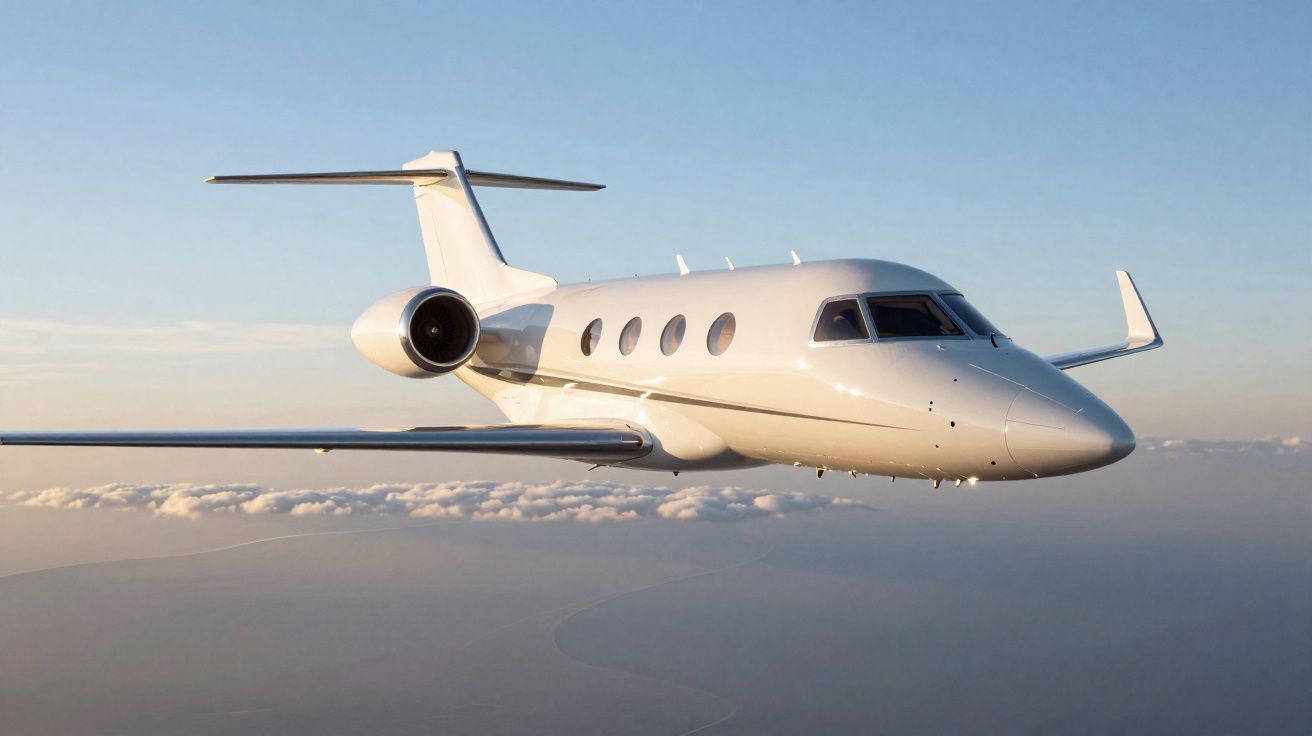
Engineers have traditionally viewed the transonic region as an unforgiving boundary, yet one Canadian manufacturer has chosen to operate right beside it-reassessing how quickly a “normal” passenger jet can sensibly travel.
A civil jet that flirts with the sound barrier
Bombardier’s Global 8000 is now the fastest civil aircraft in service since Concorde, with a certified maximum speed of Mach 0.95. In practice, that places it only a sliver below the speed of sound, while remaining technically subsonic.
Flying that fast means living in the aerodynamic grey area known as transonic flight. Over parts of the wing and fuselage, airflow can accelerate beyond Mach 1 locally, generating shock waves. Those shocks can cause a sharp rise in drag and disrupt lift-one of the key reasons most airliners typically cruise nearer Mach 0.85.
By making the edge of transonic flight an everyday operating point, the Global 8000 turns what was once a red line on engineers’ plots into a normal working regime.
This headline speed does not revive Concorde-style theatre: there is no routine Mach 2 dash and no supersonic boom. Instead, it is a marker of how far subsonic aerodynamics, propulsion and flight-control software have progressed over the past two decades.
Bombardier’s comeback: from crisis to flagship
Who Bombardier is - and why the Global 8000 matters
Bombardier Aerospace, headquartered in Canada, was reshaped by its 1986 acquisition of Canadair. Over the following 30-plus years, it evolved from specialist projects into a broad aircraft manufacturer, producing turboprops, regional jets and long-range business jets.
That momentum faltered in the 2010s. The CSeries commercial jet programme suffered delays and budget overruns, and became entangled in trade disputes. Bombardier ultimately transferred the programme to Airbus, where it continues as the A220. Around the same period, the company divested other lines too, including its CRJ regional jets, Dash 8 turboprops and amphibious aircraft.
What was left was a more concentrated business-aviation business. The Global and Challenger families became the company’s centre of gravity, backed by an extensive services footprint and engineering capability in Quebec and across North America.
The Global 8000 is the outcome of a high-stakes decision: step away from commercial jets and commit to ultra-long-range business aviation.
For that strategy to be credible, the Global 8000 must be more than a high-end cabin with a premium badge. It needs to function as a technology and brand flagship-proof that Bombardier is not merely enduring, but setting the pace on performance.
Triple certification in record time
What EASA, FAA and Transport Canada’s approval really means
Certification for the Global 8000 in Canada was granted in November 2025, followed by the US Federal Aviation Administration (FAA) in December. Europe’s regulator, EASA, has since completed the set, giving Bombardier approvals across three major jurisdictions.
This process typically runs for years and examines far more than headline performance. It assesses structural fatigue behaviour, system failure tolerance, and handling across the full flight envelope. It also involves items such as emergency-evacuation demonstrations, lightning-strike evaluation and extensive flight-test campaigns.
Because the aircraft is intended to operate close to Mach 0.95, regulators pay particularly close attention to high-speed aerodynamics. They need evidence of stable, consistent handling during fast climbs and descents, and predictable behaviour as transonic shock effects begin to appear.
This three-regulator sign-off confirms the Global 8000 is a real commercial aircraft, not simply a high-speed technology demonstrator.
With these certifications in place, Bombardier can deliver aircraft into the main markets and support operations into most significant business-aviation hubs globally.
Range, cabin and tech: what the Global 8000 actually offers
14,800 km without a refuelling stop
Bombardier quotes the Global 8000’s range at 8,000 nautical miles, which is roughly 14,800 km. In practical terms, this makes non-stop missions such as the following achievable for a private jet:
- Paris – Singapore
- Los Angeles – Sydney
- New York – Johannesburg
That reach enables executives, government delegations and medical-evacuation teams to avoid hub airports and fly direct to the most suitable destination.
Power comes from General Electric Passport engines, producing about 84 kN of thrust each. At cruise, the pairing of high-bypass turbofans with a carefully optimised wing is designed to keep fuel consumption competitive, even at the higher end of subsonic speed.
Four real cabin zones instead of one long tube
Rather than a single open-plan interior, the Global 8000 is arranged as a four-zone cabin, typically comprising:
- a forward lounge or conference space
- a dining or meeting area
- a dedicated rest or cinema section
- a private suite that converts into a full bedroom
Bombardier promotes around 16.6 m² of floor area. The underlying idea is simple: on sectors that can run beyond 15 hours, passengers can work, eat, unwind and sleep in separate environments.
Smooth Flex Wing: two wings in one
A key design element is Bombardier’s Smooth Flex Wing. Its structure and aerodynamic tuning are intended to make it behave like two wings, depending on the phase of flight.
At lower speeds-take-off and landing-the wing prioritises lift and stability, allowing operations from shorter runways than many airliners. At high cruise speeds, the geometry and control surfaces are set up to reduce drag and manage shock-wave behaviour as the aircraft approaches Mach 1.
The Smooth Flex Wing is intended to open up about 30% more airport options, while still enabling near-supersonic speed on long legs.
Being able to use smaller airports has an everyday payoff: less time on the ground, shorter transfers by road, and easier access to business districts or remote industrial locations.
A cockpit built for 15-hour days
The Global 8000 is equipped with the Vision Flight Deck, a fully digital fly-by-wire cockpit. Instead of mechanical linkages running directly from the controls, computers interpret pilot commands and move the control surfaces accordingly.
This architecture makes it possible to enforce safe operating limits automatically, refine pilot inputs and reduce workload-particularly when turbulence, step climbs or high-speed configuration changes coincide. Over ultra-long missions, small reductions in cognitive demand can be significant.
The avionics suite also brings together head-up displays, synthetic-vision imagery and advanced navigation modes, helping crews maintain situational awareness as fatigue becomes a factor late in the flight.
Cabin air as a selling point
Bombardier has put strong emphasis on cabin atmosphere. The Pũr Air system combines hospital-grade HEPA filtration with activated-carbon filters aimed at odours and volatile organic compounds.
Air is exchanged more frequently than on many large airliners, and cabin altitude is maintained at a comparatively low level. Together, those measures can ease issues such as headaches, dry eyes and jet lag-particularly for travellers crossing several time zones in quick succession.
On a 14-hour sector at near‑Mach speeds, cabin pressure and air quality can matter as much to productivity as the length of the bed.
Connectivity and mission planning (new)
For many buyers, speed is only valuable if the cabin remains a productive workspace. In this class of aircraft, high-bandwidth connectivity, secure communications and reliable power for devices can be as decisive as the seating layout-especially for teams running meetings, approvals and document review while airborne.
Route choice also matters. On ultra-long-range legs, dispatchers may trade a small amount of speed for a more favourable track, better winds or simpler arrival timing at congested airports. In other words, the aircraft’s top speed expands the options, but operational efficiency still comes from planning.
A business jet that plays on two fronts
Speed as a business tool, not a stunt
Bombardier presents the Global 8000 as “two aircraft in one”: exceptionally fast while still being genuinely ultra-long-range. The intended customer is not necessarily chasing a record, but trying to compress a schedule.
On paper, saving 30 to 60 minutes on a long sector may not sound dramatic. In practice, for travellers linking multiple continents in a week, it can mean fitting in an additional meeting during working hours-or arriving with enough energy to operate immediately after landing.
This approach differs sharply from Concorde’s. Concorde accepted high fuel burn and limited cabin space in exchange for outright speed, and it faced tight constraints on where it could fly due to noise. The Global 8000 stays subsonic, travels farther, and is designed to comply with modern noise and emissions requirements.
Sustainability and operating realities at the sharp end (new)
At the upper end of performance, operators still have to balance pace with cost and environmental expectations. Use of sustainable aviation fuel (SAF), careful payload planning and selecting efficient flight levels can all influence the real-world footprint of an ultra-long mission.
Equally, running near the edge of the envelope brings discipline: maintenance scheduling, crew-rest planning and performance monitoring become more critical when an aircraft is routinely flown close to its maximum certified speeds.
A crowded race at the top end of business aviation
How it stacks up against Gulfstream and Dassault
The Global 8000 is competing in a busy segment. Gulfstream and Dassault are pursuing the same blend of ultra-long range and high speed.
| Aircraft | Range (km) | Max speed (Mach) | Cabin (m² / zones) | Approx. price (€m) |
|---|---|---|---|---|
| Bombardier Global 8000 | 14,816 | 0.95 | 16.6 / 4 | 74 |
| Gulfstream G700 | 13,890 | 0.935 | 17.1 / 4 | 72 |
| Dassault Falcon 10X* | 13,890 | 0.925 | 16.1 / 4 | 69 |
| Gulfstream G800 | 14,816 | 0.925 | 17.5 / 4 | 74 |
*Falcon 10X figures based on development targets.
Each competitor leans into a slightly different proposition: Gulfstream highlights cabin width and a mature support network; Dassault stresses fuel efficiency and European industrial pedigree; Bombardier foregrounds peak speed and greater airport access enabled by its wing concept.
What Mach 0.95 really means
Transonic flight without the boom
Mach 1 is the speed of sound, roughly 1,235 km/h at sea level, though it varies with temperature and altitude. At cruise height, the speed of sound is lower, so Mach numbers express speed relative to local conditions rather than a fixed kilometres-per-hour figure.
Most current airliners cruise around Mach 0.78–0.85. Beyond about Mach 0.88, shock-wave effects intensify and the structural and control challenges increase, which is why mainstream commercial designs have historically stayed shy of Mach 0.9.
Reaching Mach 0.95 therefore means pressing beyond a long-established comfort zone. Achieving this safely requires refined wing shaping, materials that are both strong and lightweight, and sophisticated control laws that keep the aircraft stable as airflow behaviour shifts in the transonic region.
Crucially, unlike Concorde, the Global 8000 does not routinely cross Mach 1 in cruise. By remaining subsonic, it avoids leaving a continuous sonic-boom footprint-making operations far easier to accommodate from both a regulatory and community-noise perspective.
Who actually flies at these speeds - and why
Obvious customers include large corporates, ultra-high-net-worth individuals and governments. However, the mission set extends beyond executives trying to avoid queues.
Medical-repatriation providers may use long-range aircraft to move patients, specialist teams or organs across continents, where minutes can be meaningful. Discreet diplomatic trips and time-sensitive inspections of remote energy or industrial infrastructure can also benefit from direct routing at high subsonic speed.
There are compromises. Higher cruise speeds can increase fuel burn per hour, even if reduced journey time offsets some of the impact. At this tier of performance, operators must manage costs, crew-rest rules and maintenance planning with particular care.
For charter customers comparing offers, it also helps to understand the language. Range figures are usually based on specific assumptions about payload and fuel reserves, so the achievable distance with a full cabin may be lower. Likewise, “Mach 0.95 max” does not mean the aircraft will fly that fast on every sector: flight planners often choose a slightly slower cruise to balance fuel, winds aloft and arrival slots at busy airports.






Comments
No comments yet. Be the first to comment!
Leave a Comment