
The salesperson leans in, dropping their voice like they’re about to share something confidential. You’re standing in an immaculate showroom, a gentle playlist humming in the background, your hand resting on the pristine steering wheel of a brand‑new electric SUV. “Zero emissions,” they say, tapping a high‑gloss brochure. Outside, a bright green charging symbol reflects on rain-dark tarmac. You imagine yourself gliding through town in near silence, skipping petrol stations, doing your bit for the planet on the school run and the weekly shop.
Then the awkward questions creep in. Where did the battery materials come from? Who extracted the metals? And what, exactly, powers the socket in your garage when you plug in at night? The salesperson smiles, offers you the keys for a test drive, and you smile back.
Yet something uncomfortable follows you in the rear‑view mirror.
Electric cars and the “zero emissions” myth: the pollution starts long before you drive away
For most of us, the “clean” story begins at the charging lead: a tidy dashboard icon, a percentage that climbs, perhaps a little green leaf graphic that makes everything feel sorted. That’s the part car makers put front and centre.
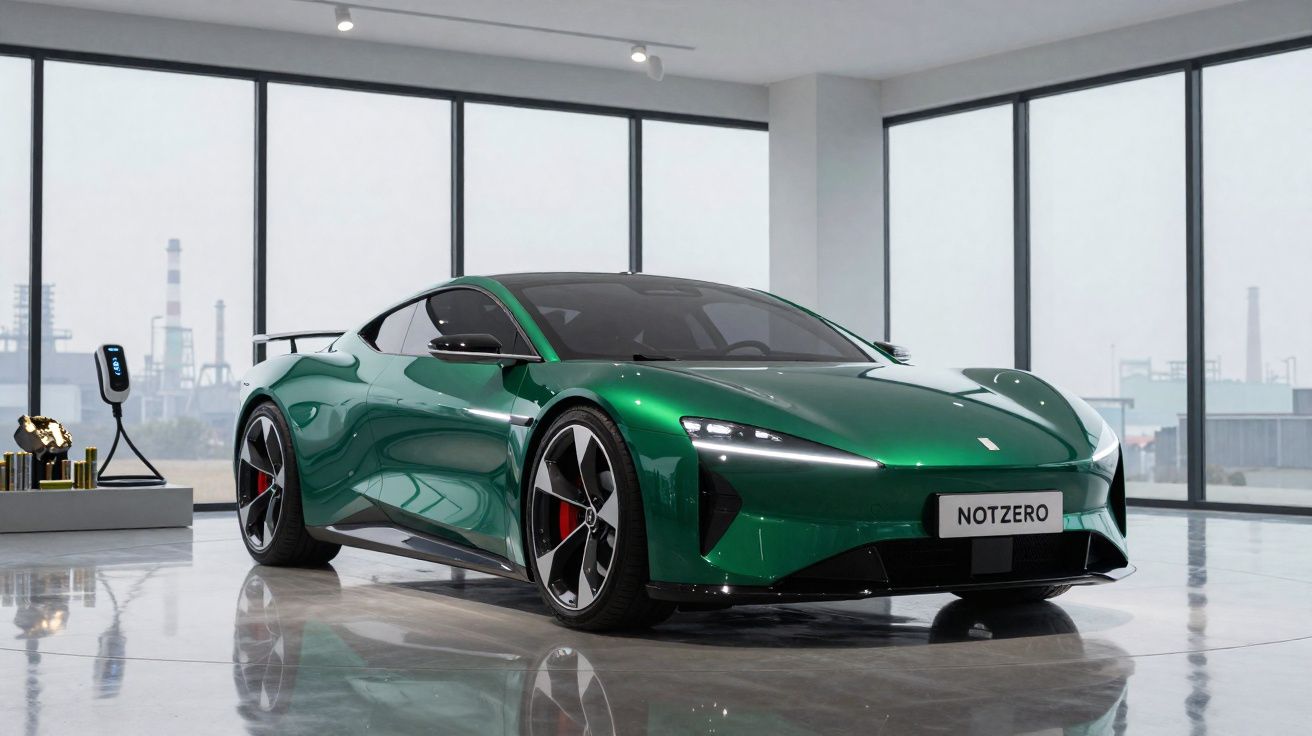
But the fuller emissions story starts years earlier-across mines, refineries, factories, container ships and power stations. Long before an electric car reaches a driveway, a trail of CO₂ has already been locked into its steel, electronics and, above all, its battery.
No one cheers when a lorry drops off battery cells at the factory gate. No one takes a celebratory photo next to a cobalt mine.
Behind the polished advertising, there are places like Chile’s Atacama Desert, where vast brine pools sit under the sun to concentrate lithium. There are hazardous, cramped tunnels in the Democratic Republic of Congo where cobalt is dug out by hand. And there are enormous battery plants in China running day and night, sometimes drawing power from grids still heavily reliant on coal while they stamp, weld and assemble modules at industrial pace.
Volvo itself has published life‑cycle estimates suggesting that building an electric SUV-particularly the battery-can generate notably more CO₂ upfront than producing an equivalent petrol model. The result is that the electric version must be driven for many thousands of kilometres before its overall footprint catches up and then improves. The “green” advantage doesn’t start at the starting line; it arrives later.
This imbalance exists because electric vehicles are emissions‑heavy at the beginning. Mining, refining, battery chemistry, specialist electronics and energy‑intensive manufacturing all happen before the car turns a wheel. In effect, your future “clean” miles are paid for with a dirtier deposit.
Once the vehicle is in use, tailpipe emissions do indeed drop to zero. But the CO₂ linked to each kilometre still depends on how electricity is generated where you live. Charge from a coal‑dominated system and your quiet commute is still backed by smoke stacks elsewhere. Charge from wind, solar, hydro or nuclear and the equation shifts decisively.
That’s the part the brochure rarely illustrates.
The life‑cycle calculation nobody wants to do on a Sunday night
If you genuinely want to know whether an electric car is greener, you have to do the tedious, unglamorous work: follow the full life cycle. That means accounting for emissions from raw material extraction, battery production, vehicle assembly, electricity generation, driving, maintenance and end‑of‑life treatment (recycling or reuse).
Online tools can help, but they immediately demand information most people don’t have to hand: your local grid’s carbon intensity, how long you’ll keep the car, how large the battery is, and roughly how many kilometres you drive each year.
In reality, most of us see the “zero emissions” badge, feel reassured, and carry on. Very few people are running the numbers after every trip.
A couple in Berlin decided to do exactly that. They bought a small electric car, fitted a smart meter, and recorded every charging session, every journey and every kWh. They even checked Germany’s electricity mix hour by hour to estimate the real CO₂ behind each “clean” mile. After 12 months, the engineer in the household had built a spreadsheet that could pass for a short book.
Their verdict surprised friends who expected a simple fairy tale: compared with a petrol car, the EV was clearly better overall-just not as spotless as the adverts suggest. Short urban journeys charged overnight, when the grid mix was more fossil-heavy, looked particularly poor. Longer drives charged during bright, windy periods looked markedly better.
In other words, “green driving” turned out not to be only about the car. It was about timing, location and behaviour.
That is the core truth about electric mobility: the answer to “is it green?” is nearly always “it depends”. It depends on where the metals were sourced, how the battery was made, what powers the grid, how the vehicle is driven, and how often people swap cars for new ones.
A modest electric car kept for 12 years and charged mostly on renewable electricity is a very different proposition from a two‑tonne luxury EV leased for three years and rapid-charged along a coal-heavy motorway network. Yet both can be marketed as “zero emission”.
When all that complexity is flattened into a single green logo, it isn’t exactly a lie-it’s just the nicest slice of the truth.
Driving greener starts before you press “Start” in your electric car
If you already have an electric car-or you’re thinking about buying one-the most meaningful step is not necessarily another gadget or upgrade. It’s asking the questions that marketing prefers you not to ask. Begin with battery size: how much range do you genuinely need? A headline figure of 500+ kilometres can feel comforting, but it usually means more raw materials, more weight and higher production emissions.
Many people discover their routine driving would be met easily by a smaller battery. Less battery often means a lighter car, reduced resource demand and a smaller upfront CO₂ burden. One size does not fit all-especially not when vehicles are measured in tonnes.
Next, focus on electricity rather than aesthetics. Can you move to a greener tariff, or charge when the grid is typically cleaner? In the UK, for example, National Grid’s carbon intensity varies by time and region; shifting charging to periods with more wind generation can lower the CO₂ tied to each kWh. Smart chargers and time‑of‑use tariffs can help, but only if you actually use them thoughtfully.
One of the most overlooked climate wins is simply keeping the car for longer. Replacing a vehicle every few years-electric or not-restarts the high‑emissions manufacturing phase again and again. We all recognise the moment: a sleek new model appears online and suddenly a three‑year‑old car feels outdated. That reaction is engineered. Yet, in many cases, the greenest car is the one you already own-well maintained, driven with restraint, and not replaced at the first scuff on the bumper.
Owning an electric car doesn’t automatically make every kilometre “innocent”.
There is also a wider, social dimension that rarely gets equal billing. Individual emissions sit within a shared transport system. Fewer private cars overall-supported by public transport, cycling, walking and car clubs-means fewer batteries the world needs to manufacture in the first place. An electric car isn’t a moral shield; it’s one tool among many, and its benefits are greatest when it reduces pollution without encouraging ever-bigger vehicles and ever-more miles.
A further piece of the puzzle is what happens after the battery’s first life in a car. Many packs can be repurposed for “second-life” stationary storage-helping balance renewable electricity-before they are finally recycled. Recycling systems are improving, including in Europe and the UK, but they are not a magic eraser: collection, transport and processing all have footprints, and the industry is still scaling. Treating recycling as a reason to buy oversized batteries misses the point; the most sustainable battery is typically the one you didn’t need to make.
“We leapt from ‘SUVs are bad’ to ‘electric SUVs are good’ without asking whether we needed SUVs at all,” a French urban planner says with a sigh. “We changed the engine, not the habit.”
To keep your decisions grounded, it helps to return to a few practical questions:
- Do I actually need a car for this journey, or is there a lower-impact alternative?
- Is my vehicle the right size for 95% of my life, or only for a handful of rare days?
- Am I charging at the cleanest realistic times and places?
- Could I share, rent or borrow rather than owning a second (or bigger) car?
- For my next upgrade, am I choosing image or impact?
The real scandal isn’t the electric car-it’s the fairytale we’re sold
The deeper you look into electric car emissions, the less tidy the picture becomes. You see harmful mining alongside genuine improvements in urban air quality. You find battery factories still powered by coal, yet also streets where children inhale less NO₂ because traffic has shifted away from exhaust pipes.
The scandal is not that electric cars have emissions-everything manufactured at scale does. The scandal is how rarely the difficult numbers are discussed at the point of sale: lifetime emissions, grid mix, the penalties of unnecessary size, and the way “zero emissions” language can hide all the complexity that matters.
A more useful conversation would be less glamorous and more honest: electric cars can be a step forward, but they are not a free pass. Some EVs are simply too large for what they do; some charging habits are needlessly high-carbon; and sometimes walking to the local shop beats driving-whatever is under the bonnet.
Seen this way, choosing an EV doesn’t stop being sensible. It simply becomes part of a bigger question: what kind of mobility system are we trying to build, and what habits are we willing to change?
| Key point | Detail | Value for the reader |
|---|---|---|
| Production emissions matter | Battery and vehicle manufacturing can create more CO₂ upfront than building a comparable petrol model | Helps you assess EVs beyond the “zero emissions” sticker |
| Electricity mix changes everything | Charging from coal-heavy grids is far more carbon-intensive than charging from renewables or nuclear | Shows when and where charging makes the biggest climate difference |
| Size and lifespan are crucial | Smaller batteries and longer ownership can dramatically reduce total impact | Steers you towards smarter choices in buying and day-to-day use |
FAQ
Do electric cars really pollute less than petrol cars?
In many regions, yes across the full life cycle-particularly once the car has covered enough kilometres. However, the size of the battery, how and where the vehicle is built, and the carbon intensity of your electricity supply can substantially widen or shrink the gap.How many kilometres do I need to drive to “offset” battery production?
Estimates differ, but many studies place the break-even range at roughly 20,000 to 80,000 kilometres. Cleaner electricity and smaller batteries tend to reduce that figure; coal-heavy electricity and very large electric SUVs tend to push it higher.Is a hybrid car greener than a full electric?
Often not over the long term. Hybrids carry two powertrains and still burn fuel. A modest full EV charged mainly using low-carbon electricity will usually come out ahead over time.What’s the most ecological choice if I already own a petrol car?
If your current vehicle is reliable and you drive relatively little, keeping it longer and reducing unnecessary trips can be better than replacing it immediately. If you cover high mileage, moving to an electric car can deliver benefits sooner.What should I look for when buying an EV with emissions in mind?
Favour a smaller, lighter model that matches your real needs, examine what the manufacturer discloses about battery sourcing and factory energy use, and-where possible-pair the car with a cleaner electricity tariff and smarter charging habits.
Comments
No comments yet. Be the first to comment!
Leave a Comment