
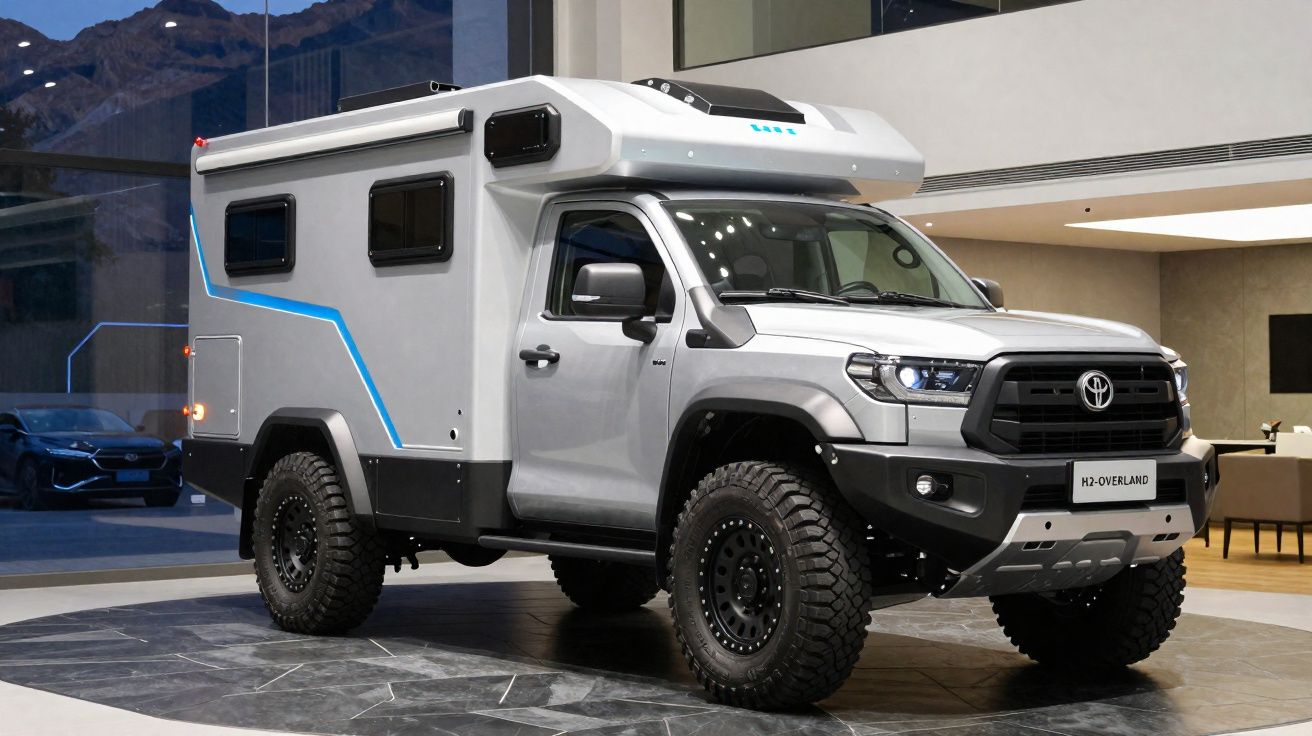
Most concept cars on the motor-show circuit chase attention with ever-larger battery packs. The Toyota Tacoma H2-Overlander Concept goes the other way, making the case for hydrogen fuel cells, long range and genuine self-sufficiency far from the grid.
A radical take on the classic overland pick-up
Revealed at the 2025 SEMA Show in Las Vegas, the Toyota Tacoma H2-Overlander Concept presents itself as a serious off-road camper build. The real surprise, however, is hidden beneath the bodywork.
In place of the Tacoma’s familiar V6 petrol engine, Toyota Motor North America has fitted a fully operational hydrogen fuel-cell powertrain. Created in collaboration with Toyota Racing Development (TRD) and the California Fuel Cell Partnership, the project turns a well-known mid-size pick-up into a rolling testbed for zero-emission adventure travel.
This concept is intended to show that long-range, heavy-duty off-road travel doesn’t have to depend on diesel or enormous battery packs.
The truck is based on Toyota’s TNGA-F body-on-frame platform-the same underlying architecture used by the Land Cruiser and Tundra-bringing the sort of toughness, payload capability and towing strength expected by anyone who spends days beyond the end of the tarmac.
Visually, it’s clearly aimed at remote-country living rather than town parking bays: a reinforced front bumper with an integrated winch, a vented bonnet, widened wheelarches and a full-length roof rack give it the stance of a vehicle designed to vanish into the backcountry for weeks at a time.
Hydrogen fuel cells and 547 hp (about 408 kW) on tap
The key headline is output: Toyota quotes up to 547 horsepower from an electric drivetrain supplied by hydrogen. The system combines three high-pressure hydrogen tanks, a fuel-cell stack, and a 24.9 kWh lithium-ion battery feeding dual electric motors with all-wheel drive.
Put simply, hydrogen stored in the tanks is fed to the fuel cell, which produces electricity. That electricity either charges the onboard battery or powers the motors directly. At the tailpipe, the fuel cell’s only by-product is water vapour.
Toyota says it can be refuelled in just a few minutes, with enough stored energy to support extended overland expeditions well beyond the reach of ordinary charging points.
For overlanding, that “minutes not hours” refuelling claim is central. A battery-electric camper with true long-distance, off-grid range often needs a very large battery, which adds mass, cost and lengthy charging stops. Hydrogen can, in theory, be replenished almost as quickly as diesel-assuming there is an H2 station nearby.
Built for real-world wilderness use (Toyota Tacoma H2-Overlander Concept)
The Tacoma H2-Overlander isn’t presented as a numbers-only engineering exercise. Its specification is packed with practical equipment for people who genuinely travel off-road:
- Raised suspension tuned for long-travel off-road use
- 33-inch (about 84 cm) all-terrain tyres for traction on sand, rocks and mud
- Front winch for self-recovery in isolated areas
- Recovery boards mounted on the sides for extracting the vehicle from deep sand
- Roof rack with solar panels and auxiliary lighting
- Modular load-bed storage with tie-down rails and external power outlets
One of the standout features is Toyota’s “buddy charge” function: the ability to export external power, up to roughly 15 kW, to tools, equipment, another vehicle, or an entire campsite. In day-to-day terms, that means the truck can act as a quiet generator for lighting, cooking appliances, power tools, communications kit or even medical equipment in remote locations.
Another thoughtful detail is the water produced by the fuel cell. Rather than venting it all away, it can be collected. For off-grid travellers, that could provide extra water for washing and basic camp chores, reducing how much needs to be carried.
A further advantage for expedition use is how the energy system separates “range” from “camp power”. Instead of choosing between driving tomorrow and running appliances tonight, a fuel-cell vehicle can keep generating electricity while stationary, with the battery acting as a buffer for bursts of demand.
Why Toyota believes hydrogen suits extreme off-roading
Toyota has consistently resisted putting all of its future on battery-electric vehicles alone. Alongside hybrids and plug-in hybrids, it continues to develop fuel-cell projects-from the Mirai saloon to a hydrogen prototype Hilux developed in the UK. The Tacoma H2-Overlander pushes that multi-energy approach into the off-road camper world.
For long-distance, off-grid overlanding-where weight, charging time and energy supply are constant constraints-hydrogen can offer a compelling set of trade-offs.
Toyota’s argument for this niche can be summarised as follows:
| Challenge in remote travel | Hydrogen fuel-cell advantage |
|---|---|
| Limited access to rapid chargers | Refuelling in minutes at H2 stations, similar to filling with diesel |
| Heavy batteries cut into payload | Higher energy storage per kilogram for a given range |
| Need for quiet, clean camp power | Built-in generation for tools, lights and appliances |
| Emissions limits in sensitive environments | Zero tailpipe emissions: only water vapour |
For scientific fieldwork, remote industrial sites or search-and-rescue deployments, a vehicle that carries a quiet, zero-emission power source is particularly attractive. It can support radios and satellite links, run lighting for a temporary field clinic, and keep drones and sensor arrays charged-without transporting a separate generator and cans of fuel.
Hydrogen also brings safety and operational considerations that matter off-road. Storage at up to 700 bar demands robust tanks, careful plumbing and reliable shut-off systems-especially when a vehicle is being jolted over rocks or operating far from immediate support. The concept implicitly serves as a durability exercise as much as a drivetrain demonstration.
Not for sale (yet), but the message is unmistakable
Toyota has been explicit that the Tacoma H2-Overlander is not a production announcement. In its current guise it is a demonstrator, not a showroom model. Even so, alongside the hydrogen Hilux and other prototypes, it underlines how committed Toyota remains to a multi-energy strategy.
The barriers are the familiar ones. Hydrogen refuelling stations are still thin on the ground, especially away from major routes. Fuel-cell systems remain costly, and green hydrogen-made using renewable electricity rather than natural gas-has not yet reached large-scale availability. For the moment, hydrogen overland trucks are closer to a vision than an everyday purchase.
Even so, the concept suggests what could follow if infrastructure expands and costs fall: fleets of fuel-cell pick-ups supporting remote construction work, fire response in national parks, or military logistics-while reducing local noise and emissions.
From show truck to an off-grid hydrogen motorhome
Although Toyota positions the H2-Overlander as a tough expedition pick-up, the configuration naturally lends itself to camper conversions. A durable 4×4 platform paired with long-range energy storage and high auxiliary power output is precisely what many DIY motorhome builders attempt to achieve with roof-mounted batteries and bulky generators.
A hydrogen-based camper on a similar base could integrate a pop-top living module, proper berths, a compact kitchen and a wet room, all supplied by the fuel cell. Heating, air conditioning and refrigeration could run quietly through the night-without fumes and without the anxiety of flattening a modest battery pack.
For overland motorhome enthusiasts, a hydrogen-powered base vehicle promises something uncommon: range, comfort and low emissions without feeling like a compromise.
It also opens the door to more capable “work-and-live” builds-vehicles that can drive deep into the countryside and then operate as mobile workshops, command posts or filming rigs, with clean power available on demand.
Key terms for new-tech campers
Fuel-cell technology can feel opaque at first, so these basics help clarify the conversation:
- Fuel cell: a device that turns hydrogen and oxygen into electricity via a chemical reaction, producing water and heat.
- High-pressure tank: a reinforced cylinder storing hydrogen gas at up to 700 bar to carry useful energy onboard.
- Buddy charge: the ability for a vehicle to export electricity via external sockets, functioning like a mobile generator.
- Overlanding: self-reliant vehicle travel for days or weeks, emphasising remote routes rather than extreme rock crawling.
For someone planning a multi-week journey through North America’s backcountry, this approach could reshape route planning. Instead of arranging overnight stops around charging points, the driver would identify the limited number of hydrogen stations on the route, refuel quickly, and then rely on the vehicle to supply campsite power each evening.
Benefits, trade-offs and realistic scenarios
A plausible use case looks like this: a small team heading into a fire-prone wilderness area for environmental monitoring. Their Tacoma-style hydrogen camper carries sensors, satellite communications, drones and a field workstation. Once they leave the motorway network there are no plugs-yet it barely matters. The truck powers their equipment for days, with the only visible “exhaust” being a faint cloud of water vapour.
The compromises remain real. If a hydrogen station is out of service in a remote region, alternative refuelling options are limited. Carrying spare compressed hydrogen is tightly regulated and requires strong safety provisions. For private owners, hydrogen prices in many markets can also be painful.
On the other hand, for governments, agencies and commercial operators funding remote work, the economics could improve as fuel-cell manufacturing scales and green hydrogen becomes cheaper. The same reasoning may appeal to specialist motorhome builders selling to high-end overland customers who already spend heavily on diesel rigs and extensive power upgrades.
Ultimately, the Tacoma H2-Overlander does more than provide SEMA spectacle. It sketches a credible route towards overland motorhomes, off-road service vehicles and work pick-ups replacing smoke and generator noise with silent torque and exportable power-without surrendering the long-distance freedom that drew people to 4×4 travel in the first place.

Comments
No comments yet. Be the first to comment!
Leave a Comment