
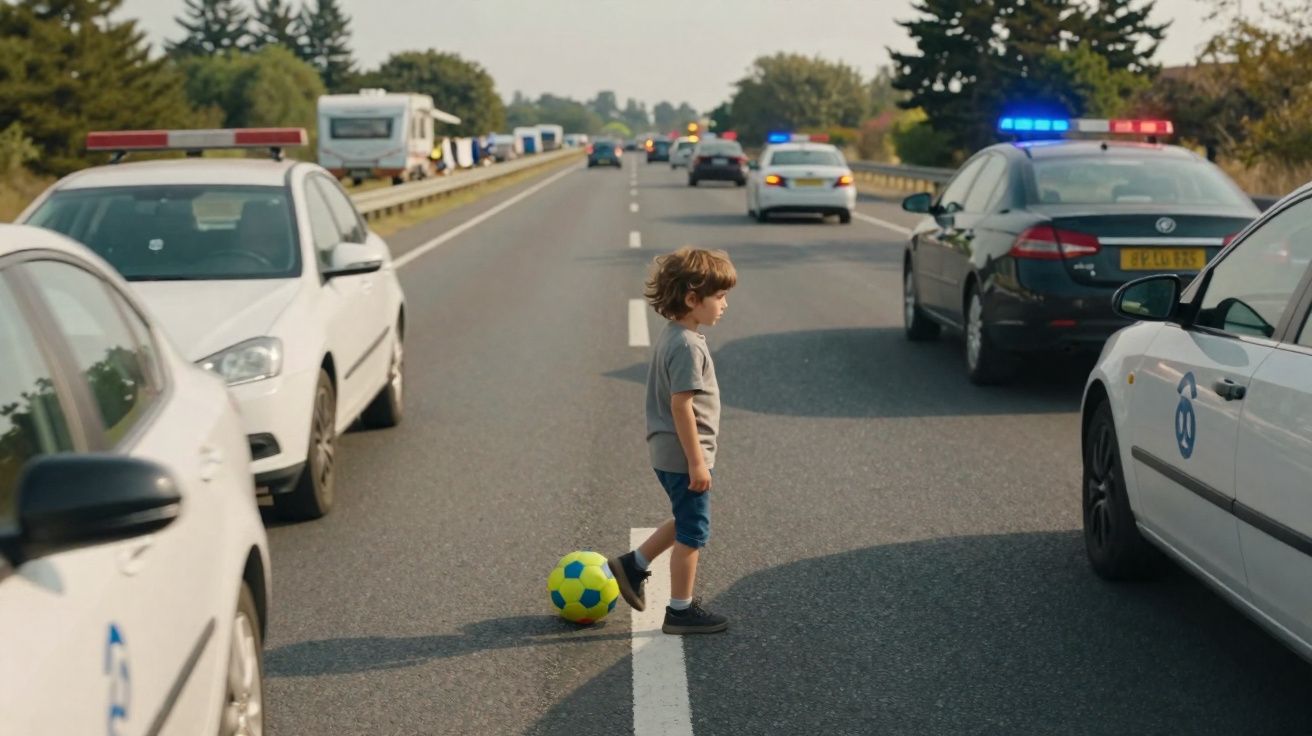
Drivers on a northern French motorway were confronted with a disturbing sight one afternoon, when everyday traffic was interrupted by something far more vulnerable: a child on the road.
On a busy section of the A21 near the town of Lourches, multiple motorists watched a young boy walk into live lanes, right where vehicles normally travel at speed. Their urgent calls brought a swift police response, while also spotlighting bigger issues around motorway safety, social exclusion, and how narrowly disaster can sometimes be avoided.
A child in the fast lane, panic spreading across the A21 motorway
The episode took place at about 15:30 on Wednesday 3 December, on the A21 motorway in northern France. As drivers approached the Lourches area, they spotted a child-thought to be around ten years old-walking in the centre of the carriageway used by fast-moving traffic.
Within moments, emergency call handlers were inundated. Several motorists, fearing they might strike the child or cause a multi-vehicle collision, contacted the police. Witnesses described a small figure moving between lanes, exposed between cars and heavy goods vehicles.
Motorists on the A21 reported a boy of around ten walking among fast-moving traffic near Lourches.
Police motorbike units were sent immediately. Riding under full warning lights, officers prepared to slow or stop vehicles if they found the child. By the time they reached the location, he was no longer visible.
Officers arrive after the boy disappears, with a traveller camp nearby
Early witness statements suggested the child may have crossed the motorway twice. According to those accounts, he seemed to enter from one side, then run back the other way, before slipping through an opening in the central barrier and heading towards a nearby camp used by travelling communities.
Police searched the hard shoulder, emergency refuge areas and the central reservation but found no sign of him. No injuries were reported, and there was no immediate evidence of a crash connected to the sighting. To authorities, it appeared to be a near-miss-an episode with potentially fatal consequences that ended without clear resolution.
Police suspect the child reached a neighbouring traveller camp just before patrols arrived, avoiding impact by only moments.
Locally, not everyone was shocked. Some residents and regular A21 users said they had seen similar situations before. Children from nearby encampments are reported to cross on foot, at times squeezing between central safety barriers rather than using any designated crossing point.
“Games” on the motorway: a pattern that leaves no time to react
Accounts from witnesses indicate that, for certain children, this kind of behaviour can be treated like a dare-something bordering on a game. They may dart between lanes, slip through gaps in metal barriers, and sometimes crouch or hide within sections of the central reservation.
For drivers, the danger is immediate. At motorway speeds, stopping distances run to many dozens of metres. If a child steps out from behind a barrier just a few metres ahead, avoiding a collision can become virtually impossible.
The A21 scare also fits a wider regional pattern. In 2016, another alarming incident occurred on the A23, where a young boy was seen cycling along the hard shoulder. Drivers braked sharply and alerted the police.
Earlier reports in the region describe children walking or cycling along high-speed roads, using the hard shoulder or the space by crash barriers as makeshift play areas.
Why children end up on high-speed roads
Road-safety specialists and social workers often point to a combination of circumstances behind these incidents:
- Physical proximity: Traveller camps or informal settlements may be situated only a few dozen metres from a motorway.
- No safe link routes: Footpaths, footbridges and underpasses may be absent between a camp and nearby shops, schools or services.
- Limited supervision: On busy or crowded sites, it can be difficult for adults to keep eyes on children continuously.
- Different risk perception: Children may misjudge vehicle speed and assume they can move quickly enough to stay safe.
Where authorised sites lack secure boundaries-or where informal settlements have no protective infrastructure at all-children can drift towards the noise and lights of the motorway. What seems like a quick shortcut to a friend’s caravan or a nearby supermarket can mean stepping directly into live traffic lanes.
How authorities usually respond when a child is reported on a motorway
When a child is seen on a motorway, it is rarely treated as “just” a traffic incident. Police and motorway operators typically combine immediate action with follow-up checks.
| Measure | Purpose |
|---|---|
| Rapid deployment of patrols | Find and safeguard the child, prevent a collision |
| Temporary lane closures | Reduce speed or stop vehicles near the reported area |
| Contact with nearby camps | Identify the child, speak with families, reinforce awareness |
| Infrastructure inspection | Check for gaps in fencing or barriers enabling access |
In the Lourches case, calls came in quickly and police reacted at speed. Even so, a delay of only a few minutes can be the difference between preventing tragedy and arriving to an empty stretch of road. When officers got there, they could only reconstruct the likely route the child had taken.
An added risk: repeated access points and unreported near-misses on the A21 motorway
One problem with incidents like this is that many do not end with a collision-meaning they can be under-reported beyond emergency calls and social media posts. Without a consistent record of where sightings occur, small breaches in fencing or habitual crossing points can persist for months. Regular monitoring, shared reporting between motorway operators and local councils, and quick repairs to damaged barriers can make a measurable difference in the same way pothole repairs prevent repeat accidents.
Risks for drivers, and what the law may examine after a crash
For motorists, seeing a child on a motorway can trigger split-second reactions: harsh braking, swerving, or pulling onto the hard shoulder. Each response carries its own hazards, especially when heavy lorries are following at close distance and traffic is dense.
If a collision occurs, investigators typically examine factors such as speed, driver attentiveness, and how the child accessed the carriageway-whether from an authorised area or through a breach in fencing. Parents or guardians can face legal scrutiny if negligence is suspected, although courts also weigh the broader context, including living conditions at the camp, any prior warnings, and whether authorities had previously raised concerns about site safety.
For the child, the danger is stark. Impact at motorway speed is overwhelmingly likely to be fatal, and even a minor strike can cause catastrophic injury or lifelong disability.
What could prevent similar near-misses near Lourches
Transport planners often argue for a two-track approach: strengthening physical infrastructure while building closer links with local communities. Around sensitive locations-such as informal camps or traveller settlements-several measures can lower the risk:
- Continuous, taller roadside fencing to reduce direct access to the carriageway
- Clear signage and visual cues indicating the boundary of the motorway environment
- Safe alternatives such as footbridges, underpasses, or protected routes to key services
- Regular outreach from social workers and community mediators
Where children are helped to understand how quickly vehicles close distance-and where parents have practical, safe routes for everyday journeys-dangerous shortcuts across lanes tend to reduce.
An added safeguard: education and trust-building alongside enforcement
Infrastructure alone may not be enough if families feel isolated from services or fear repercussions when engaging with officials. Outreach delivered through trusted mediators can improve cooperation, increase reporting of damaged fences, and encourage safer routines for school runs, shopping trips and visits between caravans. In practice, the most effective prevention often combines visible safety works with consistent, respectful engagement.
Context: traveller camps, infrastructure, and the road at the doorstep
France-like the United Kingdom-regularly experiences tensions around traveller camps located close to major infrastructure. Councils are expected to provide legal sites, but shortages and delays can leave families settling near railways, industrial land or motorways. These areas may appear open and convenient, yet they sit beside routes built solely for vehicles.
For children raised in such settings, the steady roar of engines, night-time headlights and constant movement can become normal background. In that environment, the motorway may feel like part of the neighbourhood rather than a hard boundary-helping explain how a child might cross fast lanes with the casualness of stepping over a village road.
Practical tips for drivers faced with the unthinkable
Drivers cannot control where camps appear, but they can adopt safer reflexes if something unexpected is seen on the carriageway:
- Ease off speed steadily rather than stamping on the brakes, reducing the chance of being rear-ended
- Switch on hazard lights early to alert vehicles behind you
- Call emergency services with precise information (motorway name, direction of travel, nearest junction, or a kilometre marker)
- Do not leave your vehicle on foot unless instructed-walking on a motorway puts you in danger too
These actions can buy police valuable seconds and reduce the risk of secondary collisions while patrols move into place.
Beyond the scare: what the A21 incident reveals
Seeing a child on the A21 raises a far larger question: how societies manage the boundary between vulnerable communities and high-speed infrastructure. Motorways cut through urban areas, industrial zones and precarious living spaces. Every gap in a fence and every informal access track can become a route a child might take.
For local authorities, near-misses like this function as a warning. They prompt risk mapping, site visits with camp residents, and checks on whether official or temporary sites genuinely protect children from the strip of tarmac only metres away. Without that follow-up, the next call from a horrified driver could arrive seconds too late.





Comments
No comments yet. Be the first to comment!
Leave a Comment