
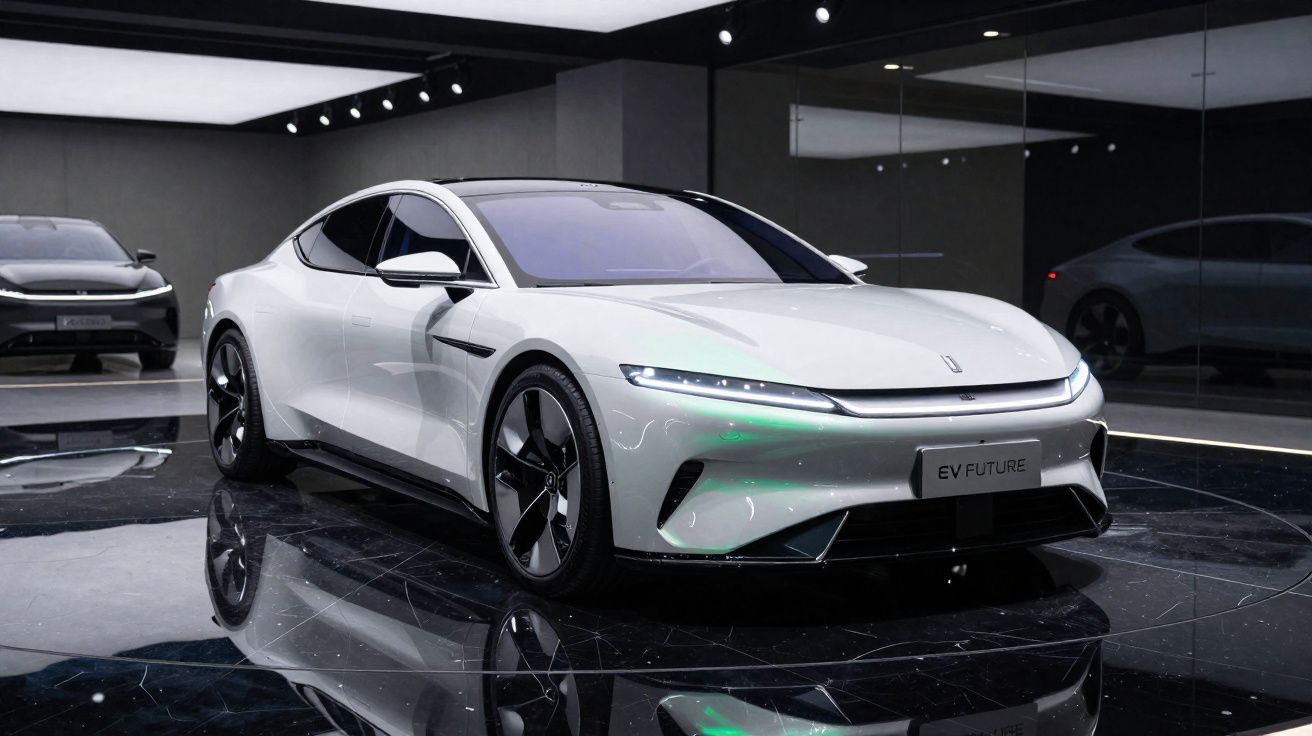
A young couple in woolly beanies are chatting confidently about “zero-emission driving”. Nearby, an older bloke in a high‑vis work jacket is leaning against his diesel van, listening with a half‑smile as he stirs his coffee. Then he drops a curveball: “Seen that new study? Says your fancy EV could be worse for the planet than my van.”
At first they laugh it off, but you can see the uncertainty settle in. Someone reaches for a phone. Screens fill with charts, headlines, and furious comment threads about batteries and coal. In moments, the mood in the car park shifts from self‑satisfied to uncomfortable.
All of a sudden, the quiet, “clean” image of the electric car feels a lot less straightforward.
Are electric cars really greener – or have we been selling ourselves a dream?
Electric cars have become a modern symbol of doing the right thing. You pull away from a junction with barely a whisper, no exhaust haze, no diesel rattle, and people assume you’re making the responsible choice. For years, the slogan has been simple: petrol and diesel are bad, electric is good - case closed.
But a growing body of research is challenging that tidy story. A number of life‑cycle studies now argue that, in certain countries and under certain usage patterns, a brand‑new electric car can end up responsible for more total emissions than a modern diesel. Not because of anything coming out of the tailpipe - EVs don’t have one - but because of what happens before you drive it and how it’s powered afterwards.
That is a tough message to hear when you’ve paid the price of a small flat for what is, in essence, a battery on wheels.
The numbers begin to make sense once you look at where the extra carbon comes from. Manufacturing an electric car is not simply “making a diesel car without the engine”. The major addition is the battery: a heavy, chemically complex pack whose materials must be mined, crushed, refined, processed, and transported long before you ever press Start. Work from European regulators and independent laboratories suggests that producing a large EV battery can add several tonnes of CO₂ compared with building a diesel engine.
Then there’s the electricity used for charging. If a country’s grid is still dominated by coal or gas, each “clean” kilometre can effectively draw fossil‑fuel emissions from a distant power station rather than a tailpipe. One widely discussed modelling study argued that in grids heavily dependent on coal, a mid‑size electric car may build up a bigger carbon footprint than a very efficient diesel during its first years on the road.
For anyone who assumed a charging cable automatically wipes away guilt, that can feel like a punch to the stomach.
Why “EVs worse than diesel” can be true - and why it often isn’t
The crucial twist is that the conclusion changes completely once the context changes. In places where electricity generation is largely renewable or nuclear, the picture improves rapidly. The same kinds of studies tend to show that when more than half of the power supply is low‑carbon, an electric car will typically overtake diesel on lifetime emissions after roughly 30,000 to 60,000 kilometres, depending on battery size and driving behaviour.
It also matters which diesel you’re comparing against. A new Euro 6 diesel with an effective filter and strong real‑world fuel economy can be surprisingly difficult to beat on long motorway journeys - particularly in countries where electricity remains carbon‑heavy. On the other hand, a large, premium EV with a big battery that is often fast‑charged using high‑carbon electricity can underperform on climate impact for years.
This is the real origin of the headline “EVs are worse than diesel”. It isn’t necessarily false - it’s just only accurate for certain places, certain vehicles, and certain drivers.
As an added UK‑specific complication, the grid is not “one thing” throughout the day. Even in a country with a relatively decarbonised power sector, the carbon intensity of electricity can swing significantly by hour and season. That means two identical EVs in the same town can end up with different real‑world footprints depending purely on when their owners tend to charge.
How to make an electric car (EV) genuinely cleaner than diesel in real life
If you already drive an EV - or you’re weighing one up - the more useful question is no longer “Are electric cars bad?” but “How do I make sure my electric car beats diesel in practice?” There are a few levers you can pull, and the first one is surprisingly ordinary: keep the car for longer. Because battery production carries a hefty one‑off carbon cost, every extra year of ownership spreads that upfront “environmental debt” across more kilometres driven.
In other words, the most climate‑friendly EV owner is often not the person upgrading to the newest model, but the one looking after an older EV well beyond the point a lease deal would push them to replace it. That means charging a bit more gently, avoiding constant 100% top‑ups, and taking wear items seriously. EVs are heavier than equivalent diesels; the wrong tyres or poor wheel alignment quietly reduce range and add unnecessary energy use.
The second lever is the electricity you actually consume, not the electricity you imagine you’re consuming. Many people plug in whenever it’s convenient, wherever the nearest socket happens to be. Yet a dull, practical habit can make a significant difference: charging at cleaner times. Overnight often brings lower demand and, in many systems, a higher share of wind or nuclear generation. Some smart chargers and tariffs can respond to live grid data, shifting charging towards greener hours automatically. These invisible choices can add up meaningfully over several years.
Location matters as well. Charging at a workplace car park covered with solar panels, using a community charger linked to local wind generation, or topping up from home rooftop solar can each tilt your personal “EV versus diesel” equation in the right direction.
Driving style is another factor many people underestimate. Plenty of drivers buy electric for the instant torque and then use it like a hot hatch. That heavy right foot can mean more frequent rapid charging, higher battery temperatures, and faster degradation. Over the life of the car, that can pull an EV back towards diesel‑like emissions if it leads to major battery work or an earlier‑than‑planned replacement.
By contrast, drivers who use eco modes, read the road ahead, and let regenerative braking do the work squeeze more kilometres out of every kWh. Stop‑start urban driving can strongly favour EVs compared with diesels that burn more fuel in congestion and emit harmful NOx into the air at street level. On a busy city road, the climate argument can almost become secondary to the immediate reality of local air quality and asthma risk.
Let’s be honest: almost nobody does all of this perfectly every day. Most of us charge when we’re knackered, drive according to mood, and only open the energy app when a warning pops up.
“An electric car isn’t a magical moral upgrade,” one energy researcher told me. “It’s a tool. Whether it beats diesel depends on how it’s built, how you power it, and how long you keep it in service.”
That lands harder when you turn it into a few practical priorities:
- Keep your car longer rather than constantly chasing the newest EV model.
- Favour renewable‑heavy charging (overnight, home solar, green tariffs).
- Drive smoothly to protect the battery and improve efficiency.
- Choose tyres carefully and maintain correct pressures to reduce rolling resistance.
- Ask whether you need to drive at all for certain journeys.
On a personal level, that last point can feel the most radical. On a policy level, it’s also the one people often avoid saying out loud.
A related piece that rarely gets enough attention is the second‑hand EV market. Buying used can reduce the pressure for fresh manufacturing (and therefore fresh battery production), while keeping more vehicles in productive service for longer. Likewise, battery repair, refurbishment, and recycling capacity - including where those facilities are powered by low‑carbon electricity - can materially change the lifetime impact of electric cars over the next decade.
So… were we wrong about electric cars all along?
The emotional whiplash is understandable. One week, electric cars are framed as climate saviours; the next, a study goes viral claiming they’re worse than diesel and social media melts down. Beneath the noise, something better may be happening: a more grown‑up discussion about trade‑offs, systems, and the complicated route away from fossil fuels.
Once you accept that an EV can be either better or worse than diesel depending on context, your perspective changes. Instead of treating the purchase as a trophy - “I bought the right car, job done” - you start looking at the whole chain: electricity grids, mining rules, battery factories, recycling plants, city design, and policy incentives. That charging lead connects not just to a wall socket, but to a long line of upstream and downstream decisions.
Picture a quiet street at night: one diesel and one electric car parked opposite each other. From the pavement you can’t see the emissions spreadsheets behind them. You can’t see the cobalt mine, the refinery, the offshore wind farm, or the congested motorway at rush hour. What you can see is ordinary people trying - sometimes clumsily - to live differently on a warming planet.
That’s why “bad news for EVs” studies spread so quickly. They puncture a comforting narrative and replace it with unsettling questions. Did I choose well? Is government backing the right approach? Are we putting all our chips on the wrong technology? Those questions sting, but they’re also the start of smarter decisions. Perhaps the next generation of batteries really will cut manufacturing emissions dramatically. Perhaps electricity grids will decarbonise faster than forecasts. Perhaps shared mobility, fewer cars, and better‑planned towns will matter even more than what sits under the bonnet.
The only thing that seems truly certain is this: no single technology fixes everything by itself - not diesel, not electric, and not an unproven fuel that hasn’t scaled yet. Progress comes when we stop searching for heroes and start accounting for the full story behind every kilometre we travel.
| Key point | Detail | Why it matters to you |
|---|---|---|
| Manufacturing impact | EV batteries often create more emissions during production than a diesel engine | Explains how a “clean” vehicle can begin life with a large carbon debt |
| Local electricity mix | Coal‑heavy electricity can make an EV less green than an efficient diesel | Encourages you to check how electricity is generated, not just what you drive |
| Real‑world use over time | Length of ownership, driving style, and charging method can all change the true balance | Gives practical levers to make an EV genuinely greener day to day |
FAQ
Are electric cars really worse for the planet than diesel?
They can be in specific circumstances: high‑carbon grids, very large batteries, short ownership periods, and lots of motorway mileage. With cleaner electricity and longer distances, EVs usually beat diesel on lifetime emissions.Which part of an electric car is most polluting to produce?
The battery. Extracting and processing lithium, nickel, cobalt and other materials - and then assembling large battery packs - creates a substantial carbon and environmental footprint during manufacturing.Does it still make sense to buy an electric car today?
Yes, in many areas it does, particularly where electricity is relatively low‑carbon and you expect to keep the car for years. The outcome depends heavily on how you charge, how you drive, and how long you keep it.Can electric cars become much cleaner in the future?
Very likely. As grids add more renewables, battery factories use cleaner energy, and recycling scales up, the overall footprint of EVs should drop significantly.What’s the single most effective thing I can do as a driver?
Drive less and keep your vehicle for longer, whatever it is. If you do go electric, prioritise renewable‑based charging and a calm driving style to extend the real climate advantage over diesel.


Comments
No comments yet. Be the first to comment!
Leave a Comment