
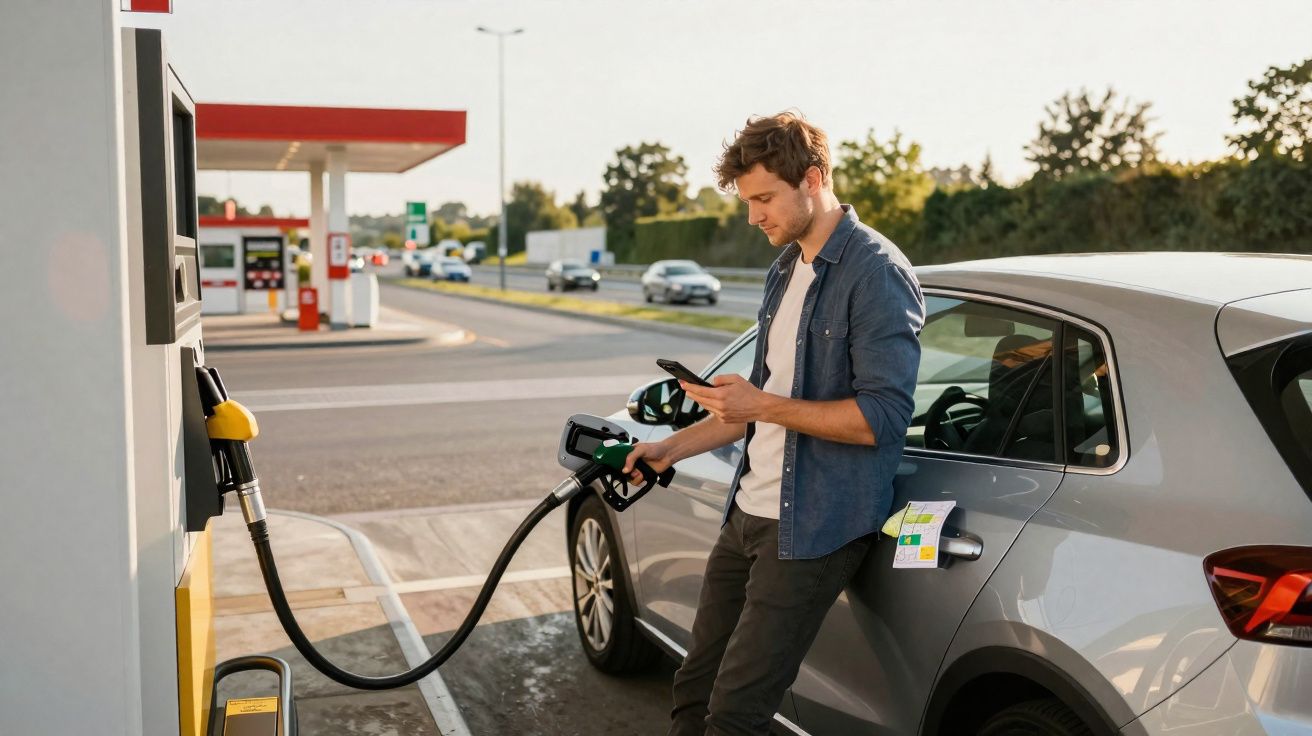
Across Germany and France, more drivers are discovering that where and when you fill up can matter almost as much as the car you drive. A few straightforward choices can cut the cost of each trip-without changing vehicles, work patterns or holiday plans.
Why German motorists are changing the way they fill up
An increasingly popular idea in France is borrowed from Germany, where the influential motoring club ADAC has monitored fuel prices for years. Its data highlights a clear trend: motorway service stations routinely charge significantly more than forecourts just a few minutes away from the main route.
ADAC has recorded price gaps of up to €0.40 per litre between motorway pumps and nearby town stations.
That gap is far from trivial. On a 50-litre tank, an extra €0.40 per litre means €20 more for a single fill. For commuters covering big distances or families driving to summer holidays, those extra euros add up quickly.
The motorway monopoly effect
The underlying reason is simple: once you commit to a long motorway stretch, your choices narrow. When the low-fuel warning appears, many people pull into the next services regardless of the displayed price.
That near-captive demand allows operators to set prices well above the going rate in nearby towns. Convenience, spotless loos and late opening come at a cost-and the markup can be steep.
ADAC’s guidance to German motorists is direct: plan your fuel stops. Don’t make the motorway your default place to fill the tank. Treat motorway services as a back-up, not the main plan.
How to “fill up the German way” (ADAC-style) on your next trip
The “German-style” approach isn’t one magic trick so much as a set of habits: compare prices, plan your route, and think about timing.
Treat fuel like accommodation: if you plan ahead and avoid the most obvious captive locations, you often pay less.
Step 1: pick your station, not the next one
With modern price-comparison apps and sat nav, it’s easy to see where fuel is cheaper before you set off. In Germany, ADAC draws on official price feeds; elsewhere in Europe, crowdsourced reporting often fills the gaps.
- Look up fuel prices before a long drive and earmark two or three cheaper stops along your route.
- Prioritise stations in towns, suburbs or industrial estates rather than motorway service stations.
- A brief diversion of 3–5 km off the motorway can reduce the bill noticeably.
Competition makes the difference. Stations in urban areas and retail parks often have rivals close by, which keeps prices tighter. Motorway services rarely face the same pressure.
Step 2: aim for the right day
Across large parts of Europe, prices often soften early in the week and climb towards the weekend, when leisure travel increases and roads get busier.
Filling up on Monday or Tuesday frequently works out cheaper than topping up on Friday afternoon, when prices-and queues-tend to rise.
The exact pattern differs by country and operator, but price-tracker data in both France and Germany repeatedly shows lower pricing in the first half of the week. Simply shifting your usual fill-up by a day or two can shave a few cents off each litre without altering your journey at all.
Step 3: consider the time of day
Some seasoned motorists prefer to refuel early. The logic is that petrol and diesel are marginally denser at lower temperatures, so each measured litre may contain slightly more energy. In reality, the gain is small, particularly because many underground storage tanks sit at relatively stable temperatures.
Where early refuelling can help more reliably is in driving conditions. Cooler air and lighter traffic often make it easier to maintain smooth progress-reducing consumption far more than tiny density differences.
Step 4 (often overlooked): use the right type of forecourt deal
One extra tactic-especially useful for UK drivers travelling in France and Germany-is to look beyond brand logos and check who is actually cheapest locally. Hypermarkets and supermarket forecourts can be very competitive, and some offer discounts via loyalty schemes. The trade-off is that they may have shorter opening hours or fewer pumps, so it’s worth checking access and peak times.
It’s also sensible to double-check you’re selecting the correct fuel grade at the pump (particularly where labels differ by country). Paying extra for a premium grade you don’t need can erase the savings you made by leaving the motorway.
What the savings look like in real life
To see how the numbers play out, consider a typical example for a UK traveller driving in France or a French driver doing regular motorway journeys.
| Scenario | Price per litre | Tank size | Cost per fill |
|---|---|---|---|
| Motorway service station | €1.95 | 50 L | €97.50 |
| Town station 5 km off route | €1.55 | 50 L | €77.50 |
That one decision saves €20. Do it weekly over a year and you’re looking at more than €1,000. Even if you drive long distances less often, refusing the “on-the-motorway” premium can still take a meaningful slice off annual fuel spend.
Beyond the station: small habits that lighten the fuel bill
Picking a cheaper forecourt is only one part of the picture. German and French motoring groups also highlight everyday driving habits that change how often you need to visit the pump.
- Tyre pressure: Under-inflated tyres increase rolling resistance and push consumption up. A quick monthly check protects both your tyres and your budget.
- Speed: Travelling at 130 km/h rather than 110 km/h on a motorway can noticeably increase fuel use for many cars.
- Weight and drag: Roof boxes, bike racks and clutter in the boot all add up. Removing them when they’re not needed helps.
- Air conditioning: Running the air con hard in slow town traffic can nudge consumption upwards.
None of these changes feels dramatic alone, but together they extend the distance you get from each tank. Combine them with smarter station choices and the savings start to compound.
A further practical point for longer trips: avoid unnecessary cold-start journeys and stop-start driving when you can. If you’re running errands, combining them into one outing typically uses less fuel than several short trips, because the engine reaches efficient operating temperature only after a few minutes.
Risks and trade-offs to keep in mind
The German-style approach does come with cautions. The first is range anxiety: pushing on to reach a cheaper station when the gauge is nearly empty can end badly-particularly on unfamiliar routes, late at night, or during long cross-border journeys.
Keep a safety buffer: plan to refuel when the tank is around one-quarter full, not when the warning light appears.
Safety matters when leaving major roads too. A quick detour into a well-lit retail park is one thing; taking an unfamiliar rural route to save a handful of euros is another. Local knowledge, user reviews and even a quick look at satellite images can help you judge whether a station looks accessible and secure.
From fuel prices to household budgets
For many households across Europe, fuel has become one of the largest monthly costs-alongside rent, food and energy bills. Anything that makes fuel spending more predictable can ease financial pressure. The “German-style” strategy essentially applies online bargain-hunting habits to the forecourt.
Apps, comparison sites and built-in car navigation now give everyday drivers the kind of pricing visibility once reserved for haulage firms. When you pair that information with modest planning-and a willingness to step outside the motorway bubble-the maths starts to swing in your favour.
There’s also an environmental knock-on effect. Drivers who plan their stops, smooth out their driving and avoid unnecessary diversions usually burn fewer litres overall. That means fewer emissions, whether you’re driving a small petrol hatchback or a large diesel SUV. Saving fuel for your wallet also saves fuel for the atmosphere, litre by litre.




Comments
No comments yet. Be the first to comment!
Leave a Comment