
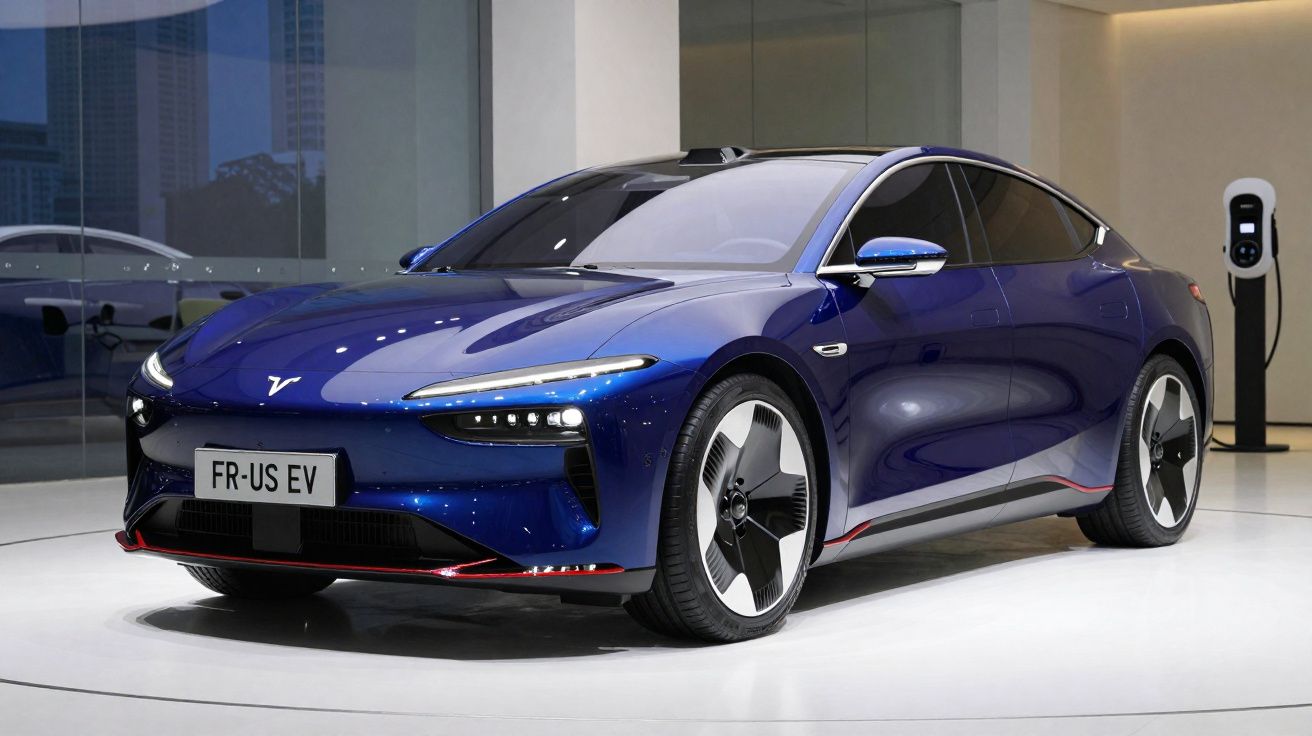
An American carmaker shaking hands with a French one, assembly lines in northern France, and a third, quiet presence in the room: China.
It reads like geopolitical fiction, yet it is unfolding in automotive plants and boardrooms. Ford and Renault have opted to work together in Europe on the electric car-an agreement that is about far more than launching a couple of new small models for city traffic.
An unexpected Ford–Renault alliance in the face of Chinese pressure
The starting point is a letter of intent signed by Ford-an emblem of the American motor industry-and Renault, one of the foundations of French manufacturing. On paper, the deal refers “only” to building compact electric cars and light commercial vehicles. In reality, it signals a coordinated response to intensifying competition from Chinese manufacturers and to rising costs associated with the energy transition.
From 2028 onwards, the plan is to produce at least two compact electric car models and one light van at Ampere’s ElectriCity complex (Ampere is Renault’s EV-focused subsidiary) in northern France. Assembly is expected to be concentrated across the Douai, Maubeuge and Ruitz sites, which together employ around 5,000 people.
The partnership allows Ford to keep selling “affordable” electric vehicles in Europe without having to build an entire in-house manufacturing footprint on the continent from scratch.
The timing is deliberate. China’s push with low-cost electric vehicles is already squeezing margins and threatening market share across Europe-particularly in the very segment where Ford had been stepping back.
Why France becomes Ford’s European “Plan B” for compact EVs
Over recent years, Ford has steadily slimmed down its conventional petrol and diesel line-up in Europe. Familiar models, including the Focus, have been dropped. The company has focused instead on SUVs, commercial vehicles and higher-margin ranges-leaving a gap where smaller, lower-priced cars used to sit.
This agreement is Ford’s way of filling that gap without committing to multi-billion-pound (and multi-year) investments in a brand-new, dedicated compact-EV platform of its own.
The French platform that drew Ford in: AmpR Small
The compact models emerging from this tie-up are expected to use the AmpR Small platform already deployed in the Renault 5, Renault 4 and the forthcoming electric Twingo. This vehicle “skeleton” was designed specifically for urban-focused cars-smaller, lighter, and built with tighter cost control in mind.
The platform also reflects an element of Asian expertise: parts of its development involved partners from the region, and some components are sourced from China. The result is a hybrid industrial setup-engineering and final assembly in Europe, with a global supply chain that retains a strong Asian footprint.
Key advantages highlighted by the arrangement include:
- A shared base usable across multiple compact models
- Lower development spend through platform reuse
- More efficient production scale
- Use of Chinese-sourced components to help keep prices in check
For Ford, it is akin to boarding a train already running rather than laying new track. For Renault, it means extra volume, improved cost absorption, and a confidence signal from a major American group.
The approach aligns with Ford CEO Jim Farley’s strategy: prioritise “highly efficient” businesses and lean on partnerships to absorb the cost shock of electrification.
Electric vans: the other pillar of the deal
This is not just about passenger cars. A major emphasis sits with light commercial vehicles-a segment quietly being reshaped by urban delivery growth and tightening environmental targets across European cities.
Ford is effectively positioning itself alongside Renault’s new family of electric vans: the Trafic Van E‑Tech, Estafette E‑Tech and Goelette E‑Tech. These vehicles are aimed both at last-mile logistics and at small firms that need access to city centres increasingly restricted to internal-combustion traffic.
Electric vans designed for European city work
The range is expected to offer driving ranges of up to around 450 km in certain configurations, supporting both regional routes and high-frequency urban delivery cycles. The Trafic E‑Tech, for instance, pairs a 10.3-metre turning circle-similar to a compact hatchback such as the Clio-with up to 5.8 m² of usable load volume in the long-wheelbase version.
The Estafette E‑Tech leans into day-to-day practicality by allowing the user to stand upright inside the cabin-useful for professionals constantly getting in and out during a working day. The Goelette targets more adaptable applications, from public services to small businesses requiring flexible body styles.
| Model | Main highlight | Typical use |
|---|---|---|
| Trafic Van E‑Tech | Strong manoeuvrability and generous usable load space | Urban and regional deliveries |
| Estafette E‑Tech | Interior height that allows standing | Mobile services, workshops, food trucks |
| Goelette E‑Tech | Multiple configuration options | Service fleets and small businesses |
If Ford were to develop a dedicated European electric-van portfolio alone, it would face a wall of technical requirements, emissions and safety rules, and platform investment demands. Working with Renault lowers the burden and speeds up the arrival of competitive vehicles in showrooms.
Renault, meanwhile, gains both credibility and scale: winning a major American customer reinforces its bet on electric vans as a long-term cornerstone.
From factory floors to geopolitics: the message aimed at China
Behind the production targets sits a clear political layer. Rather than rely on Chinese-owned factories already operating in Europe-often a cheaper route-Ford is choosing a European partner with significant industrial presence on French soil.
The message runs in two directions: to European governments, it supports the agenda of reindustrialisation and local job protection; to Chinese brands, it signals that the United States and Europe can combine forces to slow a wave of Asia-built imports.
Chinese analysts have begun to frame Renault as a kind of European “filter” for a supply chain that remains tightly connected to Asia. The argument goes like this: if French-built platforms use Chinese components and are then sold through Ford, it could delay-or at least dilute-the direct entry of Chinese manufacturers to European consumers.
Why this matters to governments and buyers
For policymakers, these alliances can help safeguard jobs, technology and production capacity without fully shutting Europe off from Asian supply chains. For consumers, the hoped-for outcome is a broader selection of electric cars and vans at less punishing price points, made within the European economic area.
At the same time, Chinese competitive pressure is not disappearing. Chinese brands continue to price aggressively, and much of that edge comes from deeply integrated production networks and global scale.
The underlying question is whether Western alliances on their own can match the pace of China’s electric-vehicle push.
Two concepts that clarify the strategy: “affordable segment” and “platform”
Two terms dominate this discussion: the “affordable segment” and the “platform”.
Here, “affordable segment” does not mean a bargain-basement electric car in the traditional sense. It means less expensive within a category that still carries high sticker prices. Instead of premium EVs, Ford wants to offer compact models priced closer to what an average European household can realistically finance.
A “platform”, meanwhile, is the shared set of structures, components and electronic architecture underpinning multiple vehicles. Creating one from scratch is costly and slow. By sharing AmpR Small with Ford, Renault spreads that investment across more units, while Ford avoids duplicating the spend.
Additional pressure points: rules of origin, battery traceability, and charging readiness
One factor likely to shape how far this partnership can go is Europe’s tightening approach to industrial origin and battery transparency. Requirements around where key components are made-alongside emerging expectations for battery traceability and sustainability reporting-could influence sourcing choices, subsidy eligibility and final pricing.
Equally important is infrastructure. For private buyers, home charging access and electricity pricing will heavily influence take-up. For fleet operators, depot charging capacity, grid connection lead times and driver training can make or break the business case, even when the vehicles themselves are competitively priced.
Likely outcomes-and the risks ahead
If the plan proceeds smoothly, a plausible end-of-decade picture is European streets filled with compact electric cars “made in France”, carrying shared Renault–Ford DNA, competing against Chinese models and against German brands racing to accelerate their own transitions.
But there are real risks. Regulatory shifts within the European Union, trade disputes with China, or delays in battery technology could all reshape today’s assumptions. Consumer perception is another sensitive point: if prices do not fall in a tangible way-even with joint production-demand may underperform.
For fleet buyers and logistics firms, the move creates openings. Long-term contracts for electric vans arising from this partnership could reduce fuel and maintenance costs and help meet environmental targets set by major clients. At the same time, these businesses will still need to manage charging infrastructure, staff training and route redesign.
In the background, the sight of an American icon working with a French manufacturer underlines a broader reality: the contest with China in electric vehicles will not be fought in isolation. It will hinge on unlikely alliances, industrial choices in places like northern France, and political decisions that cross oceans-before ending up on the driveway of the everyday buyer.
Comments
No comments yet. Be the first to comment!
Leave a Comment