
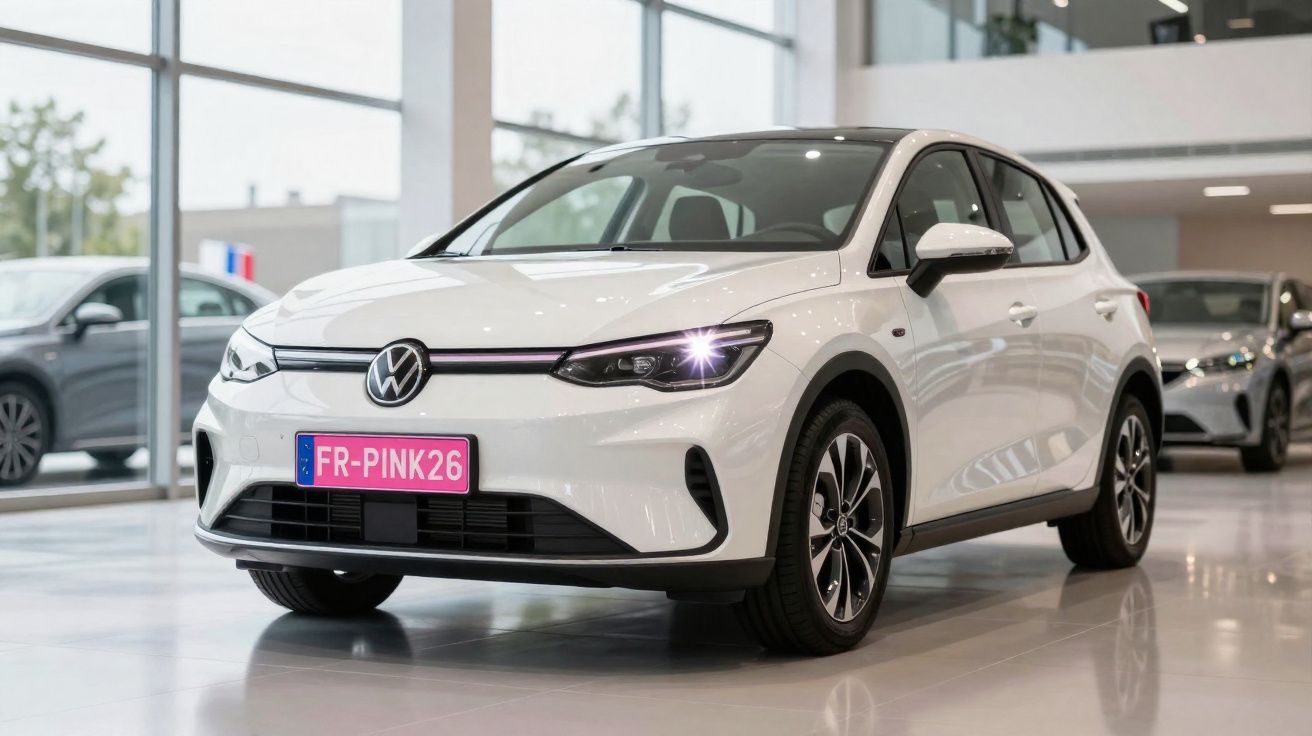
What may look like a playful design choice is in fact a significant change in how French authorities monitor newly registered and short-term vehicles. The plan behind pink licence plates combines road-safety priorities, day-to-day administrative pressure and a determined effort to stop “temporary” registrations from quietly becoming long-term.
Pink WW licence plates in France: what are they?
From the first quarter of 2026, France intends to introduce fully pink licence plates for a limited set of vehicles. These will not replace the usual French number plates; instead, they will be reserved for vehicles running under a provisional registration.
For a long time, France has relied on the WW code for temporary number plates-most commonly for brand-new vehicles, imports and cars used for testing. In theory, these registrations are meant to be used only briefly. In reality, many WW plates remain on the road well beyond the permitted window, often long after a permanent registration should have been issued.
The purpose of the new pink design is straightforward: make provisionally registered vehicles immediately identifiable in traffic and during roadside checks.
The new plates will be entirely pink, will display the “WW” code, and will show an end-of-validity date that can be read clearly from a distance.
Which vehicles will receive the pink plates?
The reform focuses on vehicles that already fall under temporary registration rules. According to the French drivers’ association “40 million motorists”, around 460,000 vehicles were in this category in 2023 alone.
Under the updated approach, a pink plate may be fitted to:
- Brand-new cars waiting for their definitive registration certificate to be issued
- Imported vehicles while administrative formalities are being completed
- Dealer and manufacturer demonstration cars, including test-drive vehicles
These vehicles already use WW plates today, but the existing designs closely resemble standard plates, making quick visual checks more difficult.
Design and operation: how the pink plates will work
The new plates will keep the familiar provisional prefix WW, followed by the standard French numbering layout. What changes is the background colour-now fully pink-and the addition of a clearly printed expiry date.
| Feature | Current WW plates | New pink WW plates (from 2026) |
|---|---|---|
| Background colour | White or lightly tinted | Full pink background |
| Code format | WW-123-AB (black characters) | WW-123-AB (black characters) |
| Validity date visible | Not printed on the plate | Printed directly on the plate |
| Typical duration | 4 to 6 months (not always respected) | 4 to 6 months, with straightforward roadside control |
Each plate will show a clear end date for the provisional registration. The permitted period should remain four to six months, intended to cover the time required for the permanent registration to be processed.
With the validity date shown on the plate, checks become instant: a single glance is enough to spot a vehicle that is out of compliance.
Why French authorities are introducing pink plates now
The move is driven by practical enforcement needs and sustained pressure from road-safety voices. Temporary plates have increasingly become an enforcement gap-visible in traffic, but not always easy to verify quickly.
The growing issue of “permanent” temporary plates
A significant number of drivers keep WW plates far longer than allowed. Some simply postpone the paperwork; others are suspected of exploiting the delay to make it harder to chase penalties, toll charges or low-emission restrictions, because tracing a provisional registration can take longer than a standard one.
There is also a capacity problem: France is running short of available WW number combinations. When numbers are recycled while older vehicles are still using them, identical sequences can appear at different times on different cars, which complicates databases and routine checks.
A strong colour cue plus a visible end date gives police and gendarmerie officers an immediate way to identify vehicles that should have switched to permanent plates months earlier.
Faster roadside decisions for police
Until now, stopping a vehicle with a provisional plate often meant an officer had to consult databases and/or examine paperwork to confirm whether the registration was still valid-an inefficient process on busy roads.
With the expiry date printed on the pink licence plates, the plate itself acts as an instant filter. If the date has passed, the situation is clear straight away, allowing officers to focus on non-compliant vehicles rather than spending time verifying those that are in order.
The stated aim is to make cars still driving on expired provisional plates visible at a glance.
What this will mean for drivers and motor traders
For most private motorists, the change will be noticeable but not disruptive. Many individuals do not keep WW plates for long, because dealers and importers typically handle most of the administration. Even so, the new format is likely to influence behaviour.
Less incentive to postpone registration
A bright pink plate that unmistakably signals “temporary” may discourage delays. A vehicle carrying a standard permanent number looks settled and tends to attract less attention at checkpoints-particularly near borders, on major routes and at city entry points.
Dealerships and vehicle import specialists may also need to run tighter timelines. If switching from provisional to permanent plates was previously treated as a task that could wait, repeated roadside stops and customer inconvenience may push it higher up the priority list.
Fines, immobilisation and insurance complications
Using an expired provisional plate is already risky. It can lead to financial penalties, the vehicle being immobilised and difficulties with insurance cover. The new pink WW design does not create new offences, but it should make existing non-compliance far easier to detect.
If a driver is found using a WW plate beyond its valid date, consequences may include:
- A fine for an irregular registration situation
- The vehicle being held until correct documents are presented
- Additional complications after a collision if the car was not properly registered at the time
Insurers generally expect the vehicle’s status to match its official registration position. A long-running “temporary” setup can raise questions during a claim, especially if the administrative trail appears unclear or intentionally delayed.
How this aligns with wider European number plate trends
Across Europe, number plate systems have been steadily adjusted to signal special categories more clearly. Many countries already use colours, stickers or distinctive layouts to identify temporary registrations, exports, diplomatic vehicles, rental fleets-and, in some markets, electric vehicles.
France has traditionally favoured visual uniformity, but the shift to pink licence plates suggests a more information-rich approach where the plate itself communicates key details instantly. For police, customs, and toll operators, that visibility can reduce wasted checks and speed up decisions.
Practical preparation for 2026: what to expect
Anyone intending to buy a new vehicle in France in 2026, or to import a car, should plan their registration timeline with the expiry date in mind.
In broad terms, the process remains familiar:
- Provisional registration is issued (a WW number with a fixed expiry date)
- Pink plates are printed and fitted to the vehicle
- The permanent registration certificate is processed
- The car moves from pink WW plates to standard plates once the definitive number is issued
The real change is the lack of “wiggle room” for simply overlooking the swap. Setting a reminder for the expiry date-or agreeing from the outset that the dealership will manage the full registration end-to-end-could prevent avoidable delays.
A further practical consideration is cost and availability: drivers and traders may see small additional fees for producing the new plates, and early in the rollout some regions could experience delays if local suppliers need time to align with the updated manufacturing and stock requirements.
Beyond 2026: what other number plate changes could follow?
The introduction of pink plates also prompts a wider question: how far can colour and layout go in improving traffic control without creating confusion? Some French road-safety commentators have suggested future visual identifiers for driving-school vehicles, shared-mobility fleets, or clearer markings linked to low-emission zone access.
Another possible direction is a gradual move towards more digital verification. France could eventually combine physical colour coding with scannable identifiers to speed up checks on taxation, roadworthiness testing status or unpaid penalties. For now, the approach is deliberately simple: a bold colour, a firm expiry date and a clear signal to anyone tempted to stretch the meaning of “temporary”.





Comments
No comments yet. Be the first to comment!
Leave a Comment