
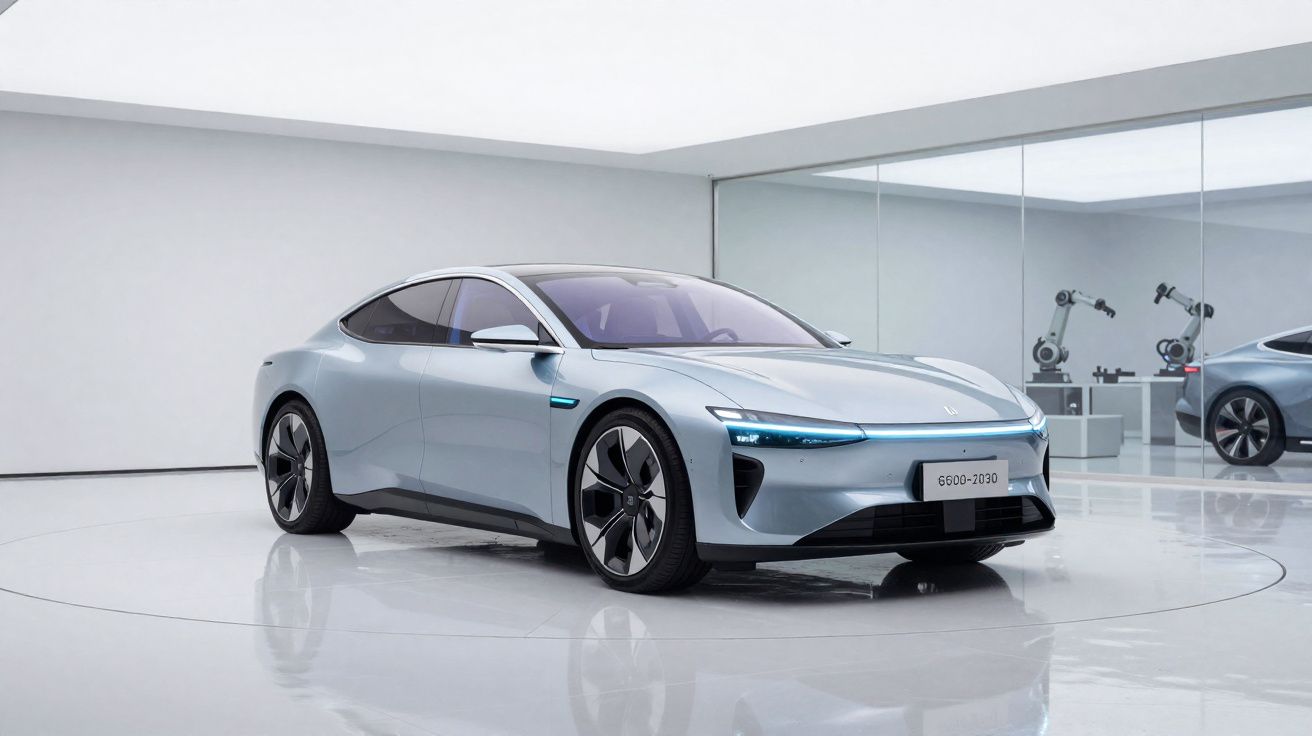
The plant’s doors don’t shut when darkness falls. It isn’t because a night shift is clocking on-there’s nobody to clock on-but because the robots keep moving. Inside, orange articulated arms slide along rails with practiced ease, while laser welders throw off sparks that briefly map the air like tiny star charts. Autonomous carts drift between racking in near silence, resembling well-trained insects following a line no-one can see. No foreman is barking orders, no canteen bell breaks the rhythm, and no-one is arguing about overtime by the clocking-in machine. You hear only server fans, the thrum of motors, and the sharp breath of compressed air.
Chinese engineers say scenes like this will be commonplace before 2030: a staff-free car factory producing thousands of vehicles each day without a single person on the shop floor.
China’s countdown to the first ghost factory
Step into a contemporary Chinese car plant and the shift is already visible: people are edging out of the physical process. In one corner, a small group of young engineers in hoodies monitor the line from behind glass, coffee beside laptops. Out on the floor, most of the heavy lifting is carried out by machines that move with a quiet, almost choreographed precision.
China’s sprint is happening in the space between those two realities.
In Guangzhou, Shanghai and Hefei, the same ambition is repeated-sometimes with pride, sometimes with unease: a fully staff-free factory. In official briefings it is often framed as an inevitability rather than a science-fiction gamble.
Several electric-vehicle leaders already talk about lights-out workshops, where production cells operate in near-darkness simply because no human needs to see. Nio, BYD and Xiaomi Auto have showcased demonstration areas in which robots and algorithms complete around 98% of the work. The remaining 2%-the awkward jobs such as detailed inspection, improvised fixes around defects, and the odd edge case no rulebook covers-is precisely what they want to eliminate before 2030.
The urgency is strategic. Beijing’s long-range planning treats the ghost factory as more than a headline-grabbing novelty: it is a competitive tool. With an ageing population, rising wages and unforgiving global competition in EVs, a facility that runs 24/7 with minimal staff offers lower costs, tighter standardisation and a type of industrial resilience that doesn’t depend on sick leave, shift rotas or negotiations with unions.
In that framing, the first fully staff-free car factory is not just a technology trophy. It is a way to cement leadership during the most dramatic transformation the automotive industry has seen in a century.
How a staff-free car factory actually works (China’s ghost factory blueprint)
From the outside, a ghost factory can look disappointingly ordinary: a large grey box beside a motorway, scarcely different from a logistics warehouse. Inside, however, the operation is anything but dull. At the very top sits a digital twin-a full virtual replica of the entire facility, updated continuously on powerful servers.
Every robot, conveyor and machine feeds data into that twin moment by moment, functioning like nerves reporting back to a brain.
Down on the shop floor, hundreds of industrial robots take on the core tasks: welding, stamping, painting and final assembly. Between stations, fleets of AGVs (automated guided vehicles) shuttle doors, battery packs and dashboards as smoothly as hotel staff delivering room service. Above it all, camera arrays track parts and motion with millimetre-level accuracy.
When a robotic arm detects a slight misalignment, it doesn’t summon a supervisor. Instead, it escalates to software. An AI system recalculates torque, nudges the part into position, records the irregularity and refines the model so the next occurrence is handled more cleanly. In truth, today’s factories rarely run like this every day without human oversight-but that is the stated destination.
What still keeps people on site is far less glamorous: maintenance and exceptions. Blockages, worn components, dust on sensors, or a warped panel that doesn’t match any known pattern-these are the moments when humans re-enter the frame in hard hats and hi-vis.
To push even those visits to the margins, Chinese firms are investing in predictive maintenance, self-diagnosing robots and remote “control towers”, where a small group of technicians can oversee several plants through screens. In effect, the factory starts to resemble software you manage, rather than a place where you wrestle with a spanner.
A further, often overlooked requirement is cybersecurity and systems resilience. If production depends on networked robots, real-time data and a digital twin, then outages, ransomware or corrupted sensor feeds become operational threats rather than IT inconveniences. That is why “lights-out” ambitions also bring investment in segmented networks, redundant servers and rigorous access controls-because a staff-free car factory still needs trust in its code, its connectivity and its backups.
Energy and climate control matter too. Running around the clock demands stable electricity, disciplined power management and careful temperature control for batteries, paint shops and precision sensors. In practice, the race to build ghost factories is also a race to secure reliable power, optimise compressed-air systems, and reduce waste heat-otherwise the savings from reduced labour can be eaten up by inefficient utilities.
What this means for workers, cities, and you
When a car plant no longer employs thousands of people in overalls, the impact lands quickly and locally. One tangible approach being tested in China is shifting employment upstream and downstream. Rather than paying large teams to tighten bolts, companies recruit people to train AI models, label video data from test lines, and run the logistics networks that supply the ghost factory.
Cities building EV hubs-places such as Changzhou and Ningde-are already reshaping technical colleges around that direction of travel. The pattern can look like: one fewer traditional factory job centre, three more data centres and operations offices.
On the ground, the tension is personal. A production-line worker in his 40s is often realistic about the odds of becoming a machine-learning engineer overnight. Reskilling programmes can look admirable on presentation slides; learning Python after a 10-hour shift is a very different proposition.
Many people recognise that uncomfortable moment when they are told, “the future is coming-just adapt,” while the mortgage and children’s school costs still need paying. Ghost factories may deliver efficiency, but they also strain the social contract that manufacturing once offered: dependable wages, predictable routines and the pride of pointing to a physical product and saying, “I helped build that.”
Officials are not blind to the risk, even if they rarely state it bluntly. They emphasise terms such as “manufacturing upgrading” and “high-quality employment” to steady nerves. Yet in cafés near industrial parks, the conversation can be more direct: robots do not buy flats, robots do not bring up children, and robots do not eat at local restaurants.
“Factories used to lift entire towns out of poverty,” a union representative in eastern China told me. “Now the new plants arrive with more robots than buses. We’re told this is progress. Maybe it is. But progress for who, exactly?”
- For younger workers - the openings are in technology, software and robot maintenance, but the pathway is steeper, more competitive and more selective.
- For smaller cities - ghost factories can increase tax receipts, yet they employ fewer people per square metre of industrial land.
- For drivers worldwide - staff-free plants could pull EV prices down sharply, intensifying pressure on carmakers far beyond China’s borders.
Are we ready to live with ghost factories?
Stand outside one of these near-future Chinese sites and it is easy to feel two narratives colliding. One is the progress story: robots that rarely slip up, cheaper electric cars, less scrap and fewer injuries in harsh industrial settings. The other is the older story of work as identity-people clocking in together, chatting by lockers, building friendships on the line.
A staff-free factory cuts straight through that second story, like an unsentimental software update.
There is also a quieter psychological change. When machines build a car end-to-end, the way we relate to the product shifts slightly. The brand becomes less about craftsmanship and more about code quality, server uptime and supply-chain resilience. The “heroes” move from the shop floor to algorithm teams working in office towers.
Most of us will not dwell on that when we book a test drive on our phones. Still, the idea lingers in the background-almost as invisibly as the data centres that keep our maps and music running.
China’s first fully staff-free car factory, anticipated before 2030, will be more than a commercial milestone. It will act as a mirror for other countries. How much are we prepared to trade human hands for robotic precision? What do we want from work beyond wages?
The next time you pass an industrial estate at night and spot a single building glowing like a spacecraft, you may find yourself asking: is anyone in there at all-or is this the future, working while we sleep?
| Key point | Detail | Value for the reader |
|---|---|---|
| China targets ghost factories before 2030 | EV giants are racing to build fully staff-free car plants using AI, robots, and digital twins | Helps you anticipate where global car prices, brands, and jobs are heading |
| Robots reshape factory work | Most manual tasks move from the line to data, software, and remote supervision roles | Clarifies which skills may stay relevant in a heavily automated world |
| Social and local impact is real | Fewer jobs per factory, more pressure on training systems and smaller cities | Offers a lens to judge future policies and corporate promises about “upskilling” |
FAQ
Question 1: Will a fully staff-free car factory really have zero humans inside?
Answer 1: Not entirely. The goal is no permanent staff on the shop floor, but technicians, cleaners and auditors will still enter from time to time for inspections, upgrades and emergencies.Question 2: Why is China leading this ghost factory race?
Answer 2: China pairs huge EV demand with dense supplier networks, strong state support and a political drive to offset ageing demographics through automation.Question 3: What happens to workers when robots take over the line?
Answer 3: Some workers transition into higher-skilled roles in maintenance, logistics and data, while others risk being left behind if retraining and the social safety net fail to keep up.Question 4: Will ghost factories make cars cheaper for consumers?
Answer 4: That is the expectation. Lower labour costs, fewer defects and continuous 24/7 output should reduce prices, particularly for mass-market electric vehicles.Question 5: Could this model spread outside China?
Answer 5: Yes, but adoption rates will differ. Countries with stricter labour rules or stronger unions may move first towards hybrid approaches, combining extensive automation with negotiated human roles.

Comments
No comments yet. Be the first to comment!
Leave a Comment