
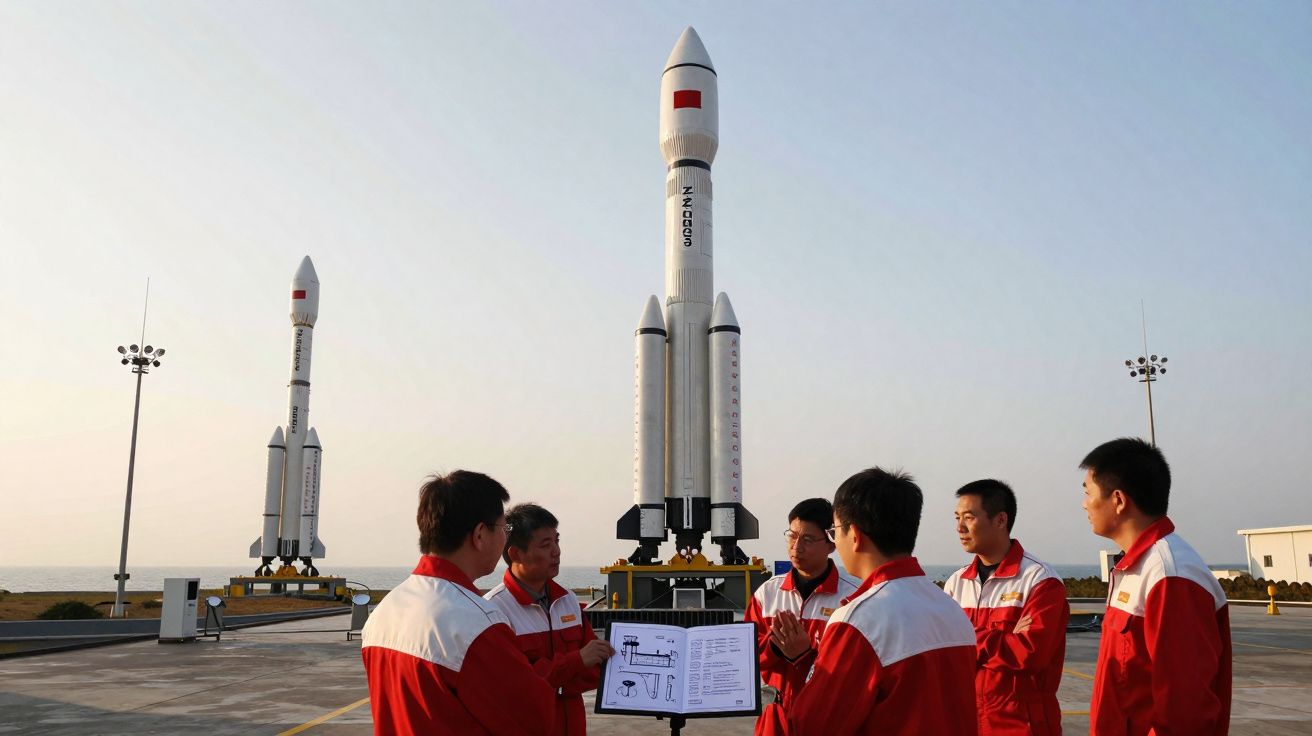
The next major challenge for reusable launch is emerging from the east.
China’s commercial space industry is moving into sharper focus through LandSpace’s Zhuque‑3: a stainless‑steel, methane‑fuelled launcher engineered for repeat flights and lower operating costs. If the vehicle performs as intended, launch prices, flight tempo and practical access to orbit could shift quickly.
China’s private space push enters a new phase
Across the past two decades, China has assembled a complete space capability: a high launch rate, the Tiangong space station, and an objective to land astronauts on the Moon before 2030. The state remains the strategic backbone, but an increasing portion of development risk is being carried by private companies. LandSpace, established in Beijing in 2015, is among the most prominent of these newer players.
Public attention first focused on Zhuque‑2, which became the first liquid‑methane orbital rocket to reach space. Those missions laid the technical groundwork for Zhuque‑3, a larger system designed to launch, return and launch again with minimal refurbishment between flights.
Zhuque‑3 carried out a full‑duration static‑fire at Jiuquan in October 2025 after completing a full propellant loading rehearsal. LandSpace is aiming for a first orbital attempt in late 2025, followed by a booster recovery trial in 2026.
LandSpace Zhuque‑3: specifications at a glance
LandSpace has selected a stainless‑steel airframe, nine methane‑oxygen engines on the first stage, and an architecture intended for rapid turnaround. On paper, the vehicle sits between today’s medium‑lift and heavy‑lift workhorses.
| Feature | Zhuque‑3 |
|---|---|
| Height | 66 m |
| Diameter | 4.5 m |
| Structure | Stainless steel |
| First stage engines | 9 Tianque‑12A |
| Propellants | Liquid methane (LNG) and liquid oxygen (LOX) |
| Payload to low Earth orbit | Up to 18,300 kg (configuration dependent) |
| Reuse target | Up to 20 flights for the first stage |
| Timeline | Debut flight late 2025; recovery attempt in 2026 |
Why methane matters
Methane‑oxygen engines generally burn more cleanly than kerosene‑based systems. Cleaner combustion reduces coking inside turbomachinery and combustion chambers, which in turn can mean fewer deposits to remove, faster inspections and lower refurbishment costs. If the rest of the vehicle tolerates real operational wear, those advantages support a higher flight cadence.
The downside is operational complexity: methane is cryogenic and demands careful thermal management. That pushes engineering effort into insulated tankage, storage, loading procedures and fast, repeatable ground operations.
Clean‑burning methane combined with a straightforward stainless‑steel structure is intended to shorten refurbishment and keep the rocket flying more often.
Starship comparisons, Falcon 9 realities
News coverage often frames Zhuque‑3 as a direct challenger to SpaceX’s Starship, but in practical capability it aligns more closely with Falcon 9. The vehicle’s size and payload figures point towards a dependable, frequently flown launcher for low Earth orbit and sun‑synchronous missions. Starship is aimed at super‑heavy transport and, later, large‑scale in‑space refuelling. The meaningful contest is therefore about cost per kilogram, flight rate and reliability.
LandSpace has stated that each first stage may be capable of as many as twenty flights. If that target is met, it could place downward pressure on prices for both commercial and state buyers. At present, the United States conducts roughly 60% of launches, with China at about 25%. A dependable, reusable Zhuque‑3 could help close that gap by serving domestic demand while attracting regional satellite operators.
- Reduced cost per mission makes larger and more frequent satellite batches economically viable.
- Recovered boosters cut hardware waste and ease production bottlenecks.
- Faster cadence improves scheduling certainty for Earth‑observation, IoT and broadband constellations.
- More competition expands access for universities and smaller agencies.
From reuse in LEO to lunar logistics
Zhuque‑3 is positioned as an opening move rather than an endpoint. China has indicated an ambition to establish a permanent science base near the Moon’s south pole with Russia under the ILRS framework. A robust, reusable launcher in low Earth orbit would support that supply chain by moving modules, tugs and propellant stages into staging orbits.
LandSpace is also assessing a heavier derivative, Zhuque‑3E, intended to deliver up to 21,000 kg when flown expendably. In that mode it would trade reuse for additional payload on missions where extra lift is the priority, while keeping the core technology approach aligned with the reusable system.
Reusable lifters in low Earth orbit can form the foundation for cislunar ambition: cheaper propellant delivery, more frequent cargo flights and more resilient schedules.
Signals to watch over the next 12 months
Near‑term milestones will reveal more than any slide deck. One successful launch matters, but repeatable recovery and rapid refurbishment are what reshape markets.
- Booster landing attempts, including guidance accuracy and stability during descent.
- Engine relight consistency after hot‑fire cycles and ascent loads.
- Turnaround time between flights, counted in weeks rather than months.
- Manifest strength: paying customers, rideshare approach and insurance terms.
- Ground operations maturity: methane handling, pad refurbishment and weather margins.
What this means for satellite operators and agencies
If Zhuque‑3 proves it can fly repeatedly, satellite operators gain negotiating power: more providers typically means better launch dates and sharper pricing. Constellation builders can distribute risk across launch fleets and geographies. Government missions can also gain flexibility for scientific payloads and sustained Earth‑monitoring programmes. National autonomy increases when fewer payloads depend on foreign launch windows.
There are practical caveats. New rockets commonly go through early teething problems, ranging from engine wear to landing‑leg dynamics. First customers may need contingency bookings on other vehicles. Insurers will price uncertainty until a flight history builds. Mission teams should plan parallel schedules and treat the first recovery attempts in 2026 as a key inflection point.
Technical context that broadens the picture
Reusability is not solely an engine story. Heat management around the booster’s lower section, grid‑fin authority in high‑drag regimes, and precise thrust‑vector control during landing all shape recovery success. Stainless‑steel structures cope well with heat and can simplify manufacturing, but they impose mass penalties. Outcomes will depend on how effectively LandSpace reduces dry mass and controls boil‑off during countdown holds.
Methane brings a second, longer‑term advantage: it aligns well with future in‑space refuelling concepts and can, in principle, be produced from carbon and hydrogen feedstocks. That route is attractive for extended logistics architectures in which propellant depots and orbital tugs reduce reliance on single, very heavy lift missions. For now, however, the decisive test remains straightforward: consistent ascent performance and reliable recovery in low Earth orbit, repeated often enough to avoid expensive overhauls.
Operational and market factors worth tracking
Beyond flight hardware, Zhuque‑3 will be judged on whether its programme can sustain routine operations. Launch‑site throughput, supply‑chain resilience for engines and tanks, and consistent quality control can matter as much as peak performance numbers. A vehicle designed for quick turnaround only achieves that promise if spare parts, inspection tooling and trained teams are in place to keep the flow moving.
It is also worth watching how the domestic market shapes early demand. If Chinese satellite constellations and government missions commit to a stable manifest, that baseline can underwrite frequent flights and accelerate learning cycles. In turn, demonstrated reliability and a predictable cadence are what typically unlock wider international interest-where permitted-through clearer schedules and more competitive insurance terms.






Comments
No comments yet. Be the first to comment!
Leave a Comment