
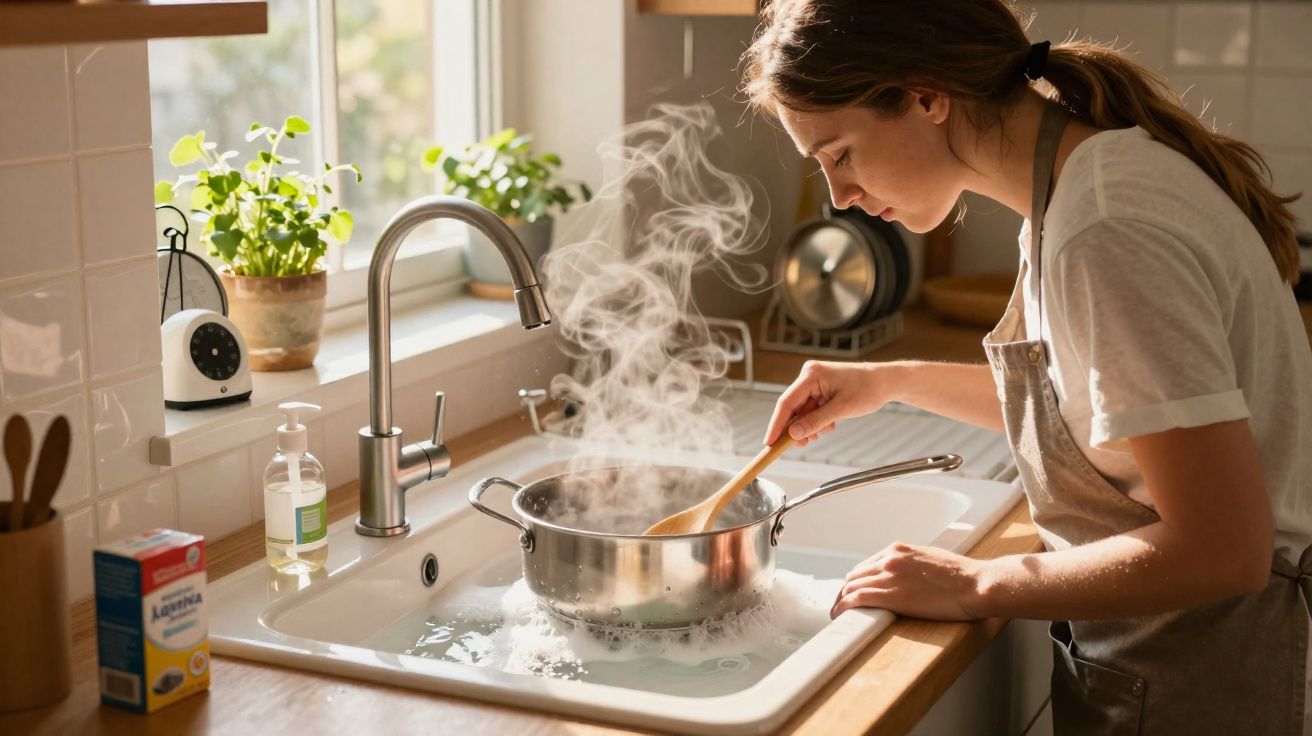
At home, it can feel as though burnt-on grease will last forever; in professional kitchens, it somehow… vanishes. The gap isn’t down to scrubbing harder. It comes from a low-key routine chefs rely on once service is over.
Picture the end of a shift: trays stacked like dominoes, the extractor fan droning, and the air carrying a faint mix of lemon and smoke. Someone wheels out a lidded steel soaking bath, pours in kettles of hot water and tips in a pale powder with the casual confidence of seasoning a pot. Oven racks and blackened roasting tins slide under the surface and, instantly, they stop being anyone’s problem. The noise drops to clinks and tired laughter. Hours later, the lid comes off, a brown haze lifts away, and the metal underneath looks oddly revived. One quick wipe and it’s finished. No theatrics. The “secret” is almost painfully straightforward.
Why burnt grease feels invincible
What’s clinging to your tray isn’t simply oil. It’s a baked-on varnish: fats heated beyond their smoke point, polymerised into a hard film and anchored by carbon grit. That’s why a scouring pad often just skates across the top. You’re not battling ordinary mess-you’re reversing chemistry.
Watch a typical Sunday-night clean-up at home: one roasting tray, 20 minutes of circular scrubbing, and a rising sense of annoyance. Now put that same tray in a restaurant kitchen. It isn’t cosseted; it’s parked-into a hot bath, lid on, lights out. By morning, the brown ring loosens and slides away as if it never belonged there. We’ve all stared at a pan and felt our patience drain; it doesn’t have to go that way.
The residue that defeats you becomes fragile when you treat it correctly. Heat softens the baked film. Alkalinity breaks the bonds, converting stubborn grease into soap-like compounds and liftable sludge. Water then carries the loosened mess away. Heat, alkalinity and time do the heavy lifting. Your role is to set it up and step back.
The chef-approved hot alkaline soak (the method that does the scrubbing for you)
The restaurant approach, without any mystique, is a hot alkaline soak. Commercial kitchens use a lidded soak tank with a non-caustic degreasing powder, filled with near-boiling water. At home, you can replicate the same idea easily:
- Fill a deep roasting tin, sink or stockpot with very hot water.
- Mix in washing soda (sodium carbonate) at roughly 2 tablespoons per litre, plus a small squeeze of washing-up liquid.
- Fully submerge oven racks, trays and stainless-steel pans-keep everything completely wet.
- Leave it for a few hours, or overnight if the items are heavily blackened.
- Rinse, then wipe clean.
That’s the whole trick.
Realistically, hardly anyone has the appetite to do this daily, so treat it as a batch job. Pick one evening a week, drop the worst offenders into the bath while you relax, and wake up to easy progress. Avoid aluminium, anodised cookware and seasoned cast iron-the alkalinity can dull, pit or strip them. If your hot tap runs lukewarm, add a kettle or two to keep the bath properly steamy. It might feel like cheating; it’s simply using chemistry to your advantage.
When it’s time to finish, be gentle. Microfibre and a light touch beat brute force every time. You don’t need to scrub-just rinse, wipe and let the sheen return on its own. If you’re cautious, begin with one rack and a weaker mix, then adjust once you’ve seen how effective it is.
“We don’t scrub, we soak. The bath does the work while we plate desserts,” says a Manchester sous-chef who’s watched hundreds of trays come back from the brink.
- What you need: washing soda, very hot water, a deep container, gloves.
- What to soak: stainless racks, steel trays, enamelled lids.
- What to avoid: aluminium, non-stick, seasoned cast iron.
- Time guide: 2–12 hours (longer for heavy carbon).
A quick safety note (worth doing properly)
An alkaline bath is effective because it’s reactive, so handle it with basic care. Wear gloves, avoid splashing, and don’t lean over the container when lifting the lid-steam can carry a strong, soapy smell. Keep the bath away from children and pets, and work in a ventilated area if you’re using a commercial degreaser (follow the label for dilution and fresh-air guidance).
When you’re done, let the water cool before emptying it. Tip out slowly to avoid stirring up loosened grease, and give the sink a brief rinse afterwards so residue doesn’t settle back onto surfaces.
How to make it part of real life
Once you’ve watched carbon lift and float away, cleaning shifts from an emergency to a routine. You start thinking in cycles rather than last-minute panic: set a soak running before a film, rinse before bed, and your morning coffee greets a kitchen that looks freshly reset. Keep it wet and warm; let it work while you rest. If you live with others, make it shared: whoever uses the oven chooses one tray and gives it a swim. It’s surprisingly satisfying.
There’s also a knock-on benefit people rarely mention: food tastes cleaner when your equipment isn’t wearing last week’s roast. Chips pick up less of that “old oil” note. Chicken skin blisters more evenly. Even your extractor can feel less clogged when the filters get a hot alkaline bath and a rinse. Swap aggressive scrubbing for light-touch maintenance and you’ll notice more than shine-you’ll recover headspace. The goal isn’t perfection; it’s permission to stop wrestling with metal and start steering the chemistry in your favour.
Different households will have different favourites-enzyme sprays, citrus foams, or even wrapping a warm oven shelf to keep cleaner wet overnight. That’s fine: the underlying principle stays the same-heat, alkalinity, time, and staying wet. If you only have bicarbonate of soda, you can still get there by using more of it and increasing the water temperature; adding a little washing-up liquid helps lift the softened film. One practical tip that makes the habit stick: keep a cheap painter’s tray or a dedicated plastic box for soaking under the sink. When a tray looks tired, you’re only one kettle away from “quiet magic”.
| Key point | Detail | Why it matters to you |
|---|---|---|
| Hot alkaline soak | Very hot water + washing soda or a non-caustic degreaser; hours, not minutes | Shifts burnt grease without scrubbing or scratching |
| Keep it wet and warm | Use a lid or foil to trap heat; top up with a kettle if it cools | Faster breakdown now, less effort later |
| Know your metals | Safe for stainless steel and enamel; avoid aluminium, non-stick, seasoned cast iron | Strong results without damaging your kit |
FAQ
Can I use bicarbonate of soda instead of washing soda?
Yes, but it’s milder. Use hotter water, soak for longer, and add a small squirt of washing-up liquid to help loosen the film.Is this safe for aluminium trays?
No. Alkaline baths can darken and pit aluminium. Clean aluminium with warm soapy water and a soft sponge, focusing on spot-cleaning rather than soaking.What about enamelled cast iron?
Enamelled lids and enamelled exteriors are generally fine to soak. Avoid leaving exposed rims or any chipped areas submerged for long periods.How do I clean extractor filters?
Soak them in a hot alkaline bath for 30–60 minutes, then rinse under a strong running tap. If they’re heavily greasy, extend the soak and repeat.Are enzyme degreasers better than alkaline baths?
Enzyme degreasers can be excellent at lower temperatures and on delicate surfaces. For heavy carbon, hot alkaline soaks are often quicker and cheaper at home.

Comments
No comments yet. Be the first to comment!
Leave a Comment